Showing posts with label Funding. Show all posts

Wednesday, September 13, 2023

Summer 2023

 Wow! So much to write, so little time. Sad that I haven’t been writing any posts about our activities or any of our new ‘stuff’. Yes, the grant funding we’ve received through the Federal funding for childcare has been wonderful but also very time consuming. Spending money is easy but trying to balance ‘wants’ vs ‘needs’ and make the best decisions so I won’t be faced with ‘I wish we had bought that instead’ after all the money is spent – that is hard.

In the Spring when the grant funding was first announced I was already in the midst of making my summer ‘vacation’ plans for revamping the outdoor play space so those plans got a little more upscaled. I knew we had to remove the old rotted wooden pergola but we used that pergola to attach the sun shades for the summer. My south facing outdoor play space can be unbearable without shade – so my first purchase was two retractable awnings.

The old sunshades provided wonderful shade over most of the back yard but it took a whole weekend to get them up using clamps and ropes attached to the house, carport, and pergola. Once they were up, we had no view of the sky until fall when we took them down. On many cloudy or cool days we would have preferred to not have the sunshades but it was far too difficult to take them down temporarily.

This is a view of the yard after all the work we did on my ‘vacation’. You can see the framework for the new awnings but the awnings are not in use as this pic was taken in the early morning when there was little sun. I still struggle with deciding if I should say the awnings are ‘open’ when they are folded and we can see the sky and closed when they are unfolded and covering the yard or vice versa. Either way, all summer we loved to have the option of having sun or shade depending on the weather when we were playing in the yard.
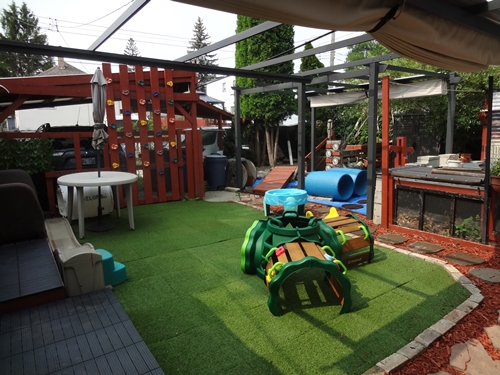
Outdoor Play Space

I also purchased more turf tiles – we used to only have a small ‘grass’ area inside the old pergola but now it is twice the size and more open without the pergola dividing the space. We also have a new ground level deck area along the fence side that we use for the easels and other art activities (the deck tiles are easy to clean and have no spaces big enough to lose crayons and paint brushes etc.
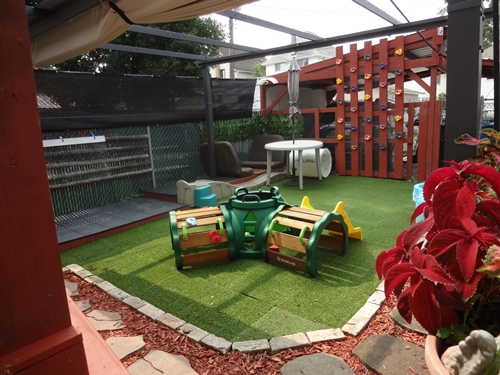
Outdoor Play Space

The turf tiles are thick rubber and placed on the mulch – both help cushion minor falls which is nice for the climbing structures and the new Ninja Slackline pictured below (also notice the awning is providing shade in this pic).
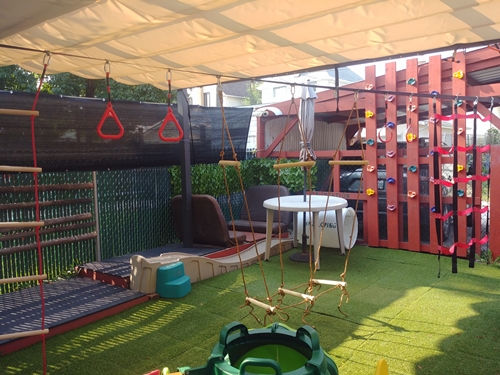
Play Space with Ninja Slackline

This summer we finally installed the large laundry sink (on the to do list last year). It is not a new sink, just a new location, and we have always had access to both hot and cold water here but now it is much more convenient to use.
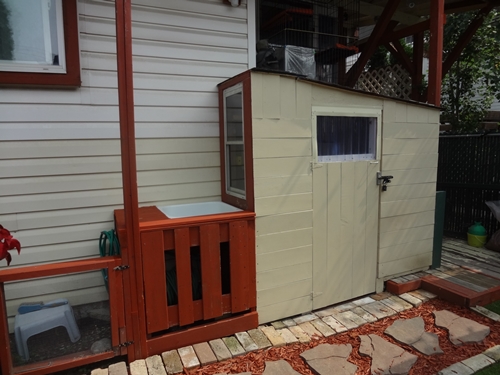
Wooden Storage Shed and counter with sink and hoses.

Moving along to the other side of the yard, we have a new, slightly sloped bridge across the ‘river’ in the water area and two new blue tunnels. The children like to pretend they are swimming under water when they crawl through these tunnels – I want to paint some fish inside the tunnels but haven’t done that yet.
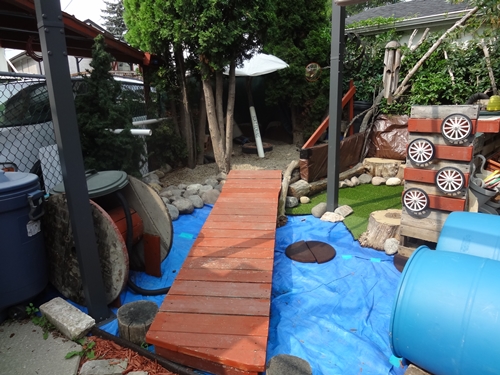
Wooden bridge over blue tarp river.

The bilge pump and water supply has a new location now too though I actually have plans to modify this area more before next summer so this is only temporary. The water from the pump flows under the bridge and down the ‘river’. The sprinkler hangs from the awning frame above the water area so we can make it ‘rain’ when we want the water area really wet (there are holes in the tarps so water does not pool).
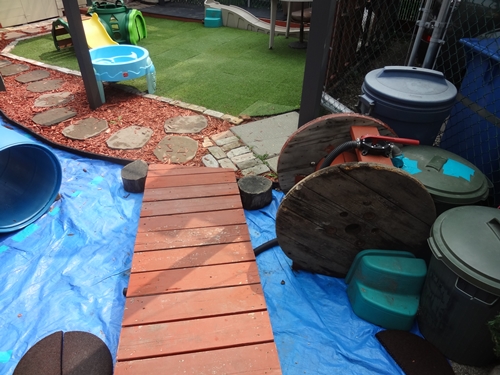
water barrel and pump with hose.

At the far end of the bridge is the gravel digging area – we needed the bridge higher here because the gravel area is more than a foot higher than the ground at this point. Plus, having a sloped bridge is extra fun ðŸ™‚ I chose to move all the gravel into the little covered ‘house’ we built last summer. The ‘house’ is in the corner of the yard which helps to keep the gravel contained in the area where it belongs and the roof above provides shade at all times of the day – particularly nice because some children like to sit and dig in the gravel for hours every day and I don’t want them to bake in the sun.
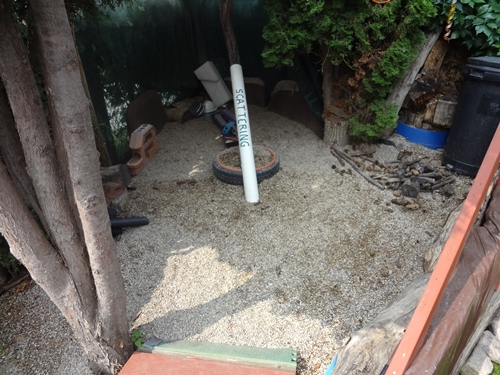
Enclosed gravel area with pots, pails, shovels, and sticks for digging.

The picture below is the view from inside the gravel area.
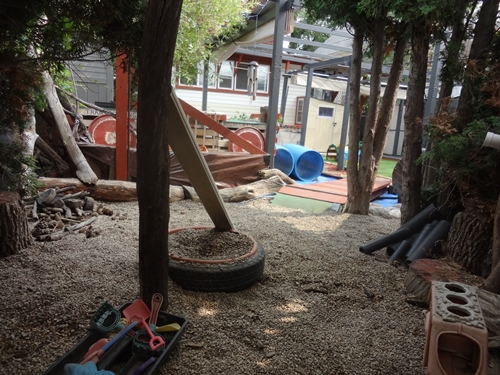
View through the trees towards the bridge and play area beyond.

I moved the talking tube (central vac pipe) from the building area where it used to be. Now it runs along the fence from the gravel area to the water area. I also added some elbows to the pipe so the children don’t look straight through the pipe when they are talking. Not that I minded them using it like a telescope, but some of them couldn’t grasp the concept of ‘talking’ into the tube when they could see through it and would get very frustrated that it didn’t work.
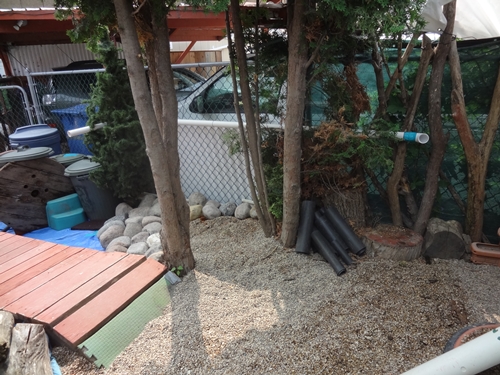
Ten foot long white pipe attached to chain link fence.

In the space where the gravel used to be is our new ‘music’ area. It is still not complete. In this picture there is nothing ‘new’, we have had the chimes, drums, and other noisy things for many years but now they are all together in a defined space. There are more turf tiles and our old stumps here for seating options. There are multiple different surfaces and items that can be used for experimenting with sound. Since this photo was taken I have purchased some Boomwackers and am collecting some additional ‘music’ making items to add in the future. (Donations are welcome if you have anything that may be useful here).
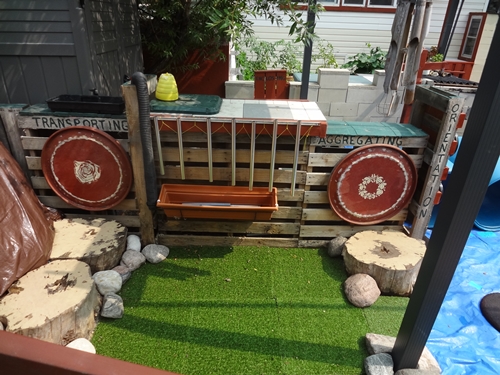
Outdoor area with chimes and drums.

View of the entrance to the music area – the Virginia Creeper has grown a lot and now covers most of the back and left side of the area – naturally containing the sounds in an acoustic chamber.

The building/construction area of the yard has not been moved or rearranged but I did purchase a large resin storage shed to store the massive amount of loose parts we have accumulated. We have far too much to have all of it out at once and our little toy shed only holds small bins and could not possibly contain all our building supplies.
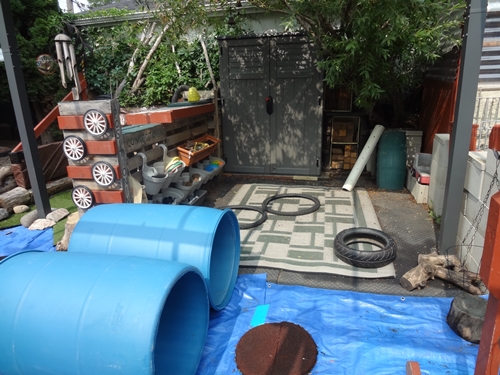
Outdoor Play area with Loose Parts for constructive activities.

A tiny peek inside the shed – this is less than a quarter of what is being stored here. Kept out of the elements but still handy when we want additional options beyond what is available in the loose parts bins.
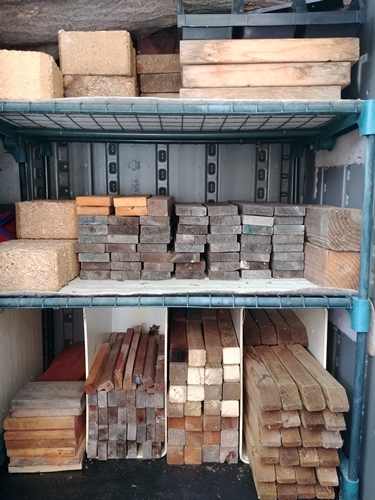
Various types of stacked wood pieces.

Saturday, December 7, 2019

Mail Delivery

I checked the mail last Tuesday afternoon. There were three envelopes in my mail box – one was addressed to my husband, there was a Christmas card addressed to a different house on my street, and the third item was addressed to my house number but on a nearby street with a much different name.

*Sigh* Here we go again. This isn’t the first time I’ve received mail addressed to someone else. I find it happens several times over a few weeks and then not at all for a while. That makes me think it may be due to a substitute mail carrier but I’m not entirely certain there is a regular mail carrier. I have seen several different mail carriers in the neighbourhood at various times of the day and there is nothing consistent about when my mail gets delivered.

I was annoyed – the addresses on these envelopes were clearly written so there was no doubt they didn’t belong at my house. Usually when I get someone else’s mail I just go out after the children have left for the day and drop the envelopes at the correct address. No big deal for me but I can’t help wondering if there is some of my mail at someone else’s house and they can’t be bothered to correct the mistake.

I had a busy evening planned and didn’t have time to deliver the mail Tuesday evening so I decided to wait until the following day. The children and I go for a walk every day – we could just take the letters with us and drop them off while we are out.

The children were actually thrilled by the task – their biggest concern was that there wasn’t more mail for them to deliver. This was the point when my mind began to spiral out of control. What if we could solve the childcare funding crisis by paying childcare homes and centres to deliver the mail?

Seriously! It is not child labor, it is curriculum – literacy, numeracy, physical activity – in a way that excites the children. There are schemas involved too – transporting, ordering, enclosing…maybe some trajectory. Don’t get me started on the social skills and art – once the toddlers figure out there is someone on the street that never gets any mail there will be a massive art project to rectify that!

Ok, so I don’t really want to suggest that we take jobs away from the mail carriers who have a greater than 33% accuracy rate so this doesn’t have to be a permanent position – maybe just to cover when the regular mail carrier is on vacation. It could be like a fundraiser- how much does Canada Post pay for two weeks of mail delivery? Probably more than we’d make selling chocolate bars. We would rather deliver mail.

Alright Canada Post – your move – what do you think?

Friday, September 6, 2019

Parent Fees & Private Childcare

So, I wrote this post more than a week ago, published it, reread it, didn’t like it, removed it, rewrote it – twice, and I think now it might be at least a little closer to what I want to say. Writing is hard sometimes.

Childcare is an important issue for many parents in Manitoba – more specifically, the lack of access to quality, affordable childcare. I’ll admit that during the last provincial election I got more than a little excited when the PC government promised to streamline the licensing process to encourage more family childcare providers to become licensed – it is not often that the government puts any focus on home based childcare. Sadly, they then froze grant funding and encouraged newly licensed unfunded providers to charge higher parent fees.

Now I will also think parent fees could be increased to help offset all the increases in expenses faced by childcare facilities. I thought this article by Tom Brodbeck was interesting. Even in my lower income area most unfunded and/or private, unlicensed home based providers charge parent fees that are much higher than my parent fees – and parents pay it. In higher income neighbourhoods and daycare deserts unfunded/unlicensed homes often charge considerably more. Maybe it is a parent’s ‘choice’ to put their child in private, unlicensed/unfunded care with higher parent fees – or maybe it is their only available option.

Funded family childcare providers like me are not allowed to raise our parent fees if we want to keep our funding. In a funded childcare facility parent fees for a preschool child are only $2.70 per day higher today than they were 22 years ago when I first began my childcare career. Over those years I have received increases in my operating grant funding so that it is now 28% of my gross income instead of just 5% of my income 22 years ago. Still, even with that grant funding and parent fees combined my income is still less than that of most private home daycares – about $13.38 per hour for hours I spend with the children – prep, cleaning and paperwork are all unpaid hours.

So yes, I am horrified when I hear a politician say they want to create portable subsidies for low income families to use in private childcare facilities because I know that even with portable subsidies those parents will still be paying much more than what they would pay in a funded, licensed facility – which already accept subsidized families. The problem is there are not enough funded licensed spaces – so the politicians say they will increase the number of licensed childcare spaces but if they don’t fund them then the parent fees will need to be increased in order to cover the costs of operating.
Even funded childcare centres are finding it difficult to attract or retain staff with the current set parents fees. When I hear politicians promise to lower parent fees to make childcare more affordable for parents I want to scream ‘Do you have any idea how much additional grant funding it will take to compensate for lower parent fees?’ Or are you planning to lower wages too and drive more ECE’s out of licensed care.

Trained ECE’s are already leaving their jobs in childcare centres and some of them are choosing to open private, unlicensed childcare homes. I fully understand the allure of home based childcare but with no funding available for new providers there is no financial benefit to becoming licensed – in fact they will probably earn more being unlicensed/unfunded and only accessible to higher income families willing/able to pay higher parent fees. There are no numbers available as to how many unlicensed childcare homes there are because there is no way to track that because they are unregulated. There are only just over 200 licensed home based providers in the whole province – far fewer than there were when I first became licensed.

Many parents and even politicians do not understand the difference between licensed and private childcare homes. When I was talking to a politician on my doorstep and mentioned that I was a licensed family childcare provider they said they had met a couple of other providers on my street – they couldn’t tell my if they were licensed or not ‘but they had business cards’. *sigh* Not licensed – there are no other licensed providers on my street – or any of the streets around me – that is easy to check here.

It is true that licensing does not guarantee ‘quality’ but I think ‘unlicensed’ is also ‘unprofessional’ even, or maybe especially unprofessional if you are a trained ECE. Many parents may not understand the difference between training and licensing and not realize that their trained private provider is in fact not licensed. In Manitoba a private home childcare provider, trained or untrained, may not care for more than four children under 12 years of age including their own children. Yet, I know many trained ECE’s whose only experience is in centre based care and who are surprised to learn that child/caregiver ratios are different in home based childcare. I also hear from many parents who are unable to find licensed childcare and have placed their child in a private home but are unsure how many children are actually being cared for there.

Yes, training enhances the quality of childcare but it is licensing and funding that enable childcare to be accessible and affordable. Private childcare is not affordable nor accessible especially for low income families even if there was a subsidy available. I don’t believe families of any income level would choose unlicensed care if there was enough licensed care available.

Maybe what should be suggested is that childcare waitlists and enrollment forms should include information about each family’s income level so licensed funded childcare facilities could weed out all the high income earners who were using up all the childcare spaces with low parent fees when they could really afford the higher fees in the private centres. I’m sure that then we’d hear a lot more public outcry that it is not fair that licensed care is only accessible to low income families.

So, I love my job and I wouldn’t want to do anything else and so far I can still pay all my bills and I get to play outside and I get paid in hugs every day so I shouldn’t complain – right? There are so many other people who are worse off than me – but really, that is my point. Even though, like other licensed funded facilities, my parent fees haven’t increased and my grant funding has been frozen for the past three years and my expenses have increased – I can still provide childcare to low income subsidized families.

Yes, I could drop my funding and raise my parent fees and still be licensed but earn more money – but then I’d have to exclude low income families and I won’t do that. I will continue to pay 22% of my taxable income back to the government because I know paying taxes is important for everyone. Then I’ll use my remaining $2400 a month to pay my ever increasing bills so I can be here for the families that trust me to provide care and education for their children while they go work to pay their bills and their taxes. I also really, really hope that the government then uses all those tax dollars to help those who don’t have as much as I do instead of offering it to those who already have more than they need.

Thursday, December 31, 2015

A Matter of Money - Home Based Childcare

The first post in this series was 'Motivation', the second was 'Centre or Home'.  For this third installment I want to focus strictly on the financial side of home based childcare - the income. Home based childcare incomes can vary greatly dependent on your neighbourhood, the ages of your own children and the children in your care and the type of program you offer. First let me define the types of home based childcare:

Family Child Care - located in the providers home - may have a maximum of eight children, of whom no more than five can be under the age of six, and no more than three may be less than two years of age. The child care provider's own children are included in these maximum numbers. All FCC homes must be licensed and inspected but they have the option of being funded or unfunded - more on that later.

Private Home Day Care - is also located in the caregivers home but is not licensed or inspected. They may offer care for a maximum of four children under the age of 12, with no more than two children under two years of age including the caregivers own children. If there are more than four children in the home at any time the home must be licensed. Unlicensed homes are never able to receive any type of funding from the Province.

Group Child Care Home - A group child care home is run by 'two' licensed providers in one of their homes. A licensed group child care home can accommodate as many as 12 children under the age of 12, of whom no more than three may be less than two years of age. These homes also have the option to be funded or unfunded.

Now let me talk a little about income.

Unlicensed/private home day care providers are free to set their own childcare rates - they can choose to charge hourly, daily, weekly or monthly. They can offer discounts to parents with more children. They do not have to charge all parents the same rates and 100% of their income comes directly from the parents using their services. They can be trained or untrained. They have absolutely no regulations regarding their childcare space, equipment, hours, or programming.

Licensed providers who operate funded programs receive an annual operating grant to supplement their income. A funded provider may not charge any parent - subsidized or not - more than the maximum, government set, daily childcare rates. Set rates for trained providers are slightly higher than those for providers without their ECE II/III classification.

These maximum daily rates have only increased by about $2/day in the past 20 years. The rate that parents pay for before/after school care is only eighty cents per day higher than it was when I first opened my childcare home in 1997. These daily childcare fees are kept low to ensure that childcare is affordable for low/middle income parents. Funded providers receive wage increases primarily through increases to operating grants. Current grant amounts work out to about $2/day for school-age children up to $6/day for infants.

Licensed providers - either family or group - may also choose to be unfunded and then - like private providers - they are also able to set their own childcare rates. Unfunded licensed providers may accept subsidized families but the maximum subsidy payment is usually far less than what the provider's regular rates are. The provider may require subsidized families to cover the additional costs but it is unlikely that the families could afford to.

It is rare for a licensed provider in a higher income neighbourhood to choose to be funded. Many of them can charge rates that are double or even triple the amount of the subsidized fees and operating grants combined. Even unlicensed/private home providers can often charge rates that are considerably higher than the combination of parent fees and operating grant that a licensed, funded childcare provider earns. In some upscale areas the rates can be $80/day for care for preschool children or $25/day for before/after school care and due to the demand for childcare services these providers are still able to fill their spaces.

This is not the case in lower income areas where many families are partially or fully subsidized. Single parents, students, those you work various shifts, don't have reliable transportation etc will all have fewer childcare choices available. Even in middle class neighbourhoods some families 'temporarily' place their children in childcare homes with higher rates - just until they find something more affordable.

Funded childcare centres are considered 'Not for Profit' but all home childcare providers are considered self employed and therefore 'for profit'. Many home providers feel that funded homes should also have the 'not for profit' status because we have no control over our childcare rates. Most of us have chosen to operate a funded home because we feel affordable childcare is an essential service.

I've heard it said that family childcare providers have options to increase their income but I don't believe that should include limiting access to quality childcare to only those who can afford it. This post is long enough already so in my next post I'll discuss the expenses related to home-based childcare and some of the things home providers can control.