Showing posts with label Manitoba. Show all posts

Monday, September 18, 2023

I've Been Thinking...


If I had to choose the one thing that bothered me the most about being a funded, licensed family childcare provider it would be the difference in daily childcare fees for infants vs preschoolers. As a trained ECE II those rates, set by the province, are $30/day for infants (under two years old) and $20.80/day for preschool children (aged 2-5 including those in Kindergarten).

These rates are the same for me as they are in funded centres and I understand the reasoning for the different rates in centres due to the different staff to child ratios for infant rooms (1 to 4) and preschool rooms (1 to 8). However, in family childcare I can have a maximum of five children under six years old of which no more than three can be under two years old.

That means I could have three infants and two preschoolers, or five preschoolers and no infants, or any of the combinations in between. It also means my income from daily fees could be as much as $131.60 per day or as little as $104 per day. That min/max difference in daily fees results in a difference of nearly $600/month without any difference in the number of children I enroll or the hours/amount of work I do. I wrote about this 10 years ago – it is not a new problem – but it is still a problem,

If your employer asked you if you would prefer to be paid $2100 or $2700 for the same number of hours work, what would you say? Silly question. Yet, in order for me to keep my income at its maximum, I could not keep all the infants I enroll. If both of my preschoolers are two years old, they may stay in my preschool spaces for up to four years meaning, in that period, my infants would have no preschool spaces to move into if I was to keep only infants in my infant spaces.

Now, multiply my three infant spaces by the four years it could take for my preschoolers to vacate their spaces and that means I may have to dismiss twelve families for no reason other than that their child had a birthday. Those families that may have waited nearly two years from conception until I had a space for their one year old, would now need to start their childcare search again. Some providers even state in their policies that childcare may be terminated when an infant turns two if a preschool space is not available.

I don’t do that – I choose to provide continuity of care because it benefits the child but that decision means I take a pay cut in order to provide what is considered a ‘best practice’. Luckily, not all the infants I enroll stay until they start school but I have gone as long as three years with the same group of children – all over the age of two – at a significant loss of income but some truly amazing long term relationships for all of us.

Still, I question why it has to be this way – especially now that parents pay $10/per day for either infants or preschoolers in any funded childcare facility – centre or home, trained or untrained – flat rate for parents. I used to get confused looks from parents when I told them they owed me less for childcare when their child turned two. Now they don’t even realize I took a pay cut in order to continue providing childcare for them – notably when my expenses for said care are increasing along with the child’s age.

Yes, the Province has been providing a parent fee top-up grant to funded facilities to offset the reduced rate for parents but to date this has been yet another administrative nightmare. I don’t want to rant about that right now but it has made me think that this is actually the perfect way to rectify the inconsistent income for family childcare providers.

If, in family childcare, the top-up grant for both infants and preschoolers was the same amount along with the consistent $10/day rate for parents then it would make budgeting so much easier. Having the same income for all children under six years would eliminate the income fluctuation and provide more stability for providers – a factor which may aid in the retention of family childcare providers.

The $10/day parent fee eliminates the difference between infant and preschool rates for parents. The operating grant rates are different for centres vs homes apparently due to variances in operating expenses. I believe a different rate for the FCC parent fee top-up grant could be possible too since, unlike centres, FCC staff to child ratio is not dependent on our enrollment of infants vs preschoolers.

Alternatively, our parent fee top-up grant could simply be based on the number of infants/preschoolers we are licensed for regardless of the age of the children we currently have enrolled in those spaces (providing they were not vacant spaces). That way our daily fee rate does not have to be different than centre rates but our income would also not fluctuate when our work load does not.

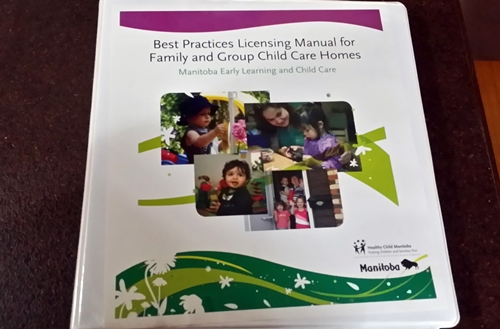
The Early Learning and Childcare Best Practices Manual for Family Childcare acknowledges that it is a benefit for the child to stay in the same setting with the same provider. Why then, do they set rates that discourage, even punish us, for choosing to build these relationships?

Sunday, January 17, 2021

Unexpected

We love playing outdoors in the winter. Compared to the warmer seasons our winter walks are shorter as is our total time outdoors but we still manage to spend 1-2 hours playing outdoors everyday.

In the winter there are no ‘toys’ in the yard – most break easily in the cold. Of course we still have sticks, pots, and the ultimate loose part – SNOW! I also routinely make various ice blocks for building, collecting and sorting. It is the perfect activity for frigid cold winters.

small coloured blocks of ice

With the addition of liquid watercolour paint to the water before freezing these blocks add a nice pop of colour to the yard. Sometimes I freeze dozens of trays full of coloured ice cubes and scatter them all over the yard. It is best done just before a snowfall because the children love hunting and digging for ‘gems’.

This year I decided to make some bigger ice blocks using both ice cream pails and square containers. I imagined the children may enjoy using them for stepping stones – they love the slippery spots in the yard. I also figured with bigger blocks they could build bigger structures than they could with small ice blocks. The gross motor skills required for manipulating the large blocks would be a bonus.

ice blocks and pails

The result was unexpected. The combination of the large containers and the above normal January temperatures meant the blocks took longer to freeze – I expected that. What I didn’t expect was that the liquid watercolour would separate from the water during freezing and even disappear completely!

green circular block of ice

Only four of the ten blocks remained intact when I removed them from the containers. The other ones were fragile because they were hollow! That was certainly unexpected and why it happened I do not know.

hollow round ice block

The centers of these hollow ice blocks were not wet and any colour that remained was a fine powdery texture. It was like, once the liquid watercolour paint separated from the tap water, the liquid part of the paint evaporated. How that was possible confuses me – the tops of all the blocks are solid thick ice – the bottoms are the thin delicate parts that shatter when touched to reveal the hollow centers.

hollow square ice block

Well that was unexpected and I still wanted some usable ice blocks so I filled all the containers with water again. I decided to not use any liquid water colour paint this time but I wanted something to make the ice blocks stand out a little in the snow. I found an old bag of potpourri and tossed a few pieces in each bucket. Interestingly, the next day the water had turned a nice shade of red,

containers full or red water

However, after four days outside, in the shade, in January, there is only a thin partial layer of ice on the surface of each bucket of water. How is it possible that in Manitoba I cannot freeze water outside in January.

That is unexpected.


Saturday, August 29, 2020

Changing

I’ve been neglecting my website – haven’t written a blog post in almost three months!

This pandemic has brought many changes. For me personally most of these changes have had very little negative impact. I don’t like crowds, concerts, festivals, sports, traveling etc so these limits/closures haven’t bothered me but I understand many people have been greatly impacted.

Line-ups for the grocery store and empty shelves were a bit of an annoyance but nothing I couldn’t adapt to. I’ve always been a borderline hoarder – I have three freezers and two pantries to store all the stuff I stock up on when things are on sale. Still, there were a few items that even I ran out of and had difficulty finding and the increased costs have been rough on my budget.

Luckily my hoarding tendencies apply to my bank account as well – I’ve been called a miser – so my lowered income level wasn’t a disaster. I could still feed my family and pay my bills. Yet honestly, when CERB was announced I did fantasize about what I could do with even a one month paid vacation. I haven’t had a paid vacation in….my entire life! It was just a fantasy though as I didn’t qualify for CERB.

I did have two months of low attendance – which means lower income for the same 11 hour work day. Same number of meals and activities to plan, same amount of supervision, just slightly less busy throughout the day – and that for me is a negative. I would have much preferred either the, sometimes hectic, excitement of having everyone here or having no children here and uninterrupted time to tackle some other projects.

However, knowing that I would have low attendance for an extended period of time did allow me to make some changes. I was able to close some play spaces temporarily – I still had to wait until the children were gone before I could do any of the rearranging, demolition, or construction but I didn’t have to finish the project before they returned. Even with some ‘off limits’ areas there was still enough play space available for the number of children attending.

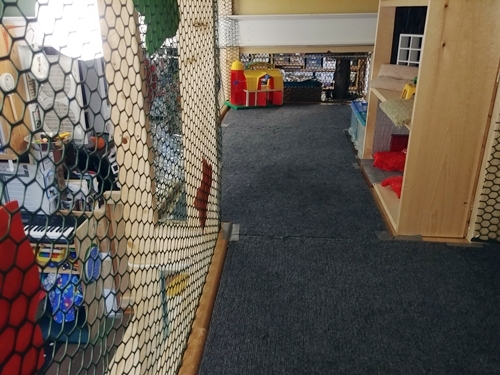
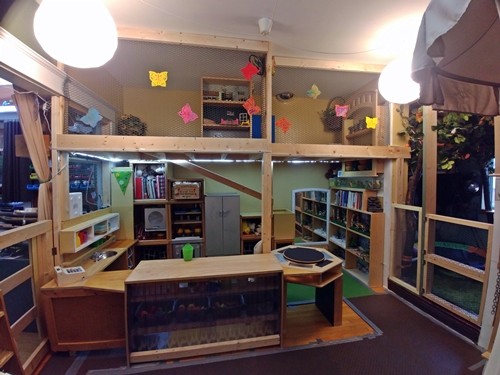
Work on the loft was the big project I had originally planned to tackle on my summer vacation but instead I was able to break the project down into smaller phases which I could then complete over several weekends in April and May. The finished play space looks like this;

Open gate between main play room and art/dining area with new table (previous post) and reorganized shelves.
Rearranged housekeeping/store area under new loft.
Entrance to housekeeping/store area, side view of loft stairs, animal/nature shelves.
View inside housekeeping/store area and stairs to the loft.
Looking North in the new loft – two separate areas, one for block play, one for doll house
South view from loft block area into doll house area.
Wide view of West side of playroom including entire loft and entrance to quiet/relaxation space.

I’ve had all eight children here full days for the past three months – the longest I’ve ever had all my school-age spaces full. I decided not to close for a summer vacation this year because the need for summer care was so high and I had already finished my summer projects. It has been an amazing summer – we’ve really enjoyed the new spaces during the limited time we’ve used them.

Really, 6:30 – 8:30 AM is our longest indoor play period. Otherwise the majority of our day has been spent outside. In fact, the reason I haven’t been writing is mostly due to long periods outside, away from my computer – trying not to obsess about what the government has done to childcare in Manitoba.

Spending plenty of time outside is nothing new for us – if the pandemic had restricted our outdoor time we would definitely have struggled – even with our new indoor play spaces. September will bring more changes. The school-age children will be leaving again – we will miss having them here all day. We hope they will still get to spend plenty of time outside – even in the winter. We may not be outside all day in the winter but we will still be outside several hours every day – and loving it.

Change isn’t always easy – sometimes it seems like an insurmountable challenge. We’ve faced it before and we’ll do it again. The unknown factors may be scary but we’ll figure it out.


Monday, March 16, 2020

To Close or Not to Close

Everyone is being affected by the Covid-19 pandemic – for some it may be just a mild inconvenience, for others it may be a major disruption to their daily lives. Some people are overwhelmed and beginning to panic while others are completely nonchalant.

For those of us working in childcare the big question has been ‘Is the daycare going to close?’ and the only available answer has been ‘We don’t know.’

Even in the field there are arguments both for and against closing childcare facilities. Many think that because the schools are closing, childcare facilities should too. Others argue that childcare is an essential service and must remain open for those parents who need to go to work.

My personal, possibly not popular opinion, is that licensed childcare facilities should NOT be forced to close.

Certainly, any sick children or staff should not be there and should be isolated at home, but what about those children whose parents still need to go to work? If they have a spouse or other family member who is temporarily off work then they have options but what if they don’t?

What if their only available childcare option is Grandma – whose immune system is already compromised? Maybe another choice is the unlicensed childcare provider who wasn’t forced to close and now has agreed to temporarily take in any and all the children who need childcare.

Wouldn’t a licensed childcare facility – with strict cleaning and disinfecting procedures already in place – be a better option?

Yes, social distancing is a very difficult if not impossible concept for children but most trained early childhood educators have the skills to implement games and activities to limit direct contact. Many of us will actually be spending most of our time playing outdoors in the fresh air.

If licensed facilities are forced to close where will those children go? Are they able to be with their family or are their parents at work and the children are huddled on the couch watching movies with their friends. What if their parents’ only option now is to send them to that one person on the block who says ‘No problem, send them all here, we’re having a party’.

Sure, if parents are off work and able to use this situation to be isolated at home spending quality time with their family that is probably the best option. The reality is that there are still a lot of parents who need to go to work and closing all licensed childcare facilities might just be the worst thing to do.

Friday, September 6, 2019

Parent Fees & Private Childcare

So, I wrote this post more than a week ago, published it, reread it, didn’t like it, removed it, rewrote it – twice, and I think now it might be at least a little closer to what I want to say. Writing is hard sometimes.

Childcare is an important issue for many parents in Manitoba – more specifically, the lack of access to quality, affordable childcare. I’ll admit that during the last provincial election I got more than a little excited when the PC government promised to streamline the licensing process to encourage more family childcare providers to become licensed – it is not often that the government puts any focus on home based childcare. Sadly, they then froze grant funding and encouraged newly licensed unfunded providers to charge higher parent fees.

Now I will also think parent fees could be increased to help offset all the increases in expenses faced by childcare facilities. I thought this article by Tom Brodbeck was interesting. Even in my lower income area most unfunded and/or private, unlicensed home based providers charge parent fees that are much higher than my parent fees – and parents pay it. In higher income neighbourhoods and daycare deserts unfunded/unlicensed homes often charge considerably more. Maybe it is a parent’s ‘choice’ to put their child in private, unlicensed/unfunded care with higher parent fees – or maybe it is their only available option.

Funded family childcare providers like me are not allowed to raise our parent fees if we want to keep our funding. In a funded childcare facility parent fees for a preschool child are only $2.70 per day higher today than they were 22 years ago when I first began my childcare career. Over those years I have received increases in my operating grant funding so that it is now 28% of my gross income instead of just 5% of my income 22 years ago. Still, even with that grant funding and parent fees combined my income is still less than that of most private home daycares – about $13.38 per hour for hours I spend with the children – prep, cleaning and paperwork are all unpaid hours.

So yes, I am horrified when I hear a politician say they want to create portable subsidies for low income families to use in private childcare facilities because I know that even with portable subsidies those parents will still be paying much more than what they would pay in a funded, licensed facility – which already accept subsidized families. The problem is there are not enough funded licensed spaces – so the politicians say they will increase the number of licensed childcare spaces but if they don’t fund them then the parent fees will need to be increased in order to cover the costs of operating.
Even funded childcare centres are finding it difficult to attract or retain staff with the current set parents fees. When I hear politicians promise to lower parent fees to make childcare more affordable for parents I want to scream ‘Do you have any idea how much additional grant funding it will take to compensate for lower parent fees?’ Or are you planning to lower wages too and drive more ECE’s out of licensed care.

Trained ECE’s are already leaving their jobs in childcare centres and some of them are choosing to open private, unlicensed childcare homes. I fully understand the allure of home based childcare but with no funding available for new providers there is no financial benefit to becoming licensed – in fact they will probably earn more being unlicensed/unfunded and only accessible to higher income families willing/able to pay higher parent fees. There are no numbers available as to how many unlicensed childcare homes there are because there is no way to track that because they are unregulated. There are only just over 200 licensed home based providers in the whole province – far fewer than there were when I first became licensed.

Many parents and even politicians do not understand the difference between licensed and private childcare homes. When I was talking to a politician on my doorstep and mentioned that I was a licensed family childcare provider they said they had met a couple of other providers on my street – they couldn’t tell my if they were licensed or not ‘but they had business cards’. *sigh* Not licensed – there are no other licensed providers on my street – or any of the streets around me – that is easy to check here.

It is true that licensing does not guarantee ‘quality’ but I think ‘unlicensed’ is also ‘unprofessional’ even, or maybe especially unprofessional if you are a trained ECE. Many parents may not understand the difference between training and licensing and not realize that their trained private provider is in fact not licensed. In Manitoba a private home childcare provider, trained or untrained, may not care for more than four children under 12 years of age including their own children. Yet, I know many trained ECE’s whose only experience is in centre based care and who are surprised to learn that child/caregiver ratios are different in home based childcare. I also hear from many parents who are unable to find licensed childcare and have placed their child in a private home but are unsure how many children are actually being cared for there.

Yes, training enhances the quality of childcare but it is licensing and funding that enable childcare to be accessible and affordable. Private childcare is not affordable nor accessible especially for low income families even if there was a subsidy available. I don’t believe families of any income level would choose unlicensed care if there was enough licensed care available.

Maybe what should be suggested is that childcare waitlists and enrollment forms should include information about each family’s income level so licensed funded childcare facilities could weed out all the high income earners who were using up all the childcare spaces with low parent fees when they could really afford the higher fees in the private centres. I’m sure that then we’d hear a lot more public outcry that it is not fair that licensed care is only accessible to low income families.

So, I love my job and I wouldn’t want to do anything else and so far I can still pay all my bills and I get to play outside and I get paid in hugs every day so I shouldn’t complain – right? There are so many other people who are worse off than me – but really, that is my point. Even though, like other licensed funded facilities, my parent fees haven’t increased and my grant funding has been frozen for the past three years and my expenses have increased – I can still provide childcare to low income subsidized families.

Yes, I could drop my funding and raise my parent fees and still be licensed but earn more money – but then I’d have to exclude low income families and I won’t do that. I will continue to pay 22% of my taxable income back to the government because I know paying taxes is important for everyone. Then I’ll use my remaining $2400 a month to pay my ever increasing bills so I can be here for the families that trust me to provide care and education for their children while they go work to pay their bills and their taxes. I also really, really hope that the government then uses all those tax dollars to help those who don’t have as much as I do instead of offering it to those who already have more than they need.

Friday, January 18, 2019

Frigid Cold

I’ve been working on a post about our winter yard and what we like to do out there. I will not have time to complete that post today but I did want to write a quick post about the weather.
Today’s weather forecast states the high temperature will be minus25 C with wind chill of minus 44 in the morning and minus 35 in the afternoon. Yet, the children and I will still be going outside for at least a brief period of time.
Why? Well, first of all, any of the children who arrive here today will have at some point had to go outside so saying ‘It is too cold to gooutside’ would not be true.
Second, if I don’t take them outside there will at some point be a mutiny because at least some of the children really want to go outside and I definitely don’t want to keep them inside all day.
Third, and probably most important, cold weather like this is a fantastic learning opportunity. As we prepare to go outside we will discuss how to dress appropriately for the weather. All the children (even the littlest ones) will work on completing self help skills, independence and decision making. We will experience the way the sun warms us and the trees shelter us from the wind. We will build resilience.
The children will make the decision as to how long we can play outside. They will learn to realize how they and others feel – are they warm enough but their friends are too cold? What can they do to help?
So, I didn’t get a chance to complete my post about our winter yard, but this quick little post may be the perfect introduction to the importance of having a outdoor play space designed for winter.

Wednesday, August 2, 2017

My Dream

In Manitoba a licensed family childcare provider can care for a maximum of eight children under 12 years of age.  Of those eight children, no more than five may be under six – the other three must be in grade one or older.  I love having a mixed age group and the opportunity to build a relationship with the children in my care from infancy through school-age.
Over the twenty years I have been providing childcare in my home I have known many amazing school-age children who have thrived in this setting.  Some struggled with peer relationships in their school environment but enjoyed being the ‘leader’ here – idolized by the younger children.  Some embraced responsibility and enjoyed helping the little ones.  Some were wildly creative and independent and of course there were also some who resented being with ‘babies’.
I’ve watched older children gain confidence and build their self-esteem by mentoring the younger children.  I’ve seen younger children develop skills they learned from watching and copying the older children play. I’ve also had some older children that taught the little ones things/words that I wish they hadn’t. *sigh*
I’ve noticed something else – the cost of providing food, craft supplies, activities and equipment for school-age children often exceeds the income I receive for their care.  I find that the school schedule is disruptive – breaking up what could be longer periods of engagement in learning activities for the preschoolers.  So, for several years now I haven’t made an effort to fill empty school-age spaces.
Summer was the exception.  I loved having all the ‘big kids’ here for the summer – working in the garden, going on adventures, making incredible creations, sharing fantastic stories – without the rigid school schedule.  It was wonderful to have all this time with the older children instead of just the fleeting moments before/after school when everything was so hectic and there wasn’t really any time to do anything.
Yet, when I only enrolled school-age children for the summer I was finding that the first month was spent getting everyone acquainted with each other, learning routines etc. Then, just when we were starting to develop relationships, summer was over and they were gone. The ‘freedom’ of summer wasn’t quite the same with ‘new’ school-age children instead of ones we already knew.  So, for the first time ever – I didn’t fill any of my school-age spaces  this summer – and I’m loving it.
The school-age table has been empty;
17-08-SA01
The little ones are engaging in more age-appropriate dramatic play.  They are demonstrating their creativity instead of copying someone else. I haven’t heard ‘I’m bored’ once this summer, nor have I had to spend hours shopping for tons of additional food and supplies.
I’ve also been imagining what the little ones and I could do with that extra space I have set aside for bigger children and all the supplies they need but the little ones don’t.  I’ve started to think that it would be really, really nice if the province would let me exchange those three empty school-age spaces for one more preschool space.
Group childcare homes have two licensed providers and up to 12 infant/preschool children – that’s a 1:6 ratio.  I have five preschool spaces and although three of those five could be infants I rarely have more than one or two – sometimes even none. If they stay with me until they start school each one year of infant care will need four years of preschool care.  Hence, I’d have to kick out preschoolers if I wanted to keep those infant spaces full - I would never do that.  One more preschool space would help.
Big dream – I know.

Wednesday, November 2, 2016

The 'Un' Factor

 'Un' is a prefix meaning “not,” freely used as an English formative, giving negative or opposite force in adjectives and their derivative adverbs and nouns.  In the field of family childcare we often use the words 'unlicensed', 'unregulated', 'untrained' yet for many government officials and people outside the field of childcare those 'un' words are not viewed as negative - simply a choice that parents should be allowed to make regarding the care of their children.

There are regulations governing the manufacturing of items like cribs, strollers, carseats, and toys etc so parents know they are safe.  There are regulations regarding the production, packaging, and labeling of food products to ensure they meet predetermined standards so people know what they are buying. Why do government officials and the general public think that parents should be able to choose unlicensed, untrained childcare but need regulations to assist them to safely feed, house, and transport their own children?

What other career field allows some businesses to operate unlicensed and/or untrained when others providing the same service are licensed?  What is the incentive for any business to be licensed if they can legally operate without any oversight?  Without any licensing/training requirements?  What if, like in childcare, they could actually make more money if they were not licensed/trained than if they were licensed/trained?

Let's use truck drivers as an example.  The majority of adults have a class 5 driver's license and have experience driving their own or a friend's vehicle.  What if there were no restrictions on what size of vehicle you could drive and anyone could just decide "Hey, I'm going to buy a big truck and start a business delivering things for other people."

 Why, is an experienced driver with their own vehicle not allowed to start up a trucking business without additional training or license? Why don't people argue "It's his truck, he can do what he wants with it.  If other people are OK with letting him transport their stuff why not let him/them.  He's never had an accident and doesn't need a little piece of paper to prove he's a good driver."

What if that same driver or another class 5 driver then decided "A bus isn't much different than a big truck.  If I had a bus I could earn money driving people around."  What if you'd seen that driver on the street with his bus full of happy passengers and decided to take a ride on his bus.  Then imagine that one day there was an issue - something was wrong with the bus or the driver.  What if it is too late to get off the bus before the accident happened?

Some argue that licensing all childcare facilities and requiring training for all childcare workers doesn't ensure quality - but it helps.  Just like trained bus/truck drivers in licensed companies will still have accidents there are standards and checks in place to limit them.  Why don't we hear arguments that training/licensing truck drivers doesn't prevent accidents so let's save some money and not bother requiring them to be licensed?

Do we need more incentives for family childcare providers to become licensed or do we need to eliminated the option for them to operate unlicensed childcare homes?  Currently only licensed providers can accept government subsidized families but private paying families usually pay higher rates than the maximum subsidized rate so that isn't an incentive to be licensed.

What about training?  Currently family childcare providers with Early Childhood Educator II/III training can receive slightly higher subsidized rates than untrained providers but those rates are still lower than the private rates most unlicensed/untrained providers charge so why bother?  Just think of all the tax dollars we could save if we had trained and untrained police officers  - both had the same duties but the city could pay the untrained ones less - but either trained or untrained officers could go work privately for more money without a gun permit or any other type of license.

In an effort to increase the number of licensed childcare spaces, the provincial government is considering lessening the requirements and 'red tape' needed to open licensed childcare homes.  Why, when there was a shortage of family doctors was it never suggested that we lower the requirements to become a doctor?  I don't think lowering FCC licensing requirements will increase the number of licensed childcare spaces and I'm absolutely positive it won't improve quality.

What part of licensing do they think is unnecessary?   Criminal record/child abuse registry checks? First aid training or a 40 hour course? Behaviour management, nutrition, safety and supervision policies? Adequate equipment? Developmentally appropriate activities? Documentation and record keeping?

I don't think any part of the licensing process is difficult or unnecessary.  If fact, I'd like to see more.  I'd like to see MANDATORY licensing for ALL childcare homes.  Greater incentives for trained providers (possibly higher ratios).  MANDATORY annual professional development and more.  I'm thinking about the best interests of the children, not just convenience and the cost for quality and safety.


licensing-manual

Sunday, April 27, 2014

Fluffy Rain

One of my fellow family childcare committee members coined the term ‘fluffy rain’ in reference to the white stuff falling from the sky during our meeting last Thursday.  Maybe it was positive thinking or maybe it was just denial – none of us wanted to believe that it was snowing again at the end of April.

There was no school on Friday and although not all the children were here we still had a larger than normal group.  The ‘fluffy rain’ did not dampen anyone’s mood – outdoor play in any type of weather is still preferred over being stuck in a classroom all day.

Most of the morning there was an elaborate dramatic play activity involving an eccentric designer, an art exhibit, and various other characters.  I was assigned the role of ‘photographer’ to document the event – perfect because I was taking pictures already.

There was artwork everywhere;

FR01

FR02

FR03

FR04

Then someone discovered the steady stream of water running out of the rain barrel overflow spout;

FR05

Eventually we had to go back inside because it was too cold for soaking wet toddlers (my decision, not theirs).  Before that though we still had some more time to play with wet fluffy rain – on the plexiglass;

FR06

One toddler was super excited to discover ‘flowers’;

FR07

Hmmm, those ones might be remnants from last summer.  However, the pasture sage has been eager to get growing this year.  It has been active for a couple weeks already.

FR08

Hopefully it won’t be deterred by a little fluffy rain – after all, it is a hardy native prairie plant.  It, like the rest of us Manitoba prairie dwellers, should be used to this by now.