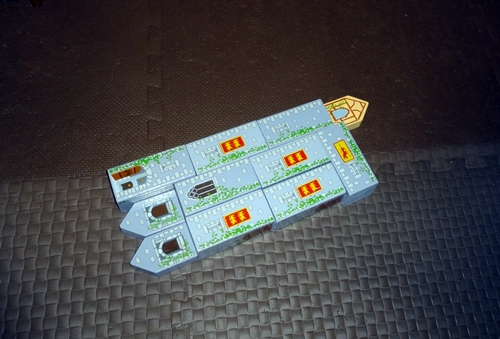
It has been just over three months since I last had the train tracks
available in the block area. There are several building sets that have
not been our for over six months but the boys (there are no girls in my
current group) had been begging for me to bring the trains out
again. I was hesitant because we have a new infant here now - babies
are not usually very 'helpful' when it comes to building with train
tracks but the boys were so insistent.
Last year I wrote about how wonderfully this group plays with the trains and tracks
so I relented and brought the trains out again. Even though all but
one of these children were here last year, they are currently at
different stages than they were before and the dynamics are much
different. Having the trains out now has been... interesting.
There is one boy who loves to sort and classify everything.
Now that the trains and tracks are available he arranges them all
according to size and shape. He creates groupings and lines the pieces
up in straight lines. He gets frustrated and very vocal when others
come near or disrupt his methodology in any way.
Another one just
wants the train cars - ALL of them. Upon entering the playroom he
tries to pick up and hold all of train cars at once but that is
impossible. Instead, he makes a pile of train cars and sits on them.
If any other child has one or more train cars he will sit and whimper,
complaining that they have 'his' trains. If I suggest that maybe he
should build a track for the trains he has, he will attach two track
pieces together, pile his train cars on the track and then sit on them.
The
third boy loves to create several small circular tracks. He is an
expert builder and can quickly select all the appropriate track pieces
and assemble his tracks. He excitedly shows everyone his accomplishment
and then walks away. When I remind him to put away his toys if he is
finished with them he wails. For each track section there is dramatic
effort required to pick up and take it to the bin. Each piece is so
heavy that he couldn't possibly carry more than one and often he is
unable to even stand so he must slither and drag himself to the bin
while sobbing "I CAN'T DO IT...I caaannn'tttt"
The fourth
boy is so concerned about and distracted by what everyone else is doing
that he has difficulty settling into an activity. He seems eager to
play with trains, states his intentions and invites others to join him
however it takes a very long time before he begins to play. Often he
hovers around the block area and complains about what the others are
doing. Once he does finally sit down and become engaged in the activity
he can play cooperatively, it just takes so long to get there and there
are so many disputes along the way that the others lose interest or we
run out of time.
Boy five has little interest in building with the
tracks but enjoys driving trains on the tracks that others have built.
He reenacts elaborate scenarios complete with narrative descriptions
and sound effects but seems oblivious to the others playing around him.
He is fully engaged in independent play but will get very upset if
others interrupt or 'bother' him.
Boy six likes to build complex
track systems using as many of the track sections as possible. He
enjoys having the others watch him build but is easily frustrated if
they attempt to assist - he has a plan. He discusses his design plans
with the others and explains how they will be able to use it once
complete. Occasionally he too plays with trains - briefly - but usually
once finished building he loses interest and leaves the block are.
However, he cannot clean up because the others are still playing - they
do love this massive track. When finished playing the others will be
overwhelmed by the prospect of putting away all those tracks - they
would never have built anything that big.
*Sigh*
By the end of the first week of train play I was ready to pack them up
and put something different in the block area. It is not that anyone is
using the toys 'wrong' but that they are all using them differently.
It wouldn't be a problem if they would sometimes play with other toys
but for the whole first week they all wanted to play with trains - only trains - together but not in agreement. Essentially it was a week long argument.
I
know that dealing with disputes is an important skill to learn but
personally I'd prefer to avoid all confrontation. It would be easier
for me to put away the trains and say it is a consequence due to the
incessant fighting. It might be easier for me to create a chart and
assign each child a specified time slot where they can each have an
equal amount of uninterrupted independent play with trains. However it
is probably better if I let them work it out themselves. I can tell
them what I see. I can facilitate conversations and mediate physical
disputes. I just don't like to.
At the moment I really don't
like trains either. Yet, during train week two there were a few moments
of hope. I few fleeting periods when I thought maybe - just maybe they
had figured it out. We are now beginning train week three and the
debate continues....
Showing posts with label Problem Solving. Show all posts
Monday, October 17, 2016
Wednesday, August 3, 2016
Indoor Space
My list of summer renovation projects was two pages long – more than 3/4 of the items have already been completed
Revamping the outdoor space (see previous post) was the largest project. Many of the indoor projects just involved sorting and reorganizing stuff but that takes time.
Of course there were some storage units that had to be re-built to fit in different locations but no ‘new’ pieces were necessary. In fact, a horizontal storage unit became a vertical unit and the items in two other units were consolidated into one so we actually gained a fair amount of extra floor space – bonus!
Much of the work was done to areas that are off-limits to the children so they are completely unaware of the changes but I am certainly pleased with the results. When you’ve only got 1200 sq ft to work with and you want to make it usable for a dozen people every little bit helps.
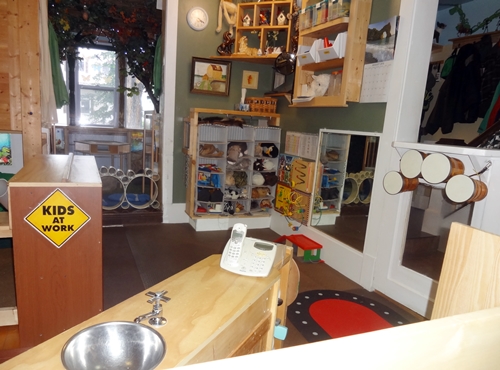
I felt there were several issues with the arrangement of the playroom and I definitely wanted to address at least some of them. First, this was the old storage space for the workshop tools and musical instruments;
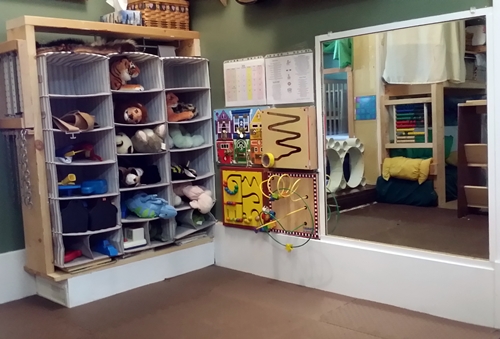
The problem I had here is that the floor space allocated for constructive play and music activities was just 6o square feet. When most of the toys are stored on one shelf unit on the longest wall the play space becomes a very narrow rectangle. I wanted to make two smaller storage spaces – one at each end of the long, narrow space which would result in a more usable almost square play space. So, the above corner now looks like this;
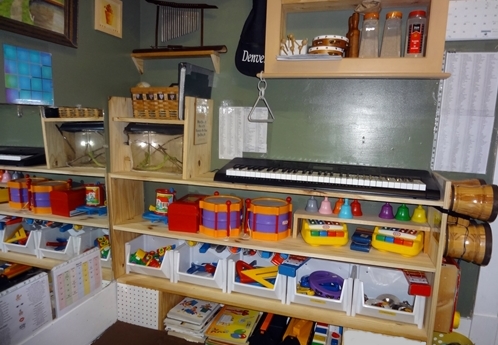
Just the tools, puzzles and stuffed animals are stored here now. The musical instruments are stored separately on the other end of the play space;
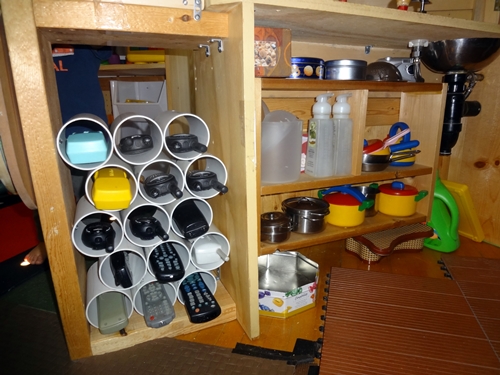
There used to be a basket of old phones, remotes, and walkie talkies in the space under the cash register. The children often dumped everything out of the basket when looking for a specific item but no one liked to pick up all the leftovers. Now the items are stored like this instead;
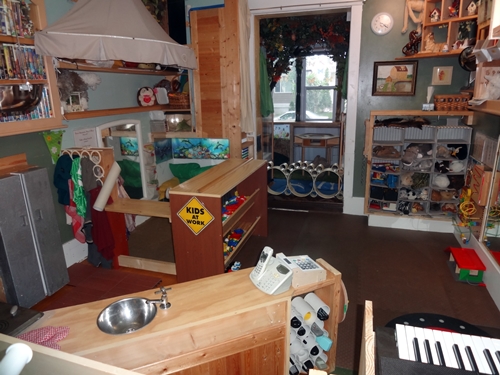
This is my new view of the playroom from my desk if I was ever inclined to sit down to do any paperwork;
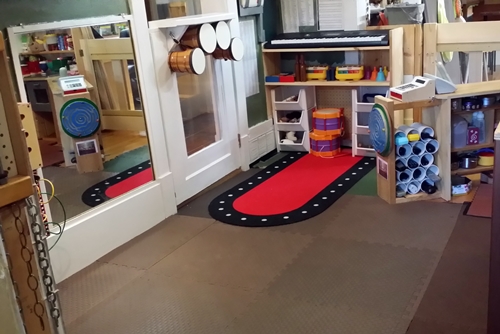
And this is as close as I can get to showing the entire playroom in one photo;
Housekeeping, dress-up, library and quiet corner on the left, entrance to nature area on far wall, blocks, tools and music on right side.
I’m not particularly fond of the way all the housekeeping toys are currently stored – some items are too high for the children to easily reach. I can’t complain if children climb when I’m the one who put things they are allowed to play with on a shelf that is too high. Reorganizing that storage space is one of the not-yet-completed items on my list. I am still not certain how to address all the issues there so until I’ve devised an acceptable plan it will have to stay as is. Sigh.
Of course there were some storage units that had to be re-built to fit in different locations but no ‘new’ pieces were necessary. In fact, a horizontal storage unit became a vertical unit and the items in two other units were consolidated into one so we actually gained a fair amount of extra floor space – bonus!
Much of the work was done to areas that are off-limits to the children so they are completely unaware of the changes but I am certainly pleased with the results. When you’ve only got 1200 sq ft to work with and you want to make it usable for a dozen people every little bit helps.
I felt there were several issues with the arrangement of the playroom and I definitely wanted to address at least some of them. First, this was the old storage space for the workshop tools and musical instruments;

The problem I had here is that the floor space allocated for constructive play and music activities was just 6o square feet. When most of the toys are stored on one shelf unit on the longest wall the play space becomes a very narrow rectangle. I wanted to make two smaller storage spaces – one at each end of the long, narrow space which would result in a more usable almost square play space. So, the above corner now looks like this;

Just the tools, puzzles and stuffed animals are stored here now. The musical instruments are stored separately on the other end of the play space;

There used to be a basket of old phones, remotes, and walkie talkies in the space under the cash register. The children often dumped everything out of the basket when looking for a specific item but no one liked to pick up all the leftovers. Now the items are stored like this instead;

This is my new view of the playroom from my desk if I was ever inclined to sit down to do any paperwork;

And this is as close as I can get to showing the entire playroom in one photo;

Housekeeping, dress-up, library and quiet corner on the left, entrance to nature area on far wall, blocks, tools and music on right side.
I’m not particularly fond of the way all the housekeeping toys are currently stored – some items are too high for the children to easily reach. I can’t complain if children climb when I’m the one who put things they are allowed to play with on a shelf that is too high. Reorganizing that storage space is one of the not-yet-completed items on my list. I am still not certain how to address all the issues there so until I’ve devised an acceptable plan it will have to stay as is. Sigh.
Thursday, March 3, 2016
Castle Blocks
A few years ago I bought some sets of Castle Blocks from Quality Classrooms.
Like all the various types of blocks I have they are rotated in and out
of our play space depending on the interests of the children in my
care.
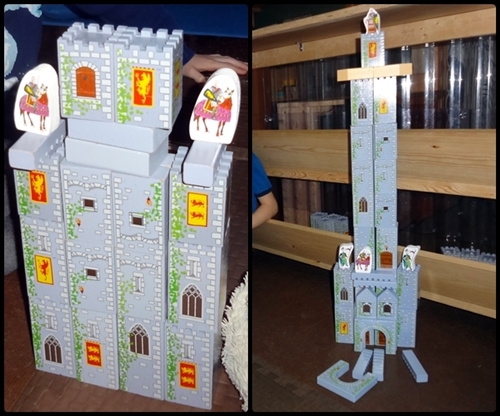
My current group of children has enjoyed building with these blocks for several weeks now. They particularly like to design and build impressive towers.
I enjoy watching the cooperation when the children agree to work together on a building project;
However, they have encountered a bit of a problem – the baby of the group gets so excited when he sees a tower that he can’t resist knocking it down. He does immediately attempt to help rebuild the towers but the original builders are still very disappointed by the destruction.
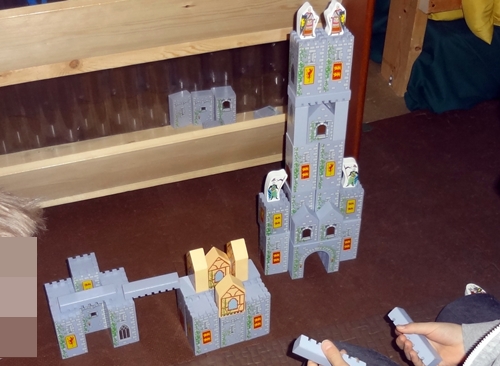
One of the solutions that the children have come up with is to only build towers when the baby is not in the room. Although effective, this strategy also severely limits the block building time. Then one day, while the baby was playing in the room, I observed the three-year-old building this;
I asked him to tell me about his creation. He said “It’s a tower – that the baby can’t knock down.” Hmmm, very interesting. These horizontal towers have become quite popular and can be built all day long without any issues.
Nice problem solving :-)
My current group of children has enjoyed building with these blocks for several weeks now. They particularly like to design and build impressive towers.

I enjoy watching the cooperation when the children agree to work together on a building project;

However, they have encountered a bit of a problem – the baby of the group gets so excited when he sees a tower that he can’t resist knocking it down. He does immediately attempt to help rebuild the towers but the original builders are still very disappointed by the destruction.
One of the solutions that the children have come up with is to only build towers when the baby is not in the room. Although effective, this strategy also severely limits the block building time. Then one day, while the baby was playing in the room, I observed the three-year-old building this;

I asked him to tell me about his creation. He said “It’s a tower – that the baby can’t knock down.” Hmmm, very interesting. These horizontal towers have become quite popular and can be built all day long without any issues.

Nice problem solving :-)
Tuesday, March 17, 2015
The Squeaky Door
It was back in December that I rearranged the play space again.
When I looked back at that post I realized that I mainly wrote about
the history of the loft and the reason for the changes. The post was
getting too long so I didn’t include pictures of the finished space. I
will have to do a full post about that soon but right now I want to
focus on one small area.
The refrigerator in the housekeeping area;

The new block bin is now located on the right hand side of the refrigerator – this is where the entrance to the block area used to be. The counter top above the block bin is centered over the block bin and overhangs the bin by several inches on both sides. This was an intentional design feature.
Due to the placement of the counter top the right hand door of the refrigerator only opens part way before it touches the counter top. The left hand door opens a full 180 degrees. I didn’t think it was a major issue so I didn’t correct it then. Months later the problem is getting worse instead of better.
Even though the food in the refrigerator is easily accessible when the right hand door is only partially open the toddlers insist on pushing on the door to force it to open fully. Since it is physically impossible for the door to open that far all they manage to do is get the door jammed so tightly against the counter top that they can then not close it. Meltdowns ensue.
The hinges on the right hand door had also begun to squeak. Some of the children like to move this door slowly back & forth simply because they like the sound. I do not like that sound – especially not for a solid 20 minute stretch of time.
Last Friday was an school inservice day which meant I had the older children here for the whole day. It also meant that my school-bus-driver husband was home for the day too. So, as the children and I were getting ready to go outside to play I said to my husband “We will be outside for the next 2 hours. While we are gone please unhook the brackets holding the counter top and move it an inch to the North. Also, grease the fridge door hinge.”
For the second half of Friday and all of Monday I have silently watched and waited. Only one of the two-year-olds has noticed the change. On several occasions he has stood by the refrigerator and slowly moved the right hand door all the way open and then all the way closed. Sometimes he stands in the space behind the door so he can watch the hinge action from a different point of view. I’ve been observing him as closely as he is observing the door.
The other children either don’t notice or don’t care that the door doesn’t stick or squeak any more. I notice, thank-you very much.
Thursday, January 9, 2014
Back At It
It has been a busy week. I have several posts I’d like to write but
no time to do so. Today I’ll just post a few pictures of some of the
things I’ve observed as the children are settling back in after the
holidays.
There was this interesting use for a ‘drill’;
Look familiar?
I have no idea why but this has been the favorite ‘accessory’ for several days;
This was an ‘orphanage’;
This child arranged the bells to play some music and did some colour matching too;
I loved watching the infants/toddlers solve this problem;
Actually, you can’t see it from here – and they couldn’t either which was what the problem was. The picture above was taken from the open side of the block bin. The back side has a clear plastic panel which allows the children to see through to the music area but prevents the blocks from falling on the floor where others may be dancing.
There was one little carpet square that had slipped into the space between the bin frame and the plastic panel. The toddlers could only see it when they were in the music area;
It wasn’t stuck but when they noticed it from the music area they would go around to the block area to ‘fix’ it but from the open side of the bin then they couldn’t see the stray piece of carpet. On and off for two days they contemplated how to get this piece of carpet.
They’ve fixed it now. I could have done it for them or shown them how but letting them work it out on their own was better – developing problem solving skills and learning to cooperate with others.
Saturday, October 19, 2013
Solving Problems - Creating More
It was about 14 months ago that we did a major building project in
the playroom space resulting in this combination block
storage/housekeeping area counter;
That renovation was done to eliminate a ‘runway’ to the nature area and gain more play space in the housekeeping area. You can read more about it here. I loved that design then and I still love it now but it had a minor flaw that became magnified when I made subsequent change to the music/workshop area.
Last winter I reconfigured my office area in the corner of the playroom – I was certain I had written about it but I went through the blog archives and could not find that post. On the left side of the picture above you can see that the playroom originally had a 3’ x 3’ walkway that leads to a 4’ x 5’ music/workshop area.
This was fine for the workshop and housekeeping areas but when all the children wanted to play instruments and dance there was not much room. So, I turned my desk which enabled me to add eight square feet to the music area;
The extra space in the music area is wonderful. Even when building projects from the adjacent block area spill over into the workshop area there is still room for a couple of music lovers to dance too. The only issue was that the walkway was now very narrow but I figured it would be sufficient since it was just an entrance into a play area.
Still, I did often have to remind children “Please keep moving, this is not a play area”. I considered making ‘NO STOPPING’ signs or taping diagonal lines on the floor to designate it as a ‘no parking’ area. Then over the spring and summer we spent most of our time outdoors and I didn’t think about the indoor walkway issue much.
Over the last few months several of our ‘old’ children moved away and new, younger, children have been enrolled. Now that the remaining older children are at school I only have four children here in the mornings. The oldest of the four little ones is not quite 2 ½ years old. The walkway issue is bad – very bad. In fact, the place where all four walkways converge has become the babies’ favourite ‘gathering’ spot and a dumping ground for toys.
Sitting here they can see it all – my desk to the South, the music area to the West, the housekeeping area to the North, and to the East there is the hallway to the front door/kitchen and stairs. They think it is the perfect spot. These little ones don’t read signs or understand the meaning of diagonal lines on the floor. Even the older children are getting frustrated because the babies are always in the way.
They bring bins and baskets from other areas and sit together to play – effectively blocking all four walkways. I sit on the floor in one of the ‘proper’ play areas and try to entice them to move. They look at me, smile, and babble as if to say ‘If you want to play with us you’ll have to come and join the circle’. I am outnumbered.
I have a plan. I’ve been working on it all week – measuring, imagining, reconfiguring – I think it is going to work. The indirect guidance necessary to solve the walkway problem but it also creates another one – my plan requires the assistance of someone with power tools. My husband doesn’t always read my blog but if he’s reading this post – there’s a long weekend coming up, hint, hint….
Sunday, September 9, 2012
Summer Group Dynamics
Many people are surprised when I say that I look forward to summer
time when the all the children are here for the full day. I’ve even
considered taking my vacation in the spring instead of summer just so I
could have even more full days with the children. Unfortunately, closing
for vacation in spring, during the school year, would be troublesome
for bus schedules and school/work routines so I don’t. I do, however,
take only two weeks of vacation time in the summer instead of three,
four, or even more that many other providers choose to take.
Summer is over now and the older children have returned to school. This year I say that with a sigh of relief. This summer was very long – and complicated. This was the summer that I wished I had taken more time off. This was the summer that almost did me in – there were some days that it took so much effort just to unlock the front door and greet the children with a smile.
So why was this summer so troublesome? There was only one new child in the group; the others have been here for at least a year – and up to six years. Over the summer I spent a lot of time observing their interactions and reflecting. There were a couple of children that tended to stand out – not in a good way. It would be easy to label these children as ‘difficult’. It would be easy to say that if they were not here then everything would run smoothly.
Easy would not be correct. Although many of them have been attending here for years this ‘group’ has not been together before. I actually have 11 children enrolled in my eight childcare spaces because some only attend part time. Some attend only during school hours while others only attend when school is out. Some have spent plenty of time together but not recently – and they’ve discovered that their ‘best friend’ has changed since they were together last – they have new interests. There was a lot of turmoil within this group.
So, here are some of my observations – I’ve given the children bird names because I can’t use their real names and I didn’t want to number them;
Finch is curious, energetic and at times – defiant. Robin is imaginative and often oblivious to the conduct of the rest of the group. These two have little interest in most group activities but will participate for short periods before wandering away to something they find more interesting. Sparrow is wildly creative and independent, always has elaborate plans and is proficient at free play. Sparrow enjoys cooperative group activities but gets frustrated by conflict and will usually return to solitary activities instead. These three require very little guidance from me.
Canary is bubbly and full of energy but relies on others to make activity choices. Often Canary has difficulty staying on task. Canary can become deeply engaged in cooperative play activities with Sparrow if not distracted. Others sometimes take advantage of Canary’s trusting nature and they encourage undesirable behaviour. Canary can be easily redirected and is never rebellious.
Jay is a keen observer who is very concerned about status and focused on results – definitely product over process. Easily overwhelmed, Jay is drawn to group activities but rarely participates – preferring to watch or be watched. When frustrated, Jay resorts to disrupting play in an effort to divide the group into smaller, more manageable clusters. Jay can play cooperatively with one or two others in a non-competitive activity – preferably something constructive but not challenging. Jay is very sensitive and views any suggestion or advice as a personal attack.
Pigeon….so wants to be where the action is, hates to be alone and is willing to do anything, absolutely anything, to be a part of the group. Others often view Pigeon as annoying and therefore avoid contact which intensifies Pigeon’s efforts to be noticed. Pigeon has little self control and cannot refuse a dare – no matter how outrageous. Pigeon has great difficulty with unstructured activities but enjoys adult led group activities. If the others allow it, Pigeon makes a wonderful addition to any group activity. One rule infraction and Pigeon seems to feel the day is a total loss and any further attempt to behave or cooperate is now pointless.
Crow is extremely intelligent but easily bored and has little interest in most free play activities. Crow follows instructions impeccably when participating in adult led group activities or working independently. Within the group Crow’s favourite role is that of ‘puppet master’ – controlling others activities as a form of entertainment. Crow has superb leadership capabilities which should be used more constructively. Initiating or encouraging others inappropriate behaviour seems to be a great source of amusement for Crow particularly with Falcon as an accomplice.
Falcon is the oldest/biggest/strongest of the group and also highly competitive. Falcon does not like to play independently or cooperatively. Falcon excels at constructive activities. Whenever others are engaged in a cooperative group activity Falcon swoops in and modifies the activity into something where Falcon is most successful and the others either fail or quit playing.
When Crow and Falcon collaborate world domination is possible – and Jay and Pigeon are guaranteed to be casualties. The others are safe if they have somewhere to play independently – if not, then they will be part of the fallout too.
This was my summer group. I will not say any one of these children was the sole cause of disturbances nor were any of them completely faultless. It was the group dynamics and it was a very difficult group. Working on ‘prevention’ is so much easier than dealing with the ‘aftermath’ but both were very time consuming endeavours.
I was constantly analyzing and anticipating – trying to determine whether we needed more structured activities or more free play, more group activities or time to be independent. How could we balance the needs of all the children in this group?
Certainly there was a ‘best’ scenario: Finch and Robin playing independently, Sparrow and Canary playing together in an elaborate imaginary world of their own, Jay helping Falcon to create another great superstructure and Crow sitting with Pigeon working together on a planned project. Yet, I couldn’t keep them separated like this indefinitely. Besides, avoiding conflict will never teach us how to deal with it.
We had some really great times this summer and some terrible, horrible, wish-this-day-never-happened times too. I didn’t keep score but for the first time I’m very, very glad that summer is over and school has started and the group dynamics have changed.
Subscribe to:
Posts (Atom)