Showing posts with label Social Skills. Show all posts

Sunday, February 14, 2021

Traffic Woes

I get excited every time I hear mention of lowering speed limits. At the moment it is only residential streets that the city of Winnipeg is considering lowering speed limits on but if I had my way it would be ALL the streets and lanes. If I were in charge back lanes would have a max speed of 20 km/h, residential streets would be 30 km/h, undivided main streets could be 40 km/h and only divided ones could be 50 km/h. Main roads with three or more lanes in each direction could have a speed limit of 60 km/h. Major roads with absolutely no pedestrian traffic could allow speeds up to 70 km/h. No roads anywhere inside city limits require any speed over 70 km/h – if you want to drive faster, take the perimeter.

I’m sure some people may be horrified at the thought of driving that slow and it may make you angry that I also think there should be traffic cams and photo radar everywhere. There is photo radar near my home – and there is also a guy that frequently stands on the corner and holds a cardboard sign to warn drivers of the camera ahead. I once told him he should just let them get a ticket – a consequence for their actions. He probably drives a black truck…I’ll explain why later.

It is no secret that I love to walk places – I do also drive, but whenever possible I prefer to walk in all types of weather. Actually, even in very cold weather I would prefer to walk than sit still in a frigid cold vehicle. Still, sometimes even I must drive instead of walking. Those drivers (and pedestrians) that choose to defy road rules cause me angst both as a driver and a pedestrian. Though sometimes even the drivers that are trying to be ‘helpful’ are really not.

My childcare home is located in a residential area that is bordered by several major streets. Even if we were to restrict our daily walks to the sidewalks in our little neighbourhood we would not be able to avoid disrespectful drivers taking shortcuts to avoid slowing down for traffic at the busy intersections. That is one reason why, throughout all our walks, in our neighbourhood and beyond, the children and I have constant conversations about all aspects of the environment around us.

Those conversation may be observations about decorations in someone’s yard/garden, birds, plants, people, animals and most definitely vehicles. Everything is a teachable moment – an opportunity to share an interesting fact, personal likes/dislikes, and of course identifying hazards. Is it safe to pet that dog without the owner’s permission? Is that tree/fence an appropriate place to climb or does if belong to someone else? Will that driver stop for us or should we wait?

Long before we have even reached an intersection we will notice if there are stop signs and count them. We discuss which direction we are planning to cross and whether the cars should be stopping for us or if they have the right of way and we should be waiting for them. Respect for drivers and pedestrians goes both ways. That is where we sometimes meet those ‘helpful’ (not) drivers that stop where they do not have a stop sign and try to let us cross – it is confusing for the children but luckily it doesn’t happen often.

Toy cars and people

I wish our encounters with disrespectful, anti-pedestrian drivers were as infrequent. As pedestrians we always follow the road rules – many of which already strongly favour vehicles over pedestrian. For example, at all the intersections with traffic lights in my neighbourhood my little group can barely make it all the way across the intersection before the light turns red IF we start instantly when it turns green AND we hustle all the way across. If our light is already green when we reach the intersection we won’t have enough time to cross and will wait for the next green light – another opportunity to observe traffic and discuss safety rules.

We have encountered drivers who are too impatient to wait for us to cross the street before they make their left turn and will try to turn in front of us instead of waiting for us to cross first. One driver actually thought it was necessary to turn into the oncoming lanes first before crossing over to the proper lanes just so he didn’t have to wait for us to clear the lane he should have turned into. He must have actually planned this in advance considering, like us, he had been waiting at a red light prior to entering the intersection and was most certainly aware of our intention to cross.

Another one of my personal opinions is that all slip lanes should be eliminated. Even though I put reflective safety vests on all the children when we go for walks near traffic, some drivers don’t see us – or choose to ignore our attempt to cross the slip lane. Other cities have some great ideas for replacing slip lanes. I’m certain the businesses on the corner near my home would appreciate the increased pedestrian traffic if the slip lane was removed.

Back lanes are another issue. I am sure that there are drivers that think pedestrians shouldn’t use back lanes – ever. Personally I think both pedestrians and vehicles can both use back lanes if they need to access property located on that lane. The children and I DO walk down my back lane to get to my back yard but we don’t travel down back lanes when we have no purpose to go there. Whenever we see a vehicle we move off the lane, into the nearest driveway, and stand still respectfully yielding right of way to the passing vehicle. This is easy to do IF the drivers are also respectful and obeying speed limits.

I am fairly certain that only the drivers who actually live on our lane obey the speed limit – which is still too fast. The drivers using the lane as a thoroughfare or shortcut to avoid the lights drive much faster than the lane speed of 30 km/h. In fact, there have been vehicles that sped down my lane so fast that I couldn’t tell you what colour the vehicle was because all I saw was a blur as they passed my yard.

When there is no snow the lane is wide enough to allow cars to pass us even if they don’t choose to wait for us to get off the lane. In warmer seasons we do always walk on the edge of the lane but we still try to move into a driveway when a car approaches. In the winter the piles of snow along the edges of the lane make it impossible to walk there and the tire ruts are treacherous. For this reason we tend to walk in the middle of the lane in the winter.

When there is ice and snow, we move slower and have fewer spaces to get off the lane when we see a vehicle. I always remain in the centre of the lane until all the children have reached a safe spot and are standing still so there is no chance they may slip back into the lane. Consequently sometimes drivers must stop and wait for us and some of them find this very frustrating – especially the ones that are using our lane as a shortcut to avoid the traffic at the major intersections. This is where we have met the driver of the black truck…

The first time we saw this particular truck approaching, I stood in the middle of the lane as usual however, when the driver did not slow his approach I grabbed the last child and jumped to the side of the lane as he swerved slightly around us. I don’t care how great you think your steering skills are, I still expect that you will also use your brake pedal! We have encountered this truck several times now and he has never slowed down.

We haven’t been for long walks since the weather got very cold so our schedule has changed. We’ve also taken to only walking the short way down the lane just in case the driver of the black truck chooses that route. Still, one day when we were almost to my driveway, the three-year-old ahead of me yells “Ackk, it’s him again! I don’t like that guy.” and then scurries up the driveway into my yard.

The black truck had just turned onto the far end of the lane ahead of us. I find it sad that a three-year-old can recognize a disrespectful driver from almost a block away. Just slow down. Please.


Wednesday, June 5, 2019

Sandwich Day

Since I first began writing this blog I’ve had parents tell me I should write a post about Sandwich Day. Well, today’s the day I’m finally getting around to doing that.
More than two decades ago, when I first opened my childcare home, I created the original 4 week revolving menu. On this menu I ensured that each week we had one lunch that included rice, one with potatoes, one with pasta, one day for hot bread meals like chili buns, burgers or meat pie and of course one day we had sandwiches.
There was a period of time, very long ago, when I had a couple children who would have been happier if we had sandwiches for lunch every single day because they didn’t want to eat anything else. With the whole group we had many discussion on the variety of food preferences and eventually these children learned to enjoy many other foods too but sandwiches remained their favourite. Hence the cheers for ‘Sandwich Day’ began.
There were no cheers for ‘Pasta Day’ even though some children really loved pasta. There were no cheers for ‘Rice Day’ either, and potato day usually got groans instead of cheers. The types of pasta, rice or potato meals on our menu changed often but so did the types of sandwiches. Yet, even when the sandwiches on the menu were not everyone’s favourite type, there were still cheers for Sandwich Day.
Parents have told me stories about their child’s Sandwich Day chant throughout the drive to daycare. They’ve commented how their normally reluctant riser will bounce out of bed when reminded that it is Sandwich Day. Some of the children have created Sandwich Day dances and rhymes. When two of the children arrive at the same time on a Tuesday morning there are special Sandwich Day hugs.
On numerous occasions I’ve been asked for my sandwich ‘recipes’ by parents whose children flat out refuse to eat sandwiches at home. However, I will also admit that all the children don’t always eat the sandwiches here either. I believe that ‘Sandwich Day’ isn’t really about the sandwiches – it is really about the shared experience, the friendships and the community.
The children who first deemed that Tuesday was ‘Sandwich Day’ left a long time ago and would be adults now. Still the tradition has continued – passed on through group after group of children in my care. As much as I would kind of like to take credit for the enthusiasm of Sandwich Day, I know that it is not something I initiated. I like sandwiches but I wouldn’t create a special day of the week for them – not without also assigning a special day for potatoes or rice or pasta too.
Year after year I have done nothing to promote ‘Sandwich Day’ other than ensure the menu has sandwiches on Tuesday because that is what the children expect. Sandwich Day is their thing – I’m just following their lead – and that is probably why they think it is so special.
I planned to take a picture of our sandwiches yesterday so I could include it in the post but lunch time was just too busy. Instead, here’s a picture of the Apple Bread I made without using the bread machine. After all, bread is a very important part of the sandwich.

Friday, March 29, 2019

Quiet Spaces

Throughout the past couple months I have observed the children using dress-up clothes and blankets to create ‘snow forts’ in the playroom. I recognized this repeated behaviour as an expression of interest in exploring the enveloping/enclosing schema and at first I assisted by simply providing some clothespins.
The children were still often frustrated because in our play room the best places to create ‘snow forts’ are also the walkways. Consequently the builders were always getting into disputes with the children who were trying to pass by to get to the other side of the room.
I had another idea. Recently I’ve been removing many of the items in the housekeeping area because the toddlers were leaving many things strewn about on the floor after searching for a particular item – there were too many toys. I took away a few more of the lesser used items, consolidated the remaining ones and then removed the empty shelves from two of the boxes that form the base of the loft. Then I added some pillow to these otherwise empty boxes.
These boxes proved to be popular places to curl up with a few small toys.
Of course I also knew that two hiding spots would never be enough so I rearranged the musical instruments and created two more spots under the keyboard shelf. These ones are even more popular – probably because the children can feel enclosed while still playing ‘with’ their friends.
Sometimes the children add curtains too
I’m considering adding ‘peek-a-boo’ holes in the board that divides these hideaways – it might make them even more interesting. Even after all the children have gone home, these spaces are still popular.

Friday, April 20, 2018

I Spy 2

Many years ago I wrote about a group of preschoolers who enjoyed playing their version of I Spy.  My current group of preschoolers has also developed their own adaptation of the game but for them it is location/time specific – they will only play it when they are sitting at the table before, during or after meals.
In my schedule as meal time approaches I take the infants/toddlers out of the playroom one at a time so I can change diapers, wash hands, and get them seated before I do the final food prep.  I expect that the three and four-year-old children will want to continue playing during this time so I don’t request that they start cleaning.  However, they anticipate the routine and rush to put their toys away so they can come to the table.
Children: “The toys are cleaned up, can we come to the table now?”
Me: “The food is not ready and I still have diapers to change. You have more time to play if you want to”.
Children: “We want to come to the table and play I Spy”.
Me: “You could play I Spy in the playroom too”.
Children: “We like to play at the table”.
So, I send them to wash their hands and then play I Spy as they wait for me to finish preparing snack/lunch.  It goes something like this;
Child 1: I spy something that is Cheryl’s chair.
Child 2: CHERYL’S CHAIR!
Child 1: That’s right! Now it is your turn.
Child 3: Cheryl’s chair is black, you were supposed to say ‘I spy something black’.
Child 1: There are lots of black things, I spied Cheryl’s chair.
Child 2: My turn, my turn, MY TURN!  I spy something that is brown and pink and blue, and green, and gold.
Child 3: AWWCK! That’s too many colours!
Child 2: No it’s not, look at that pillow – it is brown and pink and blue, and green, and gold – see.
Child 3: OK fine, my turn.  I spy something that is on that shelf.
Child 1: The shelf by the window?
Child 3: No, not that shelf, the one that is over there by that other thing – beside the curtain.
Child 2: The birdhouse, the pencil, the phone, the book, the paper, the candle, the…
Child 3: That’s right!
Child 1: Which one was it?
Child 3: Umm, the book I think.
I don’t actually think there are any ‘wrong’ answers when they play this game – the turn taking seems to be their main goal.  Their language and communication skills are what interest me.  Inevitably, no matter how quickly I try to get lunch ready, the excitement level will become far to high and I will have to intervene to remind them about volume and activity level before I can put food on the table.  Even once the food is ready the I Spy game usually continues.
Occasionally when the school-age children are here they join in, and sometimes they manage to briefly follow the preschoolers directions.  Often they try to enforce alternate rules but the preschoolers just dismiss the new rules and carry on. The little ones enjoy having the older children play along but it is ultimately ‘their’ game and they are not interested in changing it.  Just take your turn and carry on.
18-04-spy

Sunday, August 27, 2017

Old Cats, New Cat

Mali and Malta joined our family in July 2006 when they were just five weeks old;
17-08-cats01
They were sisters and best friends and together adapted quickly to living in a busy childcare home.  They usually loved all the attention they got from the children but also knew they had quiet spaces to escape to when they had enough.  I often commented on their ‘synchronized sleeping’;
17-08-cats02
17-08-cats03
Over the years they got bigger – too big actually – Malta carried a little extra weight but Mali was very overweight;
17-08-cats04
They were put on a vet recommended diet and dropped down to a healthier weight.  They still sometimes beg for food from the children so ‘Don’t feed people food to the cats’ has been an important lesson for the children.  It has also resulted in many wonderful conversations about healthy diets for both children and cats.  Through it all Mali and Malta remained best friends and still enjoy playing with the children and having alone time too.
17-08-cats05
Last winter when we first introduced a new cat into our family I was slightly concerned that the two bigger, bonded cats may pick on the little newbie.  Sure, Mali & Malta considered children, and even our old dog to be acceptable housemates but they had never lived with another cat.  I wasn’t certain how the ‘old’ cats would feel about another cat in the house but I optimistically envisioned that the old cats would teach the new cat all the house rules and everyone would live happily ever after.  I was wrong.
Although ‘Button’ was the name given to the tiny little cat at the humane society and is her official name on her license and other papers, she was soon renamed.  We call her ‘Monkey’ most of the time – sometimes ‘Monkey-Butt’ because she is a very mischievous, naughty, sometimes ornery little cat with a big attitude.
She taunts and torments the older cats.  She pushes boundaries – growling in protest when removed from places she shouldn’t be and then immediately returning – sitting there glaring as if to say ‘I go where I please, when I please and you can’t do anything about it’.  She opens doors and cupboards and has stolen whole sandwiches left unattended for just two seconds.  Her early life as a stray allowed her to perfect her hunting techniques and stealth mode – for the old cats there is no escape.
17-08-cats06
Malta seems very afraid of Monkey – running/hiding from her and refusing to enter a room Monkey is in.  I wouldn’t say Monkey is mean – just more like a toddler who keeps poking you trying to get a reaction and then laughing.  Mali has become grumpy – like the angry old woman who yells ‘Get off my lawn!’ when the neighbourhhood children play there – Mali hisses and snarls and chases Monkey off counters and other places she thinks she shouldn’t be.  Places that include my lap – I have battle wounds from cat fights that have occurred on my lap.
Monkey is not longer the scrawny little stray she once was – she has become a little ‘chunky’.  Mali & Malta however have lost more weight than they ever did on their diet. I started giving them regular food instead of ‘light’ food and when they threw that up I gave them food for sensitive digestion.  They still had difficulty holding that down and were getting so thin that I was concerned about their health.
I took them to the vet and after a thorough exam and blood tests he ruled out any illnesses.  They are however very stressed and have developed stomach ulcers.  I now have to give them medication twice a day and they have prescription cat food.  I also have a plug-in diffuser that spreads peace & joy & love (cat pheromones) throughout my house.
Fingers crossed, so far there have been no more cat fights or vomit to clean up.  Mali & Malta seem more relaxed – we’ll return to the vet next month to see if they’ve managed to regain some of their lost weight.  Monkey (finishes licking all the dishes in the sink and leaves a trail of wet footprints on paperwork as she walks across my desk) hasn’t lost any attitude yet though.
17-08-cats07

Tuesday, January 24, 2017

People & Pets

Throughout my life I have almost always had some type of a pet - some fish, a couple birds, a few dogs and many cats.  I believe that pets are a wonderful addition to almost any family including a childcare home family.

Here, even children who cannot have pets of their own can reap the benefits of having pets.  They get to play together;

17-01-pets01

The children often include the animals in their dramatic play activities - ensuring everyone has a role to play;

17-01-pets02.JPG

When playtime is over and it is time to relax - the pets often like to be there too;

17-01-pets03

Sometimes they enjoy being the centre of attention;

17-01-pets04

And other times they prefer to keep their distance;

17-01-pets05

Our number one rule about pets is that if they come to you then you can play with them but when they want to leave you cannot restrain them or chase them. 

Respect their space. 

I have found that many children who struggle with social interactions with other children have a much easier time understanding 'gentle', 'calm' and 'respectful' when interacting with animals.  Pets are also wonderful at comforting children who are withdrawn, anxious or distraught.

Back in 2014 when we lost our nearly 15 year old dog Mindy there was some discussion about whether or not we should get another dog.  A new pet is a big commit so it is very important to take everything into consideration and I felt the requirements for another dog were too much.  Although Mindy had been a wonderful dog I am admittedly much more of a cat person.

Last month, out of the blue, my husband commented 'We should get another cat'.

!?!?!!! :-)

The seed was planted....

The search began....

Last Sunday our new family member came home...

She's still in quarantine but soon the introductions will begin.  It will be a slow process, there are many new family members for her to meet and we don't want to overwhelm her.

Soon though, it will be time to say hello... 

Monday, October 17, 2016

The Train Debate

It has been just over three months since I last had the train tracks available in the block area.  There are several building sets that have not been our for over six months but the boys (there are no girls in my current group) had been begging for me to bring the trains out again.  I was hesitant because we have a new infant here now - babies are not usually very 'helpful' when it comes to building with train tracks but the boys were so insistent.

Last year I wrote about how wonderfully this group plays with the trains and tracks so I relented and brought the trains out again.  Even though all but one of these children were here last year, they are currently at different stages than they were before and the dynamics are much different.  Having the trains out now has been... interesting.

There is one boy who loves to sort and classify everything.  Now that the trains and tracks are available he arranges them all according to size and shape.  He creates groupings and lines the pieces up in straight lines.  He gets frustrated and very vocal when others come near or disrupt his methodology  in any way.

Another one just wants the train cars - ALL of them.  Upon entering the playroom he tries to pick up and hold all of train cars at once but that is impossible.  Instead, he makes a pile of train cars and sits on them.  If any other child has one or more train cars he will sit and whimper, complaining that they have 'his' trains.  If I suggest that maybe he should build a track for the trains he has, he will attach two track pieces together, pile his train cars on the track and then sit on them.

The third boy loves to create several small circular tracks.  He is an expert builder and can quickly select all the appropriate track pieces and assemble his tracks.  He excitedly shows everyone his accomplishment and then walks away.  When I remind him to put away his toys if he is finished with them he wails.  For each track section there is dramatic effort required to pick up and take it to the bin.  Each piece is so heavy that he couldn't possibly carry more than one and often he is unable to even stand so he must slither and drag himself to the bin while sobbing "I CAN'T DO IT...I caaannn'tttt"

The fourth boy is so concerned about and distracted by what everyone else is doing that he has difficulty settling into an activity.  He seems eager to play with trains, states his intentions and invites others to join him however it takes a very long time before he begins to play.  Often he hovers around the block area and complains about what the others are doing.  Once he does finally sit down and become engaged in the activity he can play cooperatively, it just takes so long to get there and there are so many disputes along the way that the others lose interest or we run out of time.

Boy five has little interest in building with the tracks but enjoys driving trains on the tracks that others have built.  He reenacts elaborate scenarios complete with narrative descriptions and sound effects but seems oblivious to the others playing around him.  He is fully engaged in independent play but will get very upset if others interrupt or 'bother' him.

Boy six likes to build complex track systems using as many of the track sections as possible.  He enjoys having the others watch him build but is easily frustrated if they attempt to assist - he has a plan.  He discusses his design plans with the others and explains how they will be able to use it once complete.  Occasionally he too plays with trains - briefly - but usually once finished building he loses interest and leaves the block are.  However, he cannot clean up because the others are still playing - they do love this massive track.  When finished playing the others will be overwhelmed by the prospect of putting away all those tracks - they would never have built anything that big. 

*Sigh*  By the end of the first week of train play I was ready to pack them up and put something different in the block area.  It is not that anyone is using the toys 'wrong' but that they are all using them differently.  It wouldn't be a problem if they would sometimes play with other toys but for the whole first week they all wanted to play with trains - only trains - together but not in agreement.  Essentially it was a week long argument.

I know that dealing with disputes is an important skill to learn but personally I'd prefer to avoid all confrontation.  It would be easier for me to put away the trains and say it is a consequence due to the incessant fighting.  It might be easier for me to create a chart and assign each child a specified time slot where they can each have an equal amount of uninterrupted independent play with trains. However it is probably better if I let them work it out themselves.  I can tell them what I see.  I can facilitate conversations and mediate physical disputes.  I just don't like to.

At the moment I really don't like trains either.  Yet, during train week two there were a few moments of hope.  I few fleeting periods when I thought maybe - just maybe they had figured it out.  We are now beginning train week three and the debate continues....


Monday, April 25, 2016

Rough & Tumble

Many parents and childcare providers are uncomfortable allowing children to engage in rough and tumble play or ‘fighting games’ for fear that someone may get hurt.  However, the problem isn’t the type of play but the ‘environment’ – both physical and emotional – in which that play takes place.

I firmly believe that rough and tumble play is very beneficial but in my program I do enforce some basic guidelines.  The first ‘rule’ involves location.  ALL play involving chasing, wrestling, jumping etc is discouraged when we are indoors.  Our main indoor play space is just 150 sq ft and when you add toys, shelving and up to eight children there is simply not enough room – the risks are greater than the reward.

That changes when we get outside.  Although my yard is not a large open space I did design it for gross motor play. There are still some rules like ‘If someone is in front of you, you have to slow down/stop’.  There are many obstacles and the walkways are narrow so when two or more children are trying to maneuver through the same space pushing someone out of your way  is not allowed.

One of the greatest benefits of chasing games and rough and tumble play is that they require/teach awareness and self control.  If you are unable to avoid colliding with another person it is not ‘an accident’.  The problem is NOT that ‘they got in your way’ or ‘they were too slow’- it IS because you were not watching where you were going or you were going too fast for the conditions.

The consequence for knocking someone down isn’t yelling ‘Sorry’ over your shoulder as you continue running away.  The consequence is that you need to stop, help them up and make sure they are OK before you continue playing.  If that is not something you are willing to do then you are not ‘playing’ you are being mean.  If you got hurt too then getting angry and blaming the others isn’t the solution – you need to be more observant, adjust your speed, or find another game to play.

Another ‘rule’ I have is that we only use imaginary weapons.  Now, this is not because I’m totally against weapon play with toy weapons but I have concerns about using toys as weapons in a mixed age group setting.  Yes, I have seen a group of older children involved in a wonderfully cooperative and respectful fighting game using toy weapons.  I have also spent hours/weeks/months teaching toddlers that hitting hurts.  The children and I have many conversations about how super heroes ‘help’ others.

Certainly most school age children can visualize an imaginary scenario, understand the difference between soft and hard objects, regulate the amount of force they use and aim appropriately but the  toddlers are not developmentally equipped to do all this.  The little ones watch, they see hitting and laughter but they don’t understand all the concepts involved and someone will get hurt. So, the imaginary weapons allow the older children to play their game without encouraging the little ones to hit with toys.

The third and most important ‘rule’ is that ALL the children involved in any type of rough and tumble play or fighting game must be willing participants.  This includes ‘shooting’ non-players even with imaginary weapons – in fact, I usually say ‘no people as targets’.  Each player must agree to their role in the game.  If at any point someone says ‘STOP!’ – even if they are laughing – the activity must stop.  If someone cries or gets upset then the game play stops until the problem is resolved.  Stop always means stop or the game is not respectful.

If someone wants to play and agrees to the game rules the others may NOT exclude them. If someone doesn’t want to play there has to be some type of mutual time/space agreement so  multiple activities don’t interfere with each other.  If someone says they want to play but cannot/will not follow the group’s game rules then that person may have to find another activity.

Creating game rules is an important part of the activity and all the children who want to play must be able to participate in this process before play begins.  When only one child is in charge of  creating the game, assigning roles, making the rules, and determining the ‘winner’ then it is not a cooperative game.  This ‘do as I say’ type of activity often enables bullying behaviour and allows the ‘leader’ to change game play in order to control outcome.

One wonderful example of a cooperative rough and tumble game was ‘Fight Club’.  The group of children who created and engaged in this activity were all between five and eleven years old.  They set boundaries for play area.  They chose opponents or teams based on physical abilities and size. They set rules for entering and exiting the game including the option to tag in/out when you got tired. They only played this game outside when there were no little children present. This particular group engaged in this activity on/off for more than a year and never needed me to intervene.  It was perfect.  And it never would have happened if there were no fighting games allowed.

16-04-roughNtumble

Wednesday, February 24, 2016

What's on Your Shirt?

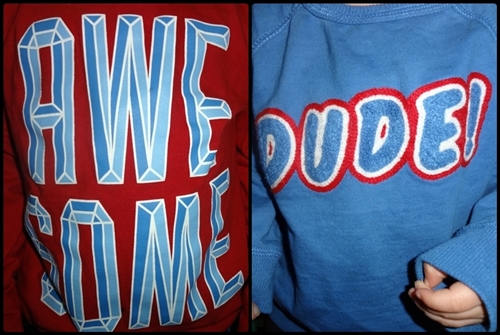
I can’t begin to count the number of time’s I hear the children ask some version of “What’s on your shirt”.  No, they’re not wondering what someone (usually me) has spilled on their shirt.  They want to see the picture, logo, or any words that are printed on the fabric.  If there are words they need to know what they say.  This whole conversation is repeated every time anyone comes in the room.

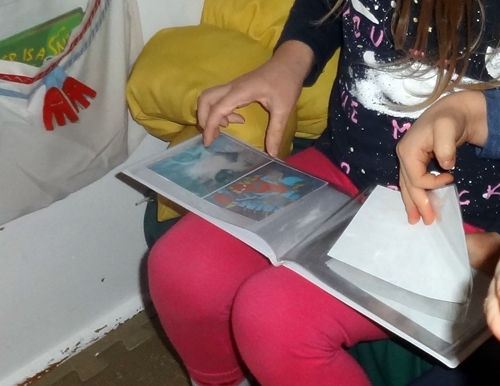
I decided to start documenting this activity by taking photos of all the children’s shirts, printing them and creating a book.  So far we have forty four shirt photos like this;


16-02-shirts01 

16-02-shirts02.jpg 

16-02-shirts03 


The album full of shirt pictures has been extremely popular.  There have been a few minor disputes over it because there is only ONE book but that may change soon because we’ve nearly run out of space so we’ll need a second album. :-)

16-02-shirts04

Even the youngest children can name the owner of each of the shirts in the album.  There have been some really amazing conversations here as the children look through the book together.  The conversations have continued at home too – I hear stories about struggles to get dressed in the morning because ‘I can’t wear that shirt, Cheryl already has a picture of it’.  Some are even demanding shopping trips to get NEW shirts to add to the album.

It is important to keep families involved in our daily activities ;-)

Sunday, May 3, 2015

Mine!

Anyone who has a toddler should expect to hear them screech ‘Mine!’ many, many times.  It’s normal. Working with a group of toddlers it is a regular occurrence to which I am accustomed.  For months now there has been an interesting daily ‘dispute’ between two of my toddlers – I will call them Bunny and Bear for this post.

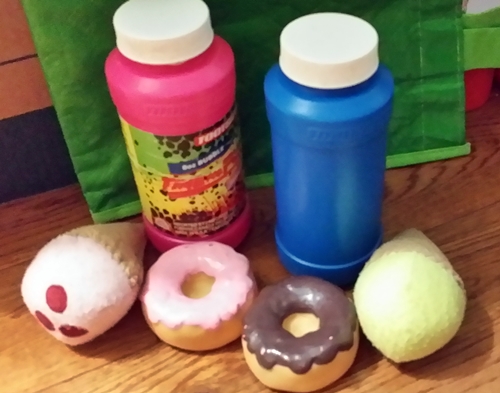
It started with the felt ice cream cones.  Bunny claimed the pink one and always had to have it nearby when she was in the playroom.  If Bear saw the pink ice cream cone unattended he would pick it and Bunny would begin to scream.  Bunny would grab the green ice cream cone and offer to trade and Bear eagerly accepted.

Both these toddlers are completely agreeable throughout this process  but they sound very upset.  Their actions are frantic and there is near constant wailing “My ice cream! My ice cream!”  A gentle reminder to just ask and say please would usually decrease the intensity of their ‘conversation’.

However, problems arise when others in the group become involved.  The ‘Defender’ considers Bunny to be their ‘best friend’ and refuses to allow others to touch Bunny’s ice cream cone. The ‘Collector’ wants all the best toys.  Anything deemed ‘special’ by anyone else is a must-have item for the Collector.  The Collector rarely plays with any of the toys but doesn’t want anyone else to have them either.

When Bear picks up the pink ice cream cone the Defender will tackle him and try to rip the pink ice cream cone from his hand.  Bear will never release the ice cream cone to the Defender or the Collector – it ‘belongs’ to Bunny and he wants to give it to her.  Bunny is not involved in the physical battle but is wailing ‘Miiiiinnnnne‘.

The ‘Defender’ and the ‘Collector’ usually choose physical aggression instead of words – they seem to thrive on it and sometimes they even initiate it.  If a defender notices the unattended pink ice cream cone they will pick it up and not give it to Bunny.   Instead, they taunt Bear with it and the battle begins.

These daily brawls were becoming more intense and disruptive so I removed the ice cream cones from the toys available for play.  That’s when the situation became even more interesting.  On learning that the ice cream cones were ‘gone’ Bunny and Bear chose plastic doughnuts instead – strawberry for Bunny and chocolate for Bear.  Whichever one of these toddlers entered the playroom first would immediately take the two doughnuts and wait for the other toddler to arrive and then give them ‘their’ doughnut.

Likewise, the Defender and Collector continued to try to control ownership of the preferred toys.  There were only two ice cream cones but there are three donuts and there are still battles over the two ‘selected’ ones.  When the doughnuts were removed then the bubble bottles became the chosen toys. There are several bubble bottles but Bunny & Bear each have a favourite one. The battles continued.

For Bunny & Bear it’s not really about the specific toys – it’s mostly about the friendship.  As the various toys come and go the one thing that remains consistent is that there is one chosen for each of these two children.  Bunny & Bear enjoy each others company and these toys are an invitation to ‘come play with me’.

 15-04-toys01

The Collector is all about the toys and the other toddlers just get in the way.  The Collector is most content when playing independently – with ALL the toys.  The Defender is focused on ownership too but their most desired ‘possession’ is power.

I’ve been working on this post on and off for a few weeks now and I struggled with how to end it.  That is probably because the ‘situation’ hasn’t ended.  This isn’t a ‘we had a problem and this was how we fixed it’ post.  It is my observation of one small part of the daily interactions within this group of toddlers.

The conflicts will continue and I will continue to observe.  I will step in to redirect behaviour that may be dangerous.  I will experiment with the room arrangement and toy selection.  I will offer to mediate disputes if required but mostly I will allow the toddlers to solve their own problems.  The conflicts are a normal – a necessary part of toddler development.  The process of learning social skills to interact with others and make friends.

Tuesday, May 13, 2014

Screen Time

Yesterday I read an interesting CTV News article about children and screen time.  I thought it was wonderful to compare screen time to nutrition – an analogy that puts the focus on the content of the programs.

Recently I was asked to speak to a group of Red River College students who were just completing their ‘Introduction to Family Childcare’ course.  As part of my presentation I included a slideshow of the past and present learning environments in my childcare home.

Screen time was briefly discussed during my presentation and the subsequent question period.  Yes, I used to have several computers available for the children in my program to use – and I did not even restrict the amount of time they engaged in the activity.

No, I don’t currently have any computers, tablets, or televisions that are available for the children to use at any time during the day.  The reason for the elimination of the ‘computer area’ was due almost entirely to the quality of content available and the fact that the children had no interest in ‘healthy’ content once they had experienced the ‘junk’.

Years ago when I first started my blog I wrote about the use of computers in my childcare program and their gradual elimination.  It is not that I don’t value technology – I use it all the time.  When the children have questions that I can’t answer we can find the answer on the internet – it is an invaluable resource in addition to their hands on experience.

Unfortunately I think the content of children’s media today has far too much focus on competition instead of collaboration.  The smaller screens further emphasize the ‘individual’ over the ‘group’.

I once had a discussion with the staff at my son’s school.  My son was extremely slow to engage in new situations and had a tendency to withdraw from social interaction.  They were concerned because he refused to use a new program they had recently introduced in their computer class.

I suggested that they should let him sit with and watch another child until he felt comfortable enough to try it himself.  They said that was not possible because it would be considered cheating and would not be fair to the other child. Seriously?!?! What were they hoping to teach?

The children and I have discussed the use of screen time – they all have access to screens at home.  They’ve described how they like to use their hand held devices when they are bored – it is easier than finding something else to do.  They’ve retold me all their favorite parts of the movies and shows they’ve recently watched.  If there are any ‘good’ parts in these shows I haven’t heard about them, the children  focus on the violent, destructive, mean or rude segments – that’s what they remember.

As I write this there are two children here – they are reading the label on a cereal box and debating the nutritional value.  Maybe I’d have screen time as part of the program if there were ‘nutrition’ labels on the content of every program.  However, I’m not sure I have the energy to break through their addiction to the junk so instead my program will continue to be screen free and really they don’t complain about the absence of screens when there are healthier options available.

56

Friday, November 1, 2013

State of Flux

I like things to be organized – if you look at my desk or my filing cabinet you might disagree.  That’s because I also tend to lack focus for mundane tasks like paperwork. When it comes to my childcare program I am a little conflicted regarding organization.

Some synonyms for organized include ‘ordered, controlled, structured’ – none of those words reflect my view of activities in a flexible childcare program.  However, other synonyms like ‘prepared’, and ‘well thought-out’ would be appropriate.

According to Dictionary.com ‘Organized’ is defined as “having a formal organization or structure, especially to coordinate or carry out for widespread activities: organized medicine; organized crime.”  To ‘Organize’ is “to form as or into a whole consisting of interdependent or coordinated parts, especially for united action”.

I like these definitions because in order for any of our daily activities to be successful we need to be able to function as a group.  We need to find a balance between our unique individual needs and the needs of the others in the group.  We need to get to know each other and that takes time.

We’ve been in a state of flux for what seems like a very long time – two whole months. We have not had a ‘normal’ schedule for two months and it has been frustrating at times.  It began with the start of the new school year where the little ones go through a period of ‘loss’ and sometimes struggle with missing their mentors who are now away much of the day.

We’ve had many other adjustments too.  Some parents have had changes in their work schedules which resulted in altered pick-up and drop-off times.  The little ones get used to a routine where certain children regularly go home first or last and variations can be confusing.

We’ve said some good-byes and enrolled two new babies.  There have been some necessary adjustments to nap times, meal times, seating and sleeping arrangements.  We’re trying to accommodate each individual without being too disruptive to the group.

It has been challenging.  Only once in the past two months has attendance been ‘normal’ – by that I mean no one was absent and everyone was dropped off and picked up on time.  It’s hard to call it ‘normal’ when it has only happened once but on paper that’s the way it should be.

It’s impossible for anyone – especially young children – to feel part of a group when you don’t understand what that group is.  We can’t focus on learning and growing until we find our place.  We need to get organized because this state of flux has been hard on us all.

Monday, September 16, 2013

Let's Be Fair

Every day begins the same.  As the children arrive they agree on an activity to play together and begin the process of making sure everything is ‘fair’.  This is a very, very, long process.  In fact, often the actual game never even begins because they can’t agree on what is ‘fair’ so they switch to another activity instead – another activity with another set of toys and another lengthy period of deliberation over what will be ‘fair’.

The problem is that each has a different definition of ‘fair’.

befair01

The ‘quantity’ child believes that it is fair if everyone involved has the exact same number of toys.  ‘Quantity’ maintains that everyone must have the same number of characters, blocks etc. before play can begin.  Even if the other children involved only want one or two toys this child delays the game until everyone has an equal number of the toys to use.  “That’s not fair!” is often heard.

‘Ruler’ insists that all the biggest, most powerful toys belong to their personal group of toys.  ‘Ruler’ often tries to use ‘Quantity’ as an ally by pointing out that each of them has the same number of toys so it is fair.  In essence it is not fair because although the number of items is equal, the quality is not. ‘Ruler’ is a very competitive child for whom ‘fair’ means they are in charge and their team always wins.

‘Cluster’ doesn’t really care how many toys are on their team as long as they all match.  ‘Cluster’ wants all the members of a family group and doesn’t worry if someone else has more toys or better toys. ‘Cluster’ believes it is fair when everything matches and gets frustrated when ‘Quantity’ insists on assigning additional dissimilar members to ‘Cluster’s’ families.  Another conflict occurs because all the ‘fathers’ of the family groups tend to also be the power toys that ‘Ruler’ has already claimed thereby leaving ‘Cluster’s’ families incomplete.

‘CoOp’ will happily accept any toys the others don’t want to use.  CoOp has favourite toys but they don’t mind if others use them and will wait patiently while the others choose and set up the activity.  ‘CoOp’ will never complain nor be assertive.  ‘CoOp’ believes it is fair when everyone is able to participate harmoniously – conflict is their greatest fear.  ‘CoOp’ often ends up playing alone either because they felt overwhelmed by the negotiations or the others failed to invite them to play.

‘Tyrant’ is impulsive – recklessly stumbling through block structures and grabbing any toys that appear interesting at the moment.  It doesn’t matter if the toy is in a bin, on the floor or in someone else’s hand, the moment ‘Tyrant’ wants it ‘Tyrant’ takes it.  Thankfully ‘Tyrant’ tends to have a short attention span so the toy is usually soon returned to its original user. Sometimes ‘Tyrant’s’ behaviour is fuelled by the reaction so it is important not to overreact to because it will intensify the conflict.  “Tyrant’ is usually a toddler so the behaviour is a ‘normal’.

Actually, all these children are ‘normal’.  They represent the children of various ages, temperaments and developmental levels who co-exist in a family childcare setting.  The conflicts don’t mean the children need to be separated or that an adult needs to intervene.  The conflicts mean that the children are learning to get along with others who have a different point of view.

Fair is not always equal.  Fair is not always the same.  Fair is not always without conflict.  Accepting the conflict is difficult but it is part of the process – the process of learning to be fair.

Sunday, September 9, 2012

Summer Group Dynamics

Many people are surprised when I say that I look forward to summer time when the all the children are here for the full day.  I’ve even considered taking my vacation in the spring instead of summer just so I could have even more full days with the children. Unfortunately, closing for vacation in spring, during the school year, would be troublesome for bus schedules and school/work routines so I don’t.  I do, however, take only two weeks of vacation time in the summer instead of three, four, or even more that many other providers choose to take.

Summer is over now and the older children have returned to school.  This year I say that with a sigh of relief.  This summer was very long – and complicated. This was the summer that I wished I had taken more time off.  This was the summer that almost did me in – there were some days that it took so much effort just to unlock the front door and greet the children with a smile.

So why was this summer so troublesome?  There was only one new child in the group; the others have been here for at least a year – and up to six years.  Over the summer I spent a lot of time observing their interactions and reflecting.  There were a couple of children that tended to stand out – not in a good way.  It would be easy to label these children as ‘difficult’.  It would be easy to say that if they were not here then everything would run smoothly.

Easy would not be correct.  Although many of them have been attending here for years this ‘group’ has not been together before.  I actually have 11 children enrolled in my eight childcare spaces because some only attend part time.  Some attend only during school hours while others only attend when school is out.  Some have spent plenty of time together but not recently – and they’ve discovered that their ‘best friend’ has changed since they were together last – they have new interests.  There was a lot of turmoil within this group.

So, here are some of my observations – I’ve given the children bird names because I can’t use their real names and I didn’t want to number them;

Finch is curious, energetic and at times – defiant. Robin is imaginative and often oblivious to the conduct of the rest of the group.  These two have little interest in most group activities but will participate for short periods before wandering away to something they find more interesting.  Sparrow is wildly creative and independent, always has elaborate plans and is proficient at free play.  Sparrow enjoys cooperative group activities but gets frustrated by conflict and will usually return to solitary activities instead.  These three require very little guidance from me.

Canary is bubbly and full of energy but relies on others to make activity choices. Often Canary has difficulty staying on task.  Canary can become deeply engaged in cooperative play activities with Sparrow if not distracted.  Others sometimes take advantage of Canary’s trusting nature and they encourage undesirable behaviour.  Canary can be easily redirected and is never rebellious.

Jay is a keen observer who is very concerned about status and focused on results – definitely product over process.  Easily overwhelmed, Jay is drawn to group activities but rarely participates – preferring to watch or be watched.  When frustrated, Jay resorts to disrupting play in an effort to divide the group into smaller, more manageable clusters.  Jay can play cooperatively with one or two others in a non-competitive activity – preferably something constructive but not challenging.  Jay is very sensitive and views any suggestion or advice as a personal attack.

Pigeon….so wants to be where the action is, hates to be alone and is willing to do anything, absolutely anything, to be a part of the group.  Others often view Pigeon as annoying and therefore avoid contact which intensifies Pigeon’s efforts to be noticed.  Pigeon has little self control and cannot refuse a dare – no matter how outrageous.  Pigeon has great difficulty with unstructured activities but enjoys adult led group activities.  If the others allow it, Pigeon makes a wonderful addition to any group activity.  One rule infraction and Pigeon seems to feel the day is a total loss and any further attempt to behave or cooperate is now pointless.

Crow is extremely intelligent but easily bored and has little interest in most free play activities.  Crow follows instructions impeccably when participating in adult led group activities or working independently.  Within the group Crow’s favourite role is that of ‘puppet master’ – controlling others activities as a form of entertainment.  Crow has superb leadership capabilities which should be used more constructively.  Initiating or encouraging others inappropriate behaviour seems to be a great source of amusement for Crow particularly with Falcon as an accomplice.

Falcon is the oldest/biggest/strongest of the group and also highly competitive. Falcon does not like to play independently or cooperatively.  Falcon excels at constructive activities.  Whenever others are engaged in a cooperative group activity Falcon swoops in and modifies the activity into something where Falcon is most successful and the others either fail or quit playing.

When Crow and Falcon collaborate world domination is possible – and Jay and Pigeon are guaranteed to be casualties.  The others are safe if they have somewhere to play independently – if not, then they will be part of the fallout too.

This was my summer group.  I will not say any one of these children was the sole cause of disturbances nor were any of them completely faultless. It was the group dynamics and it was a very difficult group. Working on ‘prevention’ is so much easier than dealing with the ‘aftermath’ but both were very time consuming endeavours.

I was constantly analyzing and anticipating – trying to determine whether we needed more structured activities or more free play, more group activities or time to be independent.  How could we balance the needs of all the children in this group?

Certainly there was a ‘best’ scenario: Finch and Robin playing independently, Sparrow and Canary playing together in an elaborate imaginary world of their own,  Jay helping Falcon to create another great superstructure and Crow sitting with Pigeon working together on a planned project.  Yet, I couldn’t keep them separated like this indefinitely.  Besides, avoiding conflict will never teach us how to deal with it.

We had some really great times this summer and some terrible, horrible, wish-this-day-never-happened times too.  I didn’t keep score but for the first time I’m very, very glad that summer is over and school has started and the group dynamics have changed.