Showing posts with label Play. Show all posts

Wednesday, February 12, 2020

Space & Time

It is no secret that I prefer to be outdoors with the children instead of indoors. It is probably also not surprising that I spend a lot of time creating indoor and outdoor play environments. However, it may not be common knowledge that I really dislike planning group activities.

Autumn/Fall tends to make me a little anxious. I love taking long hikes and marveling at the colours and watching busy squirrels but fall is a transition season. After all our long summer days outside the children are starting to complain that it is getting far too cold to enjoy their favourite activities. Many fall days have frigid winter temperatures but there is little or no snow to make the cold exciting. I start to dread the thought of spending more time indoors – confined – bored – bickering – whining. *sigh*
 
So I start to plan for some additional activities that we can do indoors when it gets too cold to play outdoors for long periods. This year I had some activities that I was quite eager to try. There were even a few fall days when I considered trying them but I didn’t – because it wasn’t yet too cold to go outside to play – except it is never actually too cold to play outside. In fact, so far this winter there has only been one day that we didn’t go outside at all – and then the children were upset when it was lunch time and they realized they missed our outdoor time.

Most days this winter we have been outside for 1-2 hours and once you add the time for everyone to get dressed and undressed that is the entire time between morning snack and lunch. We haven’t needed additional indoor activities to keep us busy. On the contrary, all that ‘bored, bickering, whining’ stuff I was stressing about is because indoors we have too many transitions and not enough uninterrupted time.

We actually have too much to do inside – too many things, too many choices, too many distractions, too many disruptions and not enough space and time. In the confined indoor space every time someone picks up a toy, or moves to a different spot, or the phone rings, or someone comes to the door it changes the focus of all the other children in the room. The last thing I want to do is initiate yet another activity and create another transition.

Transitions – arrivals, departures, meal prep/cleanup, diaper changes/bathroom breaks, etc – even if they don’t involve the busy children, they are distractions that interrupt their play. They notice when I walk toward the kitchen and one of them will announce that it is time to clean up for lunch – it is not but someone will assume it is and an argument will ensue. The children have difficulty engaging in any activity because they are anticipating what is ‘next’ – no one is actually playing. They are in limbo, watching and waiting.

I can relate. I often put off doing paperwork, writing blog posts, working on my website etc – not because I don’t want to do it but because I know I won’t have enough time to fully engage in the activity and be able to finish what needs to be done. So instead of getting a little bit of work done I get none done because I didn’t even attempt to start.

Planned group activities don’t help the children. Certainly they can briefly create an artificial period of engagement and can effectively redirect when the children are in battle mode. However, they also create more transitions and ultimately they just make it more difficult for the children to make their own independent activity choices – the way they do when we are outside.


When we are outside, even though my yard is not huge, there is still more separation between the various play areas than there is indoors making it easier for the children to sustain their focus on one activity without being distracted by others playing elsewhere in the yard. My activities are also not a distraction when we are outdoors. I have several benches around the periphery of the yard that make it easy to blend in to the environment and observe the children without disturbing their play. I am present but not involved, not directing.

Indoors we have many of the same activity choice as we do outdoors – even many gross motor opportunities (that will be another post) but indoors there is less space and I am closer which makes the children less likely to engage in self-directed activities. When I am close their questions are endless; “What are you doing? Where are you going? Can I see in that box? Are we going to do a craft? What was that noise? Who is at the door/upstairs/in the kitchen?” They are not engaged in play because I am a distraction.

When I am too close there is an expectation that I will assist them, I will solve their problems, I will entertain them and they don’t need to do anything. In a small confined space it is more difficult for me to allow them more time to solve problems and I am more likely to redirect their activities. My involvement often increases the likelihood that they will do it again – there is a lot more testing of limits as I become a prop in their cause and effect experiments.

So, I don’t want to plan more activities – we don’t need more activities. I need to tweak our schedule and indoor environment to give us more space and uninterrupted time – or we could just go outside.

Saturday, December 21, 2019

Mongomery

In keeping with my new trend of putting off writing blog posts (and most other paperwork) here is a post I’ve been planning to write for four months! However, the last part of the post was not part of my original plan…

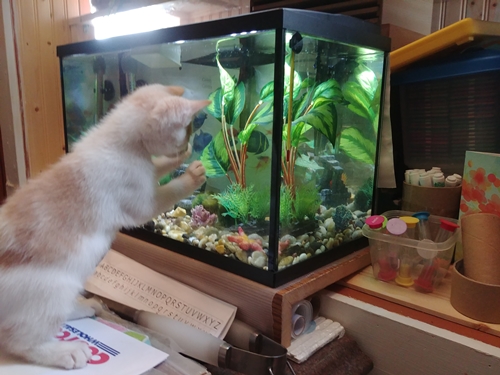
It is no secret that I love cats. I’ve written before about my view on having pets in a childcare home and about our adoption of a tiny little stray, the struggle to introduce the new cat, and the eventual loss of an old one. So, it should come as no surprise that when one of my childcare families fostered a momma cat and her kittens…I picked one.

To be honest, originally I just picked him out as my favourite one of the litter with no intention of actually adopting him but…it seems I have no self control *sigh*. I was a little apprehensive about bringing a new kitten into our home. Malta, our almost 14 year old cat is easily stressed and within seconds of the kitten being carried in the door she ran upstairs to vomit. She was not actually my biggest concern – she takes a bit of time to adjust to change but usually adapts without too much fuss.

Four year old Monkey (legal name Button) was the one I was a little worried about. Monkey is a not-so-small-anymore cat with a HUGE attitude. She has a tiny little squeaky mew but makes up for it with a loud deep snarly growl. She uses that growl to voice her opinion about everything. Her growl doesn’t always mean ‘NO! Leave me alone’ when someone tries to pet her, sometimes it is a demanding ‘Sit still, I want to sleep on your lap.’ and she doesn’t take no for an answer.

Not only did Monkey vehemently disapprove of Montgomery visiting, she also complained about any people who touched him or breathed the contaminated air around him. However, she is all noise no action so I figured she would eventually accept him – he was so small and adorable;

Monte & the toy cat the toddlers thought he needed – it looks just like him.

We did plan to keep Montgomery in quarantine for the first two weeks before letting the other cats ‘greet’ him. Rather than lock him away in a room by himself we decided the loft in the playroom would make a good temporary kennel. There I could easily observe him throughout the day and bring him out for supervised playtime with the children. Monte did not approve of the plan – it was less than one day before his first escape from quarantine and we soon discovered he could not be contained. Every new barrier we designed was treated as a challenge and quickly conquered.

Monte (far left) outside the loft he should be in.

Not only was it impossible to keep him IN the loft, we also couldn’t keep him OFF the loft. He climbed the support posts and ran laps around the OUTSIDE of the netting and over the top taunting me from the nine foot ceiling as I fretted about him falling and breaking his tiny little legs. We eventually managed to quarantine him on the main floor of the house – leave the older cats ‘safe’ space upstairs.

He loved toys – his toys, the children’s toys, my toys and things that were not toys.

Monte & the fish.

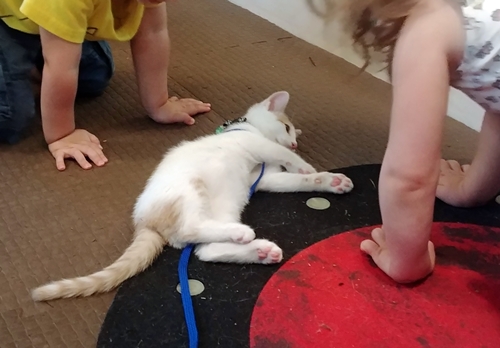
I have always taught the children to respect the cats’ space – don’t chase them, wait for them to come to you, be gentle and kind. Monte would have no part of that. I tried to keep him out of the playroom when I wasn’t able to directly supervise the toddler/cat interactions but he’d fly over the gate to play his favourite ‘come and get me’ game.


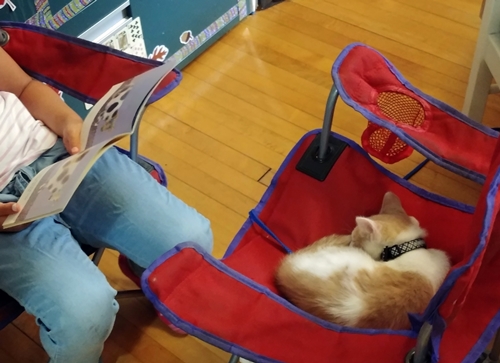
He demanded his own chair at quiet time – would knock them over and try to open them himself if I didn’t set one up for him.


The older cats cowered upstairs long after the two week quarantine. Even with food bribes, coaxing and cuddles they were reluctant to be near him. After all, he was quite terrifying.

Destructo Cat

Malta was the first to accept his presence – it took about four weeks. As long as he was being calm she would allow him to be near her. Sometimes when he was sleeping she would cuddle and bathe him. She tried to teach him to be polite but she would not tolerate any playful behaviour – she was far too old for that.


It took Monkey longer. Even after she started venturing downstairs into enemy territory she did not want him near. Monte however continued to push boundaries and considered her his favourite squeaky toy – poke its butt and it makes a funny noise.


Montgomery continued to find new things to play with – and destroy. He loved playing fetch with his mouse – it was the only way we could get out of the house without him trying to escape. Throw the mouse down the hall and rush out the door before he gets back. When we returned he’d be sitting, waiting by the door with the mouse in his mouth. We bought him dog toys after he tore up some cat toys.

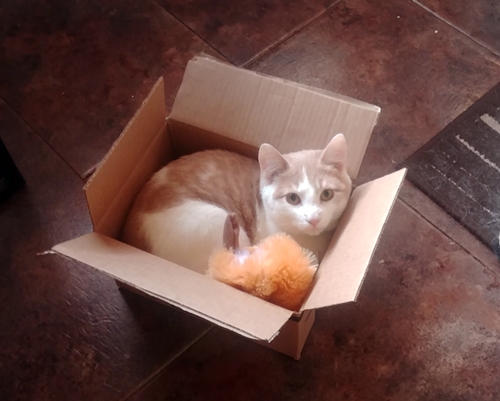
Monte in a box with ‘Firefox’ the puppy tug toy.

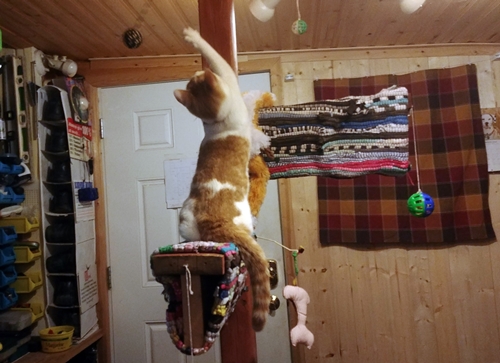
We built him a floor to ceiling scratching post with shelves to sit on and hanging toys.


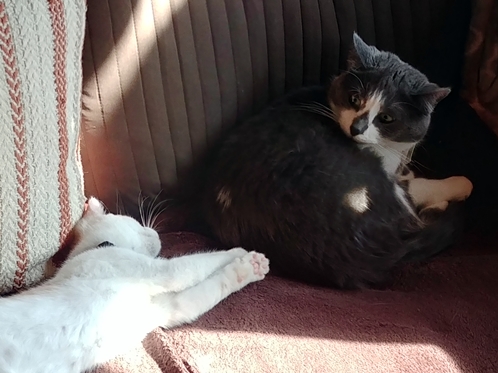
Monkey was starting to enjoy having a playful little brother – she doesn’t like toddlers and Malta doesn’t play (Monkey does chase and bully her sometimes). Still, in order to keep her ‘grumpy cat’ status Monkey wouldn’t admit she liked the little cat. If we caught her in the midst of a wrestling match or cuddle/bath time she’d immediately stop and run away growling like ‘Ewww, I acidentally got some of its fur on my tongue’. We were not fooled by the fake distaste. If she wanted to play and didn’t know where he was she would toss one of his toys around and wait for him to show up. She also liked playing tag games on the cat post.

Monkey looks grumpy because I caught her playing with Monte.

It was actually really nice to see Monkey playing now. After living with an old cat she had been getting very lazy – and ’round’.

There was one bothersome aspect of Montgomery’s that I initially blamed on ‘teething’ and I hoped he would outgrow it but instead it was getting worse. Monte likes to chew and eat things that are not food. He has chewed through just one power adapter cord but there are many other things he has chewed or eaten. Whenever I find items that have been chewed or cat barf with foreign objects in it I try to kitten proof more but he just moves on to chewing something else.

This is the part of the post I didn’t originally plan to write. In early December Monte stopped eating. He still begged a little when the other cats did but he walked away from any food he was given. He stopped playing, he stopped purring when we petted him, he didn’t like to be picked up or carried and he wouldn’t even drink water. We were worried he had an intestinal blockage so we took him to the vet.

After a hospital stay, IV fluids, pain meds, antibiotics, several x-rays, and some prescription food he seems to be back to normal now. Thankfully he didn’t need surgery. Monkey hated him for a few days after he returned but she has gotten over it and they play together again. Monte still eats things he shouldn’t *sigh*. The vet bill cost me more than if I had closed the daycare for two weeks and taken a vacation.

I’d rather have a cat than a vacation – even if he is a brat. Make better decisions Montgomery.


Wednesday, April 24, 2019

Easter Eggs

Easter egg hunts and other types of hide & seek games are always popular activities – previously I’ve written about them here (2011)and here (2017). A few weeks ago I hid twelve large plastic eggs around the playroom before any of the children arrived. Then, throughout the day the children discovered eggs as they were playing – it was always an exciting surprise.
The children enjoyed the activity so much that I have hidden the eggs every day since then. When they arrive the first thing they ask is ‘How many eggs have been found?’ So far they have never found all twelve eggs. Usually they manage to find 10 or 11 but some days a few less.
Some of the children actively search for eggs almost the entire time they are in the playroom. Others just play as usual but are equally thrilled when they find an egg. I’ve run out of original hiding spots and am now repeating past ones. The children don’t seem to mind – they still expect the egg hunts to continue.
There is no competition about who finds more eggs nor any reward for finding one. It is the search that they enjoy. Easter my be over now but they still want to search for eggs so I will still continue to hide them. Maybe today will be the day they find all twelve…

Friday, March 29, 2019

Quiet Spaces

Throughout the past couple months I have observed the children using dress-up clothes and blankets to create ‘snow forts’ in the playroom. I recognized this repeated behaviour as an expression of interest in exploring the enveloping/enclosing schema and at first I assisted by simply providing some clothespins.
The children were still often frustrated because in our play room the best places to create ‘snow forts’ are also the walkways. Consequently the builders were always getting into disputes with the children who were trying to pass by to get to the other side of the room.
I had another idea. Recently I’ve been removing many of the items in the housekeeping area because the toddlers were leaving many things strewn about on the floor after searching for a particular item – there were too many toys. I took away a few more of the lesser used items, consolidated the remaining ones and then removed the empty shelves from two of the boxes that form the base of the loft. Then I added some pillow to these otherwise empty boxes.
These boxes proved to be popular places to curl up with a few small toys.
Of course I also knew that two hiding spots would never be enough so I rearranged the musical instruments and created two more spots under the keyboard shelf. These ones are even more popular – probably because the children can feel enclosed while still playing ‘with’ their friends.
Sometimes the children add curtains too
I’m considering adding ‘peek-a-boo’ holes in the board that divides these hideaways – it might make them even more interesting. Even after all the children have gone home, these spaces are still popular.

Friday, March 31, 2017

Waffle Blocks

There is not nearly enough space in the playroom for all the toys I own so the majority are stored in bins in the basement.  Puppets, blocks and animals are sorted into groupings of similar items so it is easier for me to select the ones I want to bring out when I rotate toys. I have a spreadsheet which helps me keep track of when toys are added to or removed from the playroom.
I usually manage to get every toy into the playroom for at least a few weeks each year – more often if the children have favourites or request a specific toy.  Occasionally there are toys that don’t get brought out because they are not developmentally appropriate or interesting for the children enrolled at the time.
Last month when I put the castle blocks and the puzzle people back into storage I brought out the stacking cups and Waffle Blocks instead.  One by one as the children arrived and entered the playroom I heard “Ooooh, what are those!?” or similar comments.  I was a little confused as these are old toys so I checked the spreadsheet again an realized that it had been more than two years since the last time the Waffle Blocks were out!
This group of preschoolers really enjoyed the Waffle Blocks – they played with them almost exclusively during the entire five week period of time these blocks were in the playroom.  I liked that there was a lot of cooperation and creativity when they played with these blocks.
In the past I’ve had some groups that found these blocks boring – making nothing more than a cube or two and maybe adding a roof.  Other children have had difficulty forming the  cubes ‘properly’ and easily became frustrated, constantly asking for assistance.  I’m not concerned about ‘proper’ cubes so I tend to let them figure it out.
It is somewhat difficult to make weapons out of Waffle blocks which may have forced this group to expand their interests a little more.  Also, because I don’t have a lot of these blocks, if they want to make something BIG they have to work together on one structure.  I’ve considered getting more Waffle blocks but then I watch the children problem solve ‘not enough blocks’ and think maybe less is better.
I was particularly impressed by the architecture involved in this  creation;
Waffle blocks have never been one of my personal favorite construction toys but I was definitely pleased with what this group of preschoolers managed to do with them.

Wednesday, February 22, 2017

No Hide & Seek

Over the years I have often told children that Hide & Seek is an outdoor game.  Yes, I personally remember enjoying many wonderful indoor games of Hide & Seek but they were held in a much larger building with multiple rooms. The confined space of our little playroom does make it difficult to play a traditional game of Hide & Seek – there are not really any good places for even a little person to hide.
My current group of preschoolers often initiate indoor games that they call ‘Hide & Seek’ but I always end up redirecting them.  The problem really is that their energy level makes their game unsuitable for our indoor space – they do not play according to traditional rules.
In their game of ‘Hide & Seek’ the three of them together choose a ‘hiding spot’.  Then two of them crawl into ‘sleeping bags’ (old pillow cases that are kept with the dress-up clothes/blankets) while the third child goes to the other side of the room, covers his eyes and counts to 10.  He then shouts ‘ready or not, here I come’, runs across the room and jumps on the two ‘hiding’ boys.  This is then followed by fits of laughter and a group decision as to who hides and who seeks for the next round.
*Sigh*.  This is not Hide & Seek.  This is rough and tumble play that they call hide & seek because they know that I will say running and jumping games are outdoor games.  If I say Hide & Seek is an outdoor game they will argue – and they will be correct – Hide & Seek can be played indoors – but their game cannot even if they call it Hide & Seek.
So why won’t I allow this game?  It is a cooperative game and the three playing are in agreement – for now – but there are other, smaller children who are not.  They do occasionally try to join, or just get in the way and someone always gets hurt.  I will allow this type of play outdoors – but there is simply not enough space indoors for the reward to outweigh the risk.
So, I suggested that they could take turns hiding a small toy instead – there are many places to hide small toys. They thought this was a terrific  idea and immediately chose one of the six stuffed squirrels.  I was somewhat concerned that this would cause confusion if someone ‘found’ one of the five squirrels that were not hidden but that wasn’t a problem.
The real problem was that none of the boys  could resist telling the others where the squirrel was hidden.  Two would sit in the corner and cover their eyes while the third hid the squirrel.  Then as soon as the two seekers stood up to search the hider would say “It’s over there” and point to the hiding spot. The other two would race to the location and whomever grabbed the squirrel first would be the hider – and would hide the squirrel in exactly the same spot that it was hidden in before round after round after round. *sigh*
So, I suggested that I should be the hider and all of them could be the seekers – I also chose to hide a small stuffed bear that wasn’t normally in the playroom.  They covered their eyes and giggled while I hid the bear.  When I said it was hidden they came out of the corner and bounced around asking me where it was.  I told them to look for it.  After searching for nearly a minute they began lamenting “This is so hard”.
I smiled and said. “This is Hide and Seek – indoor style”.  The excitement when they did actually find the bear was priceless. ðŸ™‚ This is now their favourite game.  Sometimes they become engaged in other activities before the bear gets found.  If at any point I need to redirect their behaviour then all I have to do is ask if they’ve found the bear yet and they all begin searching again.
Hide and Seek might be my favourite game too.
20170222_063833

Wednesday, April 6, 2016

Spring 2016

There is a thin layer of snow on the front sidewalk but I am stubbornly refusing to go sweep it off.  The temperature display on the weather station reads ‘0’ degrees at 6am so I am confident the sidewalk snow will melt soon – the snow on the steps has already melted.  Yesterday morning when we went out to play there was no snow anywhere in my back yard and there was a collective “Awww, there’s no snow” from the children so I’m certain this recent snowfall is Mother Nature’s response to that lament.

I like winter too and this past (present?) winter has been quite pleasant.  There have been a few indoor issues with running across the playroom and jumping in and out of the nature area.  I’ve tried several indirect measures to curb the reckless behaviour – most had limited effect but this has been quite successful;

16-04-Spring01

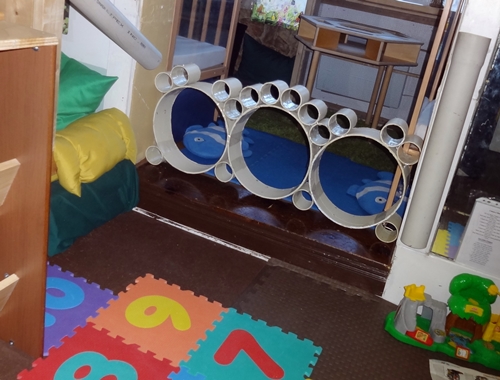
These cardboard circles used to be attached to the loft for toy storage but we no longer have the loft – of course I kept these ‘just in case’ I found another use for them… :-)  The smaller children enjoy using the ‘tunnels’.  The school age children and I can step over.  Either way it slows down traffic – like the pot holes on the street.

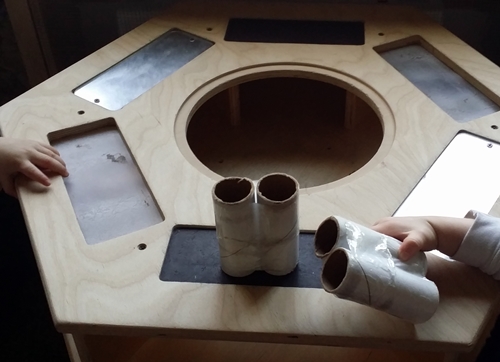
Speaking of cardboard tubes, I can’t believe we still have these ‘binoculars’ made from plastic wrap tubes and tape;

16-04-Spring03

I quickly put them together for some toddlers who wanted them for a dramatic play activity they were engaged in two years ago!  I never expected them to stay in the playroom for more than a day or two but they are just as popular as ever and they haven’t been damaged yet.  I’ve considered making, or having the children make more, fancier ones but no one is really interested so these ones stay.  The current group likes to lay on the floor in the nature area and use them to look for butterflies and birds in the trees.

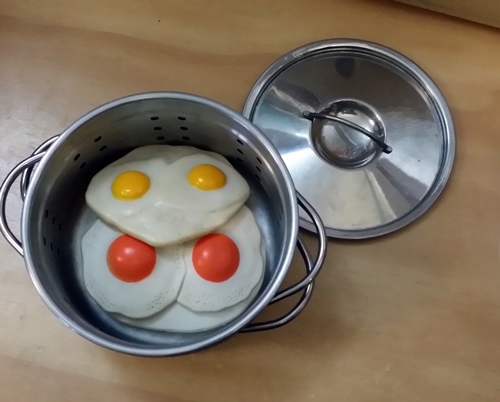
Another constant in the playroom is these eggs in this pot;

16-04-Spring02

Upon entering the playroom one of the toddlers will place these eggs in this pot and set it on the counter.  If at any point someone else moves the pot, puts other food in the pot, or puts the eggs is a different pot there will be a scuffle.  I can’t explain it but it has been like this every day for months now.  No one ever actually plays with the eggs in the pot and the toddlers will happily put them away at clean up time but they MUST be on the counter like this during play time.

However, there have been several complaints that I have not yet taken down the Easter decorations;


16-04-Spring04

Honestly, I’m happy leaving them up as ‘Spring’ decorations.  I have many window clings for Fall, Halloween, Christmas, Winter, Valentines, St Patrick’s Day, and Easter but for the period between Easter and Fall all I have are butterflies.  Butterflies are nice but I’d like to have some variation over the 5 month Spring/Summer period.  Flowers or birds would be nice.

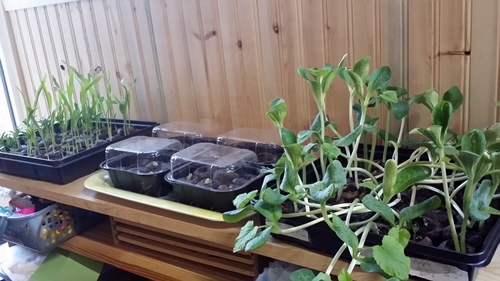
Yes, there is snow on the ground – again – but summer is coming.  Check out our seedlings;

16-04-Spring06

We’ve started our peppers, corn and several types of squash.  The corn surprised us – we don’t usually plant corn but we found an old package of corn seeds in our seed collection - we (I) didn't really expect them to grow.  I don’t usually buy seeds – most of our garden plants are grown from seeds we collect from our garden or produce from the store or CSA box.  Our peas and beans will be planted directly in the garden outside but it is too early yet – we’ve tried digging in the soil every time the snow melts but the ground is still frozen.  Some of us are very eager for Spring to arrive.

Thursday, January 14, 2016

Puzzle Masters

In my collection of childcare supplies I have dozens of puzzles.  Some of them belonged to my own children when they were young, others have been purchased or donated to my childcare program. There are some very simple puzzles with only a few pieces, some with up to 1000 pieces, and everything in between.

Puzzles have always been available as a quiet time activity but they have never been a favourite choice for any of the school-age children.  Occasionally the older children would choose a few of the simplest puzzles and have competitions to see who could complete them the fastest – this tended to be too loud for quiet time.  The larger, more complicated puzzles were never popular and simply gathered dust.

In the past I’ve wondered if the children found these larger puzzles to be too time consuming to be completed in one sitting.  When I have had several older children in attendance for longer periods of time during school breaks I have set up a puzzle area where they could work on a puzzle project independently or with others.  There was no need to put it away when they tired of working on it and so it could be completed over several days.  Still, no interest.

My current group of preschoolers might change that.  For these little ones puzzles are one of their favourite activities.  They have done all the smaller puzzles many, many times.  They can easily complete several puzzles in one sitting and often have many puzzles out at once because they finish them so quickly.  They never seem to get tired of doing puzzles.

None of the preschool puzzles offer much a a challenge to these three and four year old children any more so we now work on the 100 piece puzzles.  What I find most interesting is that they also ask if they can do these puzzles ‘together’.  Cooperating on any activity is a challenge for these little ones so of course I’m going to facilitate any request like this.

16-01-puzzle01

There are so many learning opportunities throughout this one activity!

16-01-puzzle02

Even when they are busy doing other activities they often talk about doing puzzles together – planning or reminiscing.

16-01-puzzle03

Start to finish these two can complete a puzzle this size in about 30 minutes.

16-01-puzzle04

They are puzzle masters.

Thursday, November 5, 2015

Train Tracks

I have several types of construction toys which are never all out because there is not enough space and too many toys is overwhelming.  The various construction sets are placed in the block area bins as one complete set or a combination of two or more partial sets.  Selecting the set(s) to have available is dependent on the interests and ages of the children enrolled at the time.

The train tracks are one of the construction sets that sometimes cause issues in a mixed age group.  Some children enjoy building large elaborate track systems but this requires cooperation if there are several children involved.  When infants and toddlers are present this is not always possible and many young children find building with the train tracks to be frustrating.

My current group of infants and toddlers may be the exception.  The train tracks have been available in the block area for almost three months now and the children are showing no signs of getting tired of playing with them.  I have changed the other items in the block bins several times since the tracks were introduced – now we have the stacking cups – but the train tracks remain.


At first the toddlers were mostly just interested in the trains and rarely attempted to use tracks.  Those that did use tracks were content to just put a few pieces of track together and drive a train back and forth on it.  Then one day they wanted to make a circle so we learned that eight small curves make a small circle;


And eight large curves make a larger circle;

 15-11-tracks02 

Curve, turn, flip, and direction were some of the words we used often during the process. For a couple weeks they were content with these two designs and became experts at building them without assistance. Then I suggested we change things a bit and use both types of curves – four small and four large – still eight pieces but arranged in pairs first.

 15-11-tracks03 

 Words used for this one were ‘pair, sides, ends and oval.  Then a new word – alternate – and with that we created this;

 15-11-tracks04 

By this point several of the toddlers had become expert builders able to connect several shapes together and create their own shapes.  My role was mostly just observing and introducing some new words like ‘elongate’;


 and ‘spiral’ when they created this;


With this group of toddlers the train tracks may be out for a while yet – they are still showing no signs of getting tired of building train tracks.  In fact, the two year old was super excited to build and name this ‘heart’ all by himself.

15-11-tracks07 

We love train tracks.

Friday, June 26, 2015

Llamas

It was about 10 years ago when ‘The Llama Thing’ started.  On my ‘old website’ I had written a bit about the children’s interest in llamas, this is an excerpt;

At one time the school age children I had in care became obsessed with llamas.   Originally I think they just liked the way the word “llama” sounded and they liked to say it over and over.  We started collecting pictures of llamas to display around the house.  The children searched the internet and books for information on llamas – where they came from, what they eat, and how to care for them.  They found sites where you could purchase llamas and decided they wanted a llama for a pet.  When I pointed out that we couldn’t keep a llama in the city they wanted to know “why” and set out to find the answer. 

They used their new found knowledge and imaginations to write stories about and build models of “Llamaland”.  They played indoor & outdoor llama games like “Llamas From Space” and “Spy Llama”.

The preschool children never really caught on to the llama thing but because one of our llama poems included other animals too, the younger children developed an interest in rabbits.  We read rabbit books and made rabbit crafts. I set out pop-up houses and tunnels and they spent hours every day hopping about building burrows and dens.   They all became carrot lovers — kids may hate vegetables but rabbits love them!

The llama obsession lasted about two months – I call it an obsession because during that time my school-age children had ZERO other interests.  Some of the parents lamented “When will this llama thing end?”  Listening to the never-ending Llama Song may not or may not have helped depending on which side of the llama fence you were on.

The llama obsession did eventually end but this particular group of children (and I) continued to love llamas.  Years later there was a brief llama resurgence when a new group of children discovered the llama books by Anna Dewdney.  However, this group of children didn’t have much interest in llamas beyond the books.  I still find llamas fascinating and continue to seek out llama stuff.

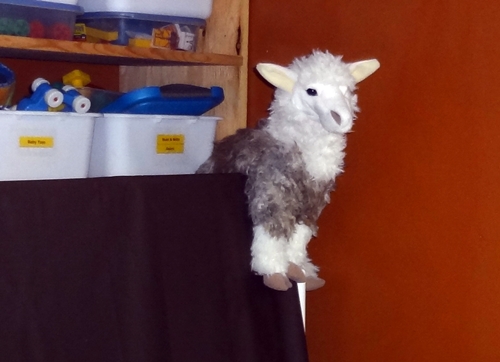
I was thrilled to discover that Folkmanis had alpaca puppets – they may consider them to be alpacas but for us they are llamas because alpaca is not nearly as fun to say.  :-) I have bought both the stage puppet (this one does look more like an alpaca) and the hand puppet (definitely a llama).

The children have named the hand puppet ‘Mortimer’ but rarely use his name because ‘llama’ is so much more fun to say.  The stage puppet is larger so therefore always just gets called ‘Mama llama’.  Once, just once, I played the Llama Song video while the children were waiting for lunch to get dished up.  Yes, I can see that becoming an addiction very quickly with this group too.  I think we’ll stick to the puppets and books instead.

15-06-llama00

Tuesday, May 13, 2014

Screen Time

Yesterday I read an interesting CTV News article about children and screen time.  I thought it was wonderful to compare screen time to nutrition – an analogy that puts the focus on the content of the programs.

Recently I was asked to speak to a group of Red River College students who were just completing their ‘Introduction to Family Childcare’ course.  As part of my presentation I included a slideshow of the past and present learning environments in my childcare home.

Screen time was briefly discussed during my presentation and the subsequent question period.  Yes, I used to have several computers available for the children in my program to use – and I did not even restrict the amount of time they engaged in the activity.

No, I don’t currently have any computers, tablets, or televisions that are available for the children to use at any time during the day.  The reason for the elimination of the ‘computer area’ was due almost entirely to the quality of content available and the fact that the children had no interest in ‘healthy’ content once they had experienced the ‘junk’.

Years ago when I first started my blog I wrote about the use of computers in my childcare program and their gradual elimination.  It is not that I don’t value technology – I use it all the time.  When the children have questions that I can’t answer we can find the answer on the internet – it is an invaluable resource in addition to their hands on experience.

Unfortunately I think the content of children’s media today has far too much focus on competition instead of collaboration.  The smaller screens further emphasize the ‘individual’ over the ‘group’.

I once had a discussion with the staff at my son’s school.  My son was extremely slow to engage in new situations and had a tendency to withdraw from social interaction.  They were concerned because he refused to use a new program they had recently introduced in their computer class.

I suggested that they should let him sit with and watch another child until he felt comfortable enough to try it himself.  They said that was not possible because it would be considered cheating and would not be fair to the other child. Seriously?!?! What were they hoping to teach?

The children and I have discussed the use of screen time – they all have access to screens at home.  They’ve described how they like to use their hand held devices when they are bored – it is easier than finding something else to do.  They’ve retold me all their favorite parts of the movies and shows they’ve recently watched.  If there are any ‘good’ parts in these shows I haven’t heard about them, the children  focus on the violent, destructive, mean or rude segments – that’s what they remember.

As I write this there are two children here – they are reading the label on a cereal box and debating the nutritional value.  Maybe I’d have screen time as part of the program if there were ‘nutrition’ labels on the content of every program.  However, I’m not sure I have the energy to break through their addiction to the junk so instead my program will continue to be screen free and really they don’t complain about the absence of screens when there are healthier options available.

56

Friday, May 2, 2014

Liking the Space

It seems like I’ve been neglecting my blog.  Truth is, I’m feeling a little overextended at the moment.  Meetings, editing, writing presentations, paperwork, and other commitments have been eating up all my ‘spare’ time.

The 11 hours/day that I spend with the children has become my ‘quiet’ time.  Right now I’m supposed to be working on a slideshow presentation that I need to finish for tomorrow so I really shouldn’t be ‘wasting’ time playing around here but….

I wanted to share some of our experiences as we try out our newly renovated spaces.  There have been (mostly) positives and (a few) negatives from my perspective and the children’s too.

I haven’t really got the time to do this now so I’m just going to post a few pictures for now.  Here is a ‘magic’ tower;

testing 01

The blanket was successfully removed and replaced several times without knocking over the impressive structure hidden under it;

testing 02

In the nature area there has been a lot of interest in our new tree pieces – we now have several different sizes to choose from.  Here are some of the smaller ones that were being used to make a fence;

testing 03

The new art spaces have been popular too – for the preschoolers;

testing 04

And the school-age children too;

testing 05

Even the cats have been checking out the new spaces.  Malta has decided that the nap area divider is her property;

testing 06

However, there have been a few disputes about that.  Both cats have also claimed that the carpet under my computer chair belongs to them;

testing 07

I continually have to decide whether the paperwork is more important than disturbing the cats.  Maybe it is their way of telling me to go outside and play instead :-)

Hopefully I’ll have time to write a ‘real’ post after things slow down a little.  Until then, I’ve got more work to do….

Friday, March 14, 2014

Stacking Order

A few weeks ago I bought a new toy from Ikea – I love that none of their toys have any connection to movies/TV shows.  Actually, I bought a few toys but only this one has been introduced into the playroom so far.

LH01

Yes, we already have a lot of stacking toys but they are not all out at the same time and each has something that makes it a little different from the others.  This one is a ‘lighthouse’ – the older children recognized it right away.  The toddlers don’t know what a lighthouse is so they just think that top blue piece is in the wrong spot. They prefer to put it like this;

LH02 

Matching it with the other blue one – they don’t care that it doesn’t have an outer tapered edge, colour is more important.

I like the colours too.  Finally a toy that has all the primary and secondary colours and arranges them in colour mixing order – green between yellow and blue, purple between red and blue.  Last year I wrote Colour Hunt about how some colours are left out.

I also like that this stacking toy allows the children to try other arrangements too.  Some stacking rings have a tapered center post which makes it impossible to put the rings on in reverse order.  The younger children get frustrated when they can’t push the smaller rings to bottom of the post.
The older children enjoy arranging this toy ‘backward’ or ‘upside down’.  These are some of the patterns they’ve made with this new toy;

LH-tile

So many options from one simple toy.  I wonder how many more they can discover.