Showing posts with label Construction. Show all posts

Saturday, November 23, 2019

Garden Produce

Yes, yet another post that I’ve been slow to write – there is snow on the ground and I’m writing about the garden… Well, actually, I’m writing about stuff leftover from the garden. I just used our last tomato so we have no more ‘food’ from our garden but our garden provides some wonderful loose parts that we will continue to use.

This year our sunflowers grew very well – I wrote about them already. We didn’t just get seeds and flowers though, we also got to use the big sunflower stalks in our construction area;


Sunflower stalks are very light for their size so the toddlers feel super strong carrying them about. They make good bridges and paths;


Other popular loose parts we get from the garden are the beans. We usually grow several different varieties of beans. Some of course are grown to eat but the scarlet runner beans we grow for fun. This year there were some pretty impressive beans;


Taking the seeds from the pods is a very popular activity – partly because many of the toddlers love disassembling stuff (disconnecting schema) but it is also great for developing fine motor skills.


We were surprised to discover that the biggest pods did NOT contain the biggest seeds. The variety of seed colours and sizes is also very interesting.


These ones we brought inside to add to our seed collection to plant in the spring. We have many more out in the yard – they get used as ‘ingredients’ for potions, sorting by size and shape, transporting in pails and trucks, land art, and so much more. Sometimes we even discover bean plants growing in random spots outside of the garden. Wonder how that happened? 🙂

Saturday, August 3, 2019

Vacation 2019

Another two week vacation, another big outdoor project – perfect! But before I tell you what I did on my vacation I’ll give you a little yard history.

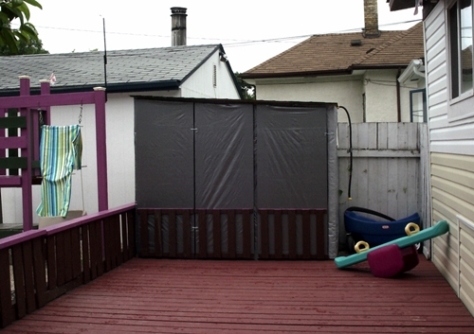
The upper deck existed before my childcare home opened. It separated the South facing backyard from the East facing side yard. The side yard was the dog’s yard and the vast space under the upper deck was her dog house. The play space in the back yard consisted of a 300 sq ft gravel area with a play structure and a 360 sq ft ground level deck. The outdoor toys were stored in a tarp wrapped wooden frame shed built against the West fence.

There was no back wall on that little toy shed because it was positioned against the fence. It was about 15 years ago that we moved the toy shed so we could use that spot for our first garden – it was the only spot in our back yard that was not deck or gravel. We then attached the toy shed to the South side of the upper deck where the open back allowed us to extend the toy storage to the space under the deck (after we made the dog house smaller).

The tool/garden shed was located by the carport – South of the lower deck and East of the gravel area. When we decided we needed a bigger garden space, we took the tool shed apart and rebuilt it ON the rarely used lower deck and attached it to the front of the toy shed. We then put in a bigger garden where the tool shed had been.

This picture was taken many years ago on the upper deck;


The shelf and framed white panel on the right side is the back and top of the old toy shed. The higher redwood wall beyond it is the back of the tool shed. Not visible in the picture – back door of the house behind me, stairs down to the back yard on the right, and stairs down to the side yard on the left. Also not shown is the bike shed which is in the side yard attached to the North side of the upper deck.

We had created ‘Frankenshed’ – it had a very large foot print but inefficient storage. You could enter the bike shed from the side yard, then crawl under the upper deck, go through the toy shed and then go out the tool shed into the back yard. However, it wasn’t a convenient path – more like a labyrinth where there was the possibility you could be lost for long periods of time. Sometimes when the children asked for toys that were stored I would tell them I’d see if I could find them on the weekend. I was never sure how long it might take me to find the toy and get back out of Frankenshed.

The only good way to get from the back yard to the side/front yard was by going over the upper deck. Even the lawn mower, snow blower, bikes and lumber had to be taken this way. It was frustrating at times. When the children and I were out in the back I couldn’t see the front gate because the upper deck and Frankenshed blocked my view. Consequently we rarely played outside later in the day when there was the chance parents may arrive.

So, on my vacation we;
  • built a new tool shed in the side yard
  • sorted all the stored items from all the sheds
  • took apart the garden shed, toy shed, potty house and bike shed
  • removed half of the upper deck and one staircase and moved the other staircase
  • built a new toy shed and a new garden shed/potty house
  • disassembled, repaired and reassembled the garden wall
  • created a new ground level walkway

We worked outside for 10-12 hours each day of my two week vacation. It was wonderful! Now I want to spend even more time outside in the yard. Some of the changes are actually quite subtle but almost every part of the yard has changed at least a little bit so I’ll include before and after pictures for each corner of the back yard.

NW yard in 2018
 
NW yard in 2019
 
The old potty house – by the water barrel in the back of the garden – was used only for potty training toddlers who couldn’t make it inside quick enough. Now that area is our new convenient toy storage shed.

SW yard in 2018
 
SW yard in 2019
 
Picture angle is slightly different due to the movement of the stairs so the entrance to the back yard is now six feet farther East. Many of the stumps, stepping stones and tables have been moved too.

SE yard in 2018
 
SE yard in 2019
 
Again, stepping stones, stumps and table moved. Added rope swings and removed sensory bins – the bins now have a spot in the gravel area with the toys instead of being in the active play area.

Construction area & kitchen
 
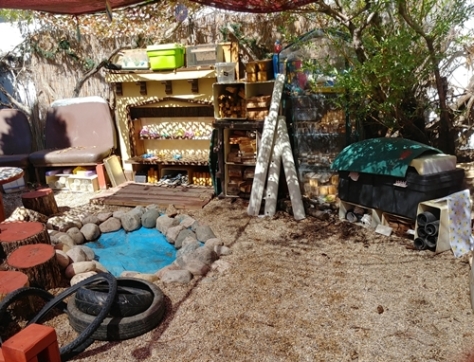
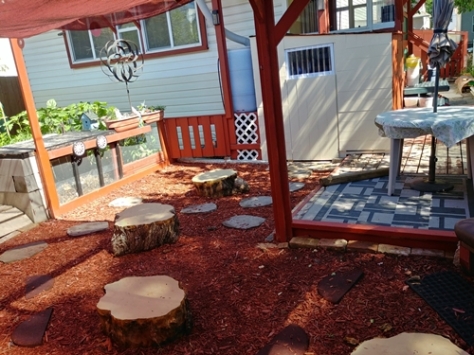
The pond was moved to make room for a larger loose parts/construction area. In the old fireplace mantle we added shelves for storage of dishes & pots which never had a dedicated space before. There is also a counter which can be used for ‘cooking’ but can also hold the sensory bins when we want to use them.

NE yard in 2018
 
NE yard in 2019
 
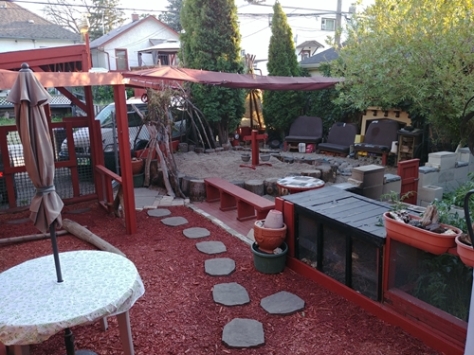
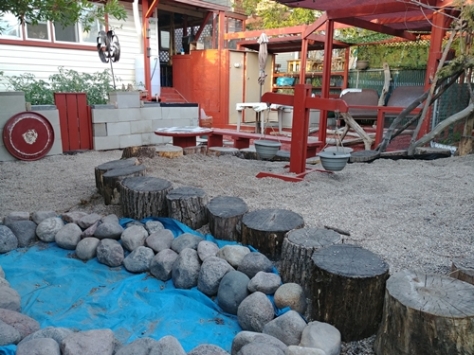
Here is where you see the biggest difference. The cinder block garden wall was originally built on the wooden cribbing for the gravel area. The wood was deteriorating and sections of the wall were tilting in different directions. The wooden cribbing was replaced with an additional row of cinder blocks. I doubled the size of the awning so we have twice as much shade. The ‘pond’, rocks, table, stumps etc were rearranged to create a larger construction area and make room for the sensory bin area (not visible in this picture).

The stairs and a portion of Frankenshed were visible in the 2018 photo but in the 2019 photo there is only the smaller garden shed/potty house. This new little shed was built entirely from wood salvaged from the old shed and deck. The potty shed half is large enough for diaper changing and also has running water.

This next picture shows my view from the bench by the carport – on the East side of the garden shed I can now see all the way through the side yard to the front gate! The ground level walkway (also built from recycled deck boards) has enough space for the art table which used to be on the upper deck and was not visible from the yard. There is a small gate beside the garden shed to prevent any of the littles from wandering into the side yard which is still not a play area.


That’s enough writing for now – I’m going outside to play…

Friday, March 29, 2019

Quiet Spaces

Throughout the past couple months I have observed the children using dress-up clothes and blankets to create ‘snow forts’ in the playroom. I recognized this repeated behaviour as an expression of interest in exploring the enveloping/enclosing schema and at first I assisted by simply providing some clothespins.
The children were still often frustrated because in our play room the best places to create ‘snow forts’ are also the walkways. Consequently the builders were always getting into disputes with the children who were trying to pass by to get to the other side of the room.
I had another idea. Recently I’ve been removing many of the items in the housekeeping area because the toddlers were leaving many things strewn about on the floor after searching for a particular item – there were too many toys. I took away a few more of the lesser used items, consolidated the remaining ones and then removed the empty shelves from two of the boxes that form the base of the loft. Then I added some pillow to these otherwise empty boxes.
These boxes proved to be popular places to curl up with a few small toys.
Of course I also knew that two hiding spots would never be enough so I rearranged the musical instruments and created two more spots under the keyboard shelf. These ones are even more popular – probably because the children can feel enclosed while still playing ‘with’ their friends.
Sometimes the children add curtains too
I’m considering adding ‘peek-a-boo’ holes in the board that divides these hideaways – it might make them even more interesting. Even after all the children have gone home, these spaces are still popular.

Friday, March 31, 2017

Waffle Blocks

There is not nearly enough space in the playroom for all the toys I own so the majority are stored in bins in the basement.  Puppets, blocks and animals are sorted into groupings of similar items so it is easier for me to select the ones I want to bring out when I rotate toys. I have a spreadsheet which helps me keep track of when toys are added to or removed from the playroom.
I usually manage to get every toy into the playroom for at least a few weeks each year – more often if the children have favourites or request a specific toy.  Occasionally there are toys that don’t get brought out because they are not developmentally appropriate or interesting for the children enrolled at the time.
Last month when I put the castle blocks and the puzzle people back into storage I brought out the stacking cups and Waffle Blocks instead.  One by one as the children arrived and entered the playroom I heard “Ooooh, what are those!?” or similar comments.  I was a little confused as these are old toys so I checked the spreadsheet again an realized that it had been more than two years since the last time the Waffle Blocks were out!
This group of preschoolers really enjoyed the Waffle Blocks – they played with them almost exclusively during the entire five week period of time these blocks were in the playroom.  I liked that there was a lot of cooperation and creativity when they played with these blocks.
In the past I’ve had some groups that found these blocks boring – making nothing more than a cube or two and maybe adding a roof.  Other children have had difficulty forming the  cubes ‘properly’ and easily became frustrated, constantly asking for assistance.  I’m not concerned about ‘proper’ cubes so I tend to let them figure it out.
It is somewhat difficult to make weapons out of Waffle blocks which may have forced this group to expand their interests a little more.  Also, because I don’t have a lot of these blocks, if they want to make something BIG they have to work together on one structure.  I’ve considered getting more Waffle blocks but then I watch the children problem solve ‘not enough blocks’ and think maybe less is better.
I was particularly impressed by the architecture involved in this  creation;
Waffle blocks have never been one of my personal favorite construction toys but I was definitely pleased with what this group of preschoolers managed to do with them.

Monday, October 17, 2016

The Train Debate

It has been just over three months since I last had the train tracks available in the block area.  There are several building sets that have not been our for over six months but the boys (there are no girls in my current group) had been begging for me to bring the trains out again.  I was hesitant because we have a new infant here now - babies are not usually very 'helpful' when it comes to building with train tracks but the boys were so insistent.

Last year I wrote about how wonderfully this group plays with the trains and tracks so I relented and brought the trains out again.  Even though all but one of these children were here last year, they are currently at different stages than they were before and the dynamics are much different.  Having the trains out now has been... interesting.

There is one boy who loves to sort and classify everything.  Now that the trains and tracks are available he arranges them all according to size and shape.  He creates groupings and lines the pieces up in straight lines.  He gets frustrated and very vocal when others come near or disrupt his methodology  in any way.

Another one just wants the train cars - ALL of them.  Upon entering the playroom he tries to pick up and hold all of train cars at once but that is impossible.  Instead, he makes a pile of train cars and sits on them.  If any other child has one or more train cars he will sit and whimper, complaining that they have 'his' trains.  If I suggest that maybe he should build a track for the trains he has, he will attach two track pieces together, pile his train cars on the track and then sit on them.

The third boy loves to create several small circular tracks.  He is an expert builder and can quickly select all the appropriate track pieces and assemble his tracks.  He excitedly shows everyone his accomplishment and then walks away.  When I remind him to put away his toys if he is finished with them he wails.  For each track section there is dramatic effort required to pick up and take it to the bin.  Each piece is so heavy that he couldn't possibly carry more than one and often he is unable to even stand so he must slither and drag himself to the bin while sobbing "I CAN'T DO IT...I caaannn'tttt"

The fourth boy is so concerned about and distracted by what everyone else is doing that he has difficulty settling into an activity.  He seems eager to play with trains, states his intentions and invites others to join him however it takes a very long time before he begins to play.  Often he hovers around the block area and complains about what the others are doing.  Once he does finally sit down and become engaged in the activity he can play cooperatively, it just takes so long to get there and there are so many disputes along the way that the others lose interest or we run out of time.

Boy five has little interest in building with the tracks but enjoys driving trains on the tracks that others have built.  He reenacts elaborate scenarios complete with narrative descriptions and sound effects but seems oblivious to the others playing around him.  He is fully engaged in independent play but will get very upset if others interrupt or 'bother' him.

Boy six likes to build complex track systems using as many of the track sections as possible.  He enjoys having the others watch him build but is easily frustrated if they attempt to assist - he has a plan.  He discusses his design plans with the others and explains how they will be able to use it once complete.  Occasionally he too plays with trains - briefly - but usually once finished building he loses interest and leaves the block are.  However, he cannot clean up because the others are still playing - they do love this massive track.  When finished playing the others will be overwhelmed by the prospect of putting away all those tracks - they would never have built anything that big. 

*Sigh*  By the end of the first week of train play I was ready to pack them up and put something different in the block area.  It is not that anyone is using the toys 'wrong' but that they are all using them differently.  It wouldn't be a problem if they would sometimes play with other toys but for the whole first week they all wanted to play with trains - only trains - together but not in agreement.  Essentially it was a week long argument.

I know that dealing with disputes is an important skill to learn but personally I'd prefer to avoid all confrontation.  It would be easier for me to put away the trains and say it is a consequence due to the incessant fighting.  It might be easier for me to create a chart and assign each child a specified time slot where they can each have an equal amount of uninterrupted independent play with trains. However it is probably better if I let them work it out themselves.  I can tell them what I see.  I can facilitate conversations and mediate physical disputes.  I just don't like to.

At the moment I really don't like trains either.  Yet, during train week two there were a few moments of hope.  I few fleeting periods when I thought maybe - just maybe they had figured it out.  We are now beginning train week three and the debate continues....


Tuesday, September 27, 2016

Hiking in the City

It has been just over a week since I returned home after Nature Summit 2016.  I'll admit that for the first few days I did seriously consider putting my tent up in the backyard because I really missed spending all day, every day outside.  Summit was fabulous as usual - I got to participate in many outdoor workshops.  I went for a ride on a zip line, climbed almost to the top of this;

16-09-hike0

And of course I did a lot of hiking through the woods.

I know I really enjoy a nature hike and so do the  children in my care.  I also know that, even in the city, there are many places where we can hike and feel like we are out in the wilderness.  However, a city hike can be pretty special too - especially to a group of boys who can tell me the name and purpose of almost every type of construction vehicle. :-)

My little group and I have spent the last few months exploring the the nearby neighbourhoods.  Our city hikes vary in length from just a few blocks to up to 8 km.  They can take anywhere from a half hour to several hours and it is rarely the children that suggest we've been walking too long and it is time to go back.  Pretty amazing when you consider that these are 2 and 3 year olds.

So, what do we see when we go on an 8km city hike?  Back hoes, buses, dump trucks and trains.  Cement trucks, front loaders, street cleaners and cranes.  Yes, there is a lot of noisy traffic but there are also many quiet spots too.  In fact, one of our favourite paths takes us through the cemetery.

16-09-hike00

We look for birds - the children know where all the nest boxes are located (there is a nest box in the above picture but it is hard to see).  We listen to the wind in the trees and watch the river in the distance.  Inevitably the river sparks the topic of bridges - which one will we cross today?  Within walking distance of the cemetery there are FIVE bridges we can go over, and THREE that we can go under.

There are several more bridges we can explore if we pack a lunch and make it a day long hike but that tends to be too much even for this active little group.  Once this past summer we did make it to two distant bridges but the children were obviously tired and there was not much excitement.  Besides, when we stick to the familiar, nearby areas there is a whole more to our hikes than just walking.

In some cases we can cross one bridge and examine the structure of another bridge at the same time.

16-09-hike01

There are bridges for people, bikes, cars and trains. Only some of our bridges cross over water.  Others cross over roads or train tracks and give us a whole lot more to talk about.  The children often complained that there were never any trains on these tracks when we crossed over them - but twice this summer there was a train here!  So of course we had to stop for a while to watch.

16-09-hike02

One time the train was moving so very slowly that we were able to continue our walk, loop around and walk under the same train we had just been standing over.

16-09-hike03

Standing under a train bridge while a train slowly squeaked and creaked, clanged and banged overhead was a new experience.  Trains on bridges sound much different that cars on bridges. The children also enjoyed yelling 'ECHO!' as they do every time we venture under bridges.

We don't spend all our time on noisy city streets.  For contrast we also explore parks and riverbanks along the way.  We get to hear and smell the difference between the roadway and the forest.  On this particular hike the 'big' boys were with us and the 'littles' enjoyed showing them all our favourite spots.

16-09-hike04

Just as we use the bridges to compare the traffic and trains from above and below we can also do the same with the river.  Standing on the bridge we watch the water flow, count geese and ducks, and watch sticks and other debris float by but there is the noise of the traffic crossing the bridge too.
It is amazing how just a few steps away from a busy road can feel like a totally different world.  What can you hear now?  Our river bank trails offer another perspective of the water.  We can get closer to the water - but not too close, this is not a swimming river.

16-09-hike05

There is a tree they want to climb.  Normally I'd say yes to a tree climbing adventure but a quick risk assessment resulted in a 'No' to climbing on this tree;

16-09-hike06

Yes, I love a good nature hike but a city hike offers something special too.  We could read books or watch videos and memorize facts about cars and trucks, trees and birds, rivers and roads or we can go for a city hike, experience it, and begin to understand the impact we have on the natural environment.

Tuesday, February 2, 2016

A Compilation

Every once in a while I find I have collected a few photos from activities that don't become a blog post on their own but I'd still like to share them.  These are a few from the past month;

This was the result of nearly an hour of independent play after we got past the 'There's nobody else here to play with me' stage;

16-02-misc01

Here is a picture of a cooperative game these two enjoyed;

16-02-misc02

I thought this was a pretty amazing tower built by a three-year-old;

16-02-misc03.JPG

And this two-year-old sorted these blocks like this several times, every day for more than a week!

16-02-misc04

Finally, this was something I made to use some extra acorn squash.  It was definitely not my favourite squash dish but it had the preschoolers clamoring for more.


16-02-misc05
  • 3 cups acorn squash, cubed
  • 1/2 cup applesauce
  • 1/2 cup raisins
  • 1/4 cup honey
  • 1 Tbsp margarine, melted
  • 2 tsp lemon juice
  • 1/4 tsp cinnamon
Mix all ingredients together and place in a greased baking dish. Bake, covered, in preheated 375 F (190 C) oven for 30 minutes; uncover and bake for another 20 minutes or until squash is tender.

Thursday, November 5, 2015

Train Tracks

I have several types of construction toys which are never all out because there is not enough space and too many toys is overwhelming.  The various construction sets are placed in the block area bins as one complete set or a combination of two or more partial sets.  Selecting the set(s) to have available is dependent on the interests and ages of the children enrolled at the time.

The train tracks are one of the construction sets that sometimes cause issues in a mixed age group.  Some children enjoy building large elaborate track systems but this requires cooperation if there are several children involved.  When infants and toddlers are present this is not always possible and many young children find building with the train tracks to be frustrating.

My current group of infants and toddlers may be the exception.  The train tracks have been available in the block area for almost three months now and the children are showing no signs of getting tired of playing with them.  I have changed the other items in the block bins several times since the tracks were introduced – now we have the stacking cups – but the train tracks remain.


At first the toddlers were mostly just interested in the trains and rarely attempted to use tracks.  Those that did use tracks were content to just put a few pieces of track together and drive a train back and forth on it.  Then one day they wanted to make a circle so we learned that eight small curves make a small circle;


And eight large curves make a larger circle;

 15-11-tracks02 

Curve, turn, flip, and direction were some of the words we used often during the process. For a couple weeks they were content with these two designs and became experts at building them without assistance. Then I suggested we change things a bit and use both types of curves – four small and four large – still eight pieces but arranged in pairs first.

 15-11-tracks03 

 Words used for this one were ‘pair, sides, ends and oval.  Then a new word – alternate – and with that we created this;

 15-11-tracks04 

By this point several of the toddlers had become expert builders able to connect several shapes together and create their own shapes.  My role was mostly just observing and introducing some new words like ‘elongate’;


 and ‘spiral’ when they created this;


With this group of toddlers the train tracks may be out for a while yet – they are still showing no signs of getting tired of building train tracks.  In fact, the two year old was super excited to build and name this ‘heart’ all by himself.

15-11-tracks07 

We love train tracks.

Sunday, April 12, 2015

Outdoor Activities

Spring is here and I’m finding it difficult to stay indoors.  Still, there is a lot of indoor work to do so sometimes I have to.  Luckily the children and I have been able to spend several hours outdoors each day.  Instead of spending too much time sitting here writing I’ll just post a few pictures and a brief description of some of their recent activities.

One day during spring break the children built ‘bridges’ all around the gravel area.  This activity was initiated by one of the children but all of the others joined in.  Everyone used the bridges/walkways.  Everyone helped create and modify the paths as needed.  There was no bickering, grabbing/pushing, or screeching ‘MINE!’ when pieces were rearranged.

15-04-bridge01 

The cooperation was amazing :-)

15-04-bridge02 

Last week there was another magical cooperative activity.  The three-year-old built a ‘fire’ and roasted ‘marshmallows';

15-04-marsh01 

She then shared them with her friends who were eager to accept her invitation to join the camp out;

15-04-marsh02 

On Friday we went for a super long walk up and down every street in the neighbourhood.  These toddlers are becoming expert hikers!  They are also very observant.  These one and two year olds were easily able to spot the woodpecker when they heard the sound.  The bird was barely visible so high up in the tree that my phone camera on maximum zoom could not capture it.  Still the toddlers focused on it and stood silently for over five minutes watching the busy bird.

15-04-walk01 

They also got excited about a ‘spaceship’ – this one took me longer to locate and not all the toddlers could see it but at least one was really thrilled about it;

15-04-walk02 

Love the imagination.