Showing posts with label Quality. Show all posts

Monday, September 18, 2023

I've Been Thinking...


If I had to choose the one thing that bothered me the most about being a funded, licensed family childcare provider it would be the difference in daily childcare fees for infants vs preschoolers. As a trained ECE II those rates, set by the province, are $30/day for infants (under two years old) and $20.80/day for preschool children (aged 2-5 including those in Kindergarten).

These rates are the same for me as they are in funded centres and I understand the reasoning for the different rates in centres due to the different staff to child ratios for infant rooms (1 to 4) and preschool rooms (1 to 8). However, in family childcare I can have a maximum of five children under six years old of which no more than three can be under two years old.

That means I could have three infants and two preschoolers, or five preschoolers and no infants, or any of the combinations in between. It also means my income from daily fees could be as much as $131.60 per day or as little as $104 per day. That min/max difference in daily fees results in a difference of nearly $600/month without any difference in the number of children I enroll or the hours/amount of work I do. I wrote about this 10 years ago – it is not a new problem – but it is still a problem,

If your employer asked you if you would prefer to be paid $2100 or $2700 for the same number of hours work, what would you say? Silly question. Yet, in order for me to keep my income at its maximum, I could not keep all the infants I enroll. If both of my preschoolers are two years old, they may stay in my preschool spaces for up to four years meaning, in that period, my infants would have no preschool spaces to move into if I was to keep only infants in my infant spaces.

Now, multiply my three infant spaces by the four years it could take for my preschoolers to vacate their spaces and that means I may have to dismiss twelve families for no reason other than that their child had a birthday. Those families that may have waited nearly two years from conception until I had a space for their one year old, would now need to start their childcare search again. Some providers even state in their policies that childcare may be terminated when an infant turns two if a preschool space is not available.

I don’t do that – I choose to provide continuity of care because it benefits the child but that decision means I take a pay cut in order to provide what is considered a ‘best practice’. Luckily, not all the infants I enroll stay until they start school but I have gone as long as three years with the same group of children – all over the age of two – at a significant loss of income but some truly amazing long term relationships for all of us.

Still, I question why it has to be this way – especially now that parents pay $10/per day for either infants or preschoolers in any funded childcare facility – centre or home, trained or untrained – flat rate for parents. I used to get confused looks from parents when I told them they owed me less for childcare when their child turned two. Now they don’t even realize I took a pay cut in order to continue providing childcare for them – notably when my expenses for said care are increasing along with the child’s age.

Yes, the Province has been providing a parent fee top-up grant to funded facilities to offset the reduced rate for parents but to date this has been yet another administrative nightmare. I don’t want to rant about that right now but it has made me think that this is actually the perfect way to rectify the inconsistent income for family childcare providers.

If, in family childcare, the top-up grant for both infants and preschoolers was the same amount along with the consistent $10/day rate for parents then it would make budgeting so much easier. Having the same income for all children under six years would eliminate the income fluctuation and provide more stability for providers – a factor which may aid in the retention of family childcare providers.

The $10/day parent fee eliminates the difference between infant and preschool rates for parents. The operating grant rates are different for centres vs homes apparently due to variances in operating expenses. I believe a different rate for the FCC parent fee top-up grant could be possible too since, unlike centres, FCC staff to child ratio is not dependent on our enrollment of infants vs preschoolers.

Alternatively, our parent fee top-up grant could simply be based on the number of infants/preschoolers we are licensed for regardless of the age of the children we currently have enrolled in those spaces (providing they were not vacant spaces). That way our daily fee rate does not have to be different than centre rates but our income would also not fluctuate when our work load does not.

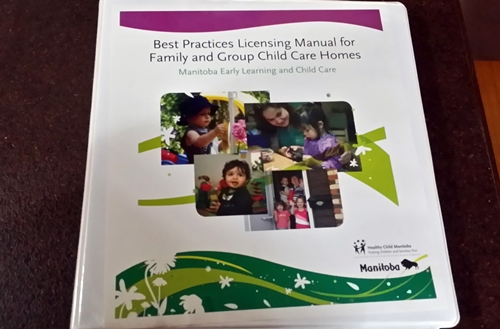
The Early Learning and Childcare Best Practices Manual for Family Childcare acknowledges that it is a benefit for the child to stay in the same setting with the same provider. Why then, do they set rates that discourage, even punish us, for choosing to build these relationships?

Thursday, February 3, 2022

Photographs


In my childcare home I have always used photos to document our activities. I have created posters and booklets covering all the steps of big projects. Sometimes the photos are part of the activity – like this one. I have used photos in slideshows for workshops, presentations and on a digital display in the front entrance. As a good bye gift I provide each child with a photo album containing pictures arranged chronologically throughout the entire time they have attended.

Some of my oldest childcare photos were taken with a camera that required film and needed to be taken in to a photo lab to be developed. I’d have to order reprints to put in family albums and scan photos if I needed a digital copy. Taking and using photos became so much easier when I got a digital camera but even then there were occasions when the camera batteries died while we were on an outing and no more pictures could be taken until we go back and replaced them.

The number of photos I took increased dramatically when I got a rechargeable digital camera. So much so that I had to create a separate folder for unsorted photos and dedicate time on weekends to go through the week’s photos and file them according to activity like ‘sensory play’, ‘gross motor’, ‘art’, ‘constructive’, etc so it was easier to find specific photos when I needed them. My ‘Daycare Photos’ directory currently has nearly 10,000 photos in 20 folders with many sub-folders too.

When I got my first smartphone I stopped bringing my digital camera on everyday outings. It seemed like it would be easier to just use the camera on my phone instead. I was wrong. Taking photos with my phone was a slow process which at first I attributed to me learning a new skill. However, many years have passed and I’ve had several different phones and I still find it to be a slow process.

At first, I don’t think I noticed the decline in the number of photos I was taking. Actually, maybe I wasn’t taking fewer pictures, but I was definitely deleting more photos than I was saving. The quality of my phone photos was so much worse than the photos my little digital camera could take quickly.

Sure, my phone cameras were capable of taking good photos but only if I was willing to spend the time adjusting settings and planning each shot. However, most of the photos I take are very spontaneous and even the time required to load the camera app would be too long so I’d be left muttering ‘It would have been nice to have a photo of that’ *sigh*

My little point and shoot camera was so much more convenient to use. I kept the wrist strap on so the camera was always handy. The camera fit easily in my hand and one finger could reach all the controls. I never needed two hands to take photos so there was no need to put down the baby or whatever else I was carrying. This was extremely important since I rarely take photos when the children ‘pose’.

Most of my photos are pictures of the children in action. Either they are moving or I am moving or both. All my phone cameras have been way too slow to take decent action photos. Even if I have the camera app loaded and I am standing still, holding the phone with two hands the moving child will usually be just a blur if I even manage to keep them in the frame.

I suppose I could record videos with my phone and then select photos from the videos but that seems like a lot of extra work for which I have no time. My little camera allowed me to take photos while the children, not the camera controls, were my main focus. Honestly, the children’s focus is an issue too – many of them are obsessed with phones and will instantly stop what they are doing if they see a phone in my hand, so my phone is rarely handy for photos.

Recently I’ve noticed that the good-bye albums I’ve given to departing children were lacking. It has been surprisingly difficult to find enough photos to put in a 50 or 100 page album – even when children had been here for several years. When I was using my old camera I used to have to be selective and only choose the best photos of our favourite activities to include in albums – no way I’d have room to include all the photos.

The last few albums have had another noticeable issue too – the vast majority of the photos are of the children sitting at the table. Doing art, playing with small table toys, working on a puzzle, or eating food. These things are only a very small portion of our activities but comprise the majority of the photos. I believe it is due to the fact that when the children are seated at the table, my phone is handy on my nearby desk. It is the only time it is convenient for me to take photos with my phone.

Yes, there are some photos of the children in the playroom and of course more of the children outdoors. Yet, one thing that really upsetting for me is that there are almost no winter photos. We play outside every day – even in the winter – but I counted less than 30 pictures of the children in the snow in the last three years! As difficult and annoying as it is for me to use my phone to take photos in optimum conditions, the issues are magnified in the winter so usually I don’t even bother trying.

Last month I was so frustrated by the lack of new photos to add to the front entrance slideshow that I dug out my old camera and charged. I’ve even taking it outside when we were playing in the snow. It still hasn’t become a habit to have it handy but I have definitely take more photos lately – and generally the photo subject quality has been better too. Though, many of the children look somewhat confused as they do not recognize that object in my hand.


Wednesday, August 2, 2017

My Dream

In Manitoba a licensed family childcare provider can care for a maximum of eight children under 12 years of age.  Of those eight children, no more than five may be under six – the other three must be in grade one or older.  I love having a mixed age group and the opportunity to build a relationship with the children in my care from infancy through school-age.
Over the twenty years I have been providing childcare in my home I have known many amazing school-age children who have thrived in this setting.  Some struggled with peer relationships in their school environment but enjoyed being the ‘leader’ here – idolized by the younger children.  Some embraced responsibility and enjoyed helping the little ones.  Some were wildly creative and independent and of course there were also some who resented being with ‘babies’.
I’ve watched older children gain confidence and build their self-esteem by mentoring the younger children.  I’ve seen younger children develop skills they learned from watching and copying the older children play. I’ve also had some older children that taught the little ones things/words that I wish they hadn’t. *sigh*
I’ve noticed something else – the cost of providing food, craft supplies, activities and equipment for school-age children often exceeds the income I receive for their care.  I find that the school schedule is disruptive – breaking up what could be longer periods of engagement in learning activities for the preschoolers.  So, for several years now I haven’t made an effort to fill empty school-age spaces.
Summer was the exception.  I loved having all the ‘big kids’ here for the summer – working in the garden, going on adventures, making incredible creations, sharing fantastic stories – without the rigid school schedule.  It was wonderful to have all this time with the older children instead of just the fleeting moments before/after school when everything was so hectic and there wasn’t really any time to do anything.
Yet, when I only enrolled school-age children for the summer I was finding that the first month was spent getting everyone acquainted with each other, learning routines etc. Then, just when we were starting to develop relationships, summer was over and they were gone. The ‘freedom’ of summer wasn’t quite the same with ‘new’ school-age children instead of ones we already knew.  So, for the first time ever – I didn’t fill any of my school-age spaces  this summer – and I’m loving it.
The school-age table has been empty;
17-08-SA01
The little ones are engaging in more age-appropriate dramatic play.  They are demonstrating their creativity instead of copying someone else. I haven’t heard ‘I’m bored’ once this summer, nor have I had to spend hours shopping for tons of additional food and supplies.
I’ve also been imagining what the little ones and I could do with that extra space I have set aside for bigger children and all the supplies they need but the little ones don’t.  I’ve started to think that it would be really, really nice if the province would let me exchange those three empty school-age spaces for one more preschool space.
Group childcare homes have two licensed providers and up to 12 infant/preschool children – that’s a 1:6 ratio.  I have five preschool spaces and although three of those five could be infants I rarely have more than one or two – sometimes even none. If they stay with me until they start school each one year of infant care will need four years of preschool care.  Hence, I’d have to kick out preschoolers if I wanted to keep those infant spaces full - I would never do that.  One more preschool space would help.
Big dream – I know.

Wednesday, November 2, 2016

The 'Un' Factor

 'Un' is a prefix meaning “not,” freely used as an English formative, giving negative or opposite force in adjectives and their derivative adverbs and nouns.  In the field of family childcare we often use the words 'unlicensed', 'unregulated', 'untrained' yet for many government officials and people outside the field of childcare those 'un' words are not viewed as negative - simply a choice that parents should be allowed to make regarding the care of their children.

There are regulations governing the manufacturing of items like cribs, strollers, carseats, and toys etc so parents know they are safe.  There are regulations regarding the production, packaging, and labeling of food products to ensure they meet predetermined standards so people know what they are buying. Why do government officials and the general public think that parents should be able to choose unlicensed, untrained childcare but need regulations to assist them to safely feed, house, and transport their own children?

What other career field allows some businesses to operate unlicensed and/or untrained when others providing the same service are licensed?  What is the incentive for any business to be licensed if they can legally operate without any oversight?  Without any licensing/training requirements?  What if, like in childcare, they could actually make more money if they were not licensed/trained than if they were licensed/trained?

Let's use truck drivers as an example.  The majority of adults have a class 5 driver's license and have experience driving their own or a friend's vehicle.  What if there were no restrictions on what size of vehicle you could drive and anyone could just decide "Hey, I'm going to buy a big truck and start a business delivering things for other people."

 Why, is an experienced driver with their own vehicle not allowed to start up a trucking business without additional training or license? Why don't people argue "It's his truck, he can do what he wants with it.  If other people are OK with letting him transport their stuff why not let him/them.  He's never had an accident and doesn't need a little piece of paper to prove he's a good driver."

What if that same driver or another class 5 driver then decided "A bus isn't much different than a big truck.  If I had a bus I could earn money driving people around."  What if you'd seen that driver on the street with his bus full of happy passengers and decided to take a ride on his bus.  Then imagine that one day there was an issue - something was wrong with the bus or the driver.  What if it is too late to get off the bus before the accident happened?

Some argue that licensing all childcare facilities and requiring training for all childcare workers doesn't ensure quality - but it helps.  Just like trained bus/truck drivers in licensed companies will still have accidents there are standards and checks in place to limit them.  Why don't we hear arguments that training/licensing truck drivers doesn't prevent accidents so let's save some money and not bother requiring them to be licensed?

Do we need more incentives for family childcare providers to become licensed or do we need to eliminated the option for them to operate unlicensed childcare homes?  Currently only licensed providers can accept government subsidized families but private paying families usually pay higher rates than the maximum subsidized rate so that isn't an incentive to be licensed.

What about training?  Currently family childcare providers with Early Childhood Educator II/III training can receive slightly higher subsidized rates than untrained providers but those rates are still lower than the private rates most unlicensed/untrained providers charge so why bother?  Just think of all the tax dollars we could save if we had trained and untrained police officers  - both had the same duties but the city could pay the untrained ones less - but either trained or untrained officers could go work privately for more money without a gun permit or any other type of license.

In an effort to increase the number of licensed childcare spaces, the provincial government is considering lessening the requirements and 'red tape' needed to open licensed childcare homes.  Why, when there was a shortage of family doctors was it never suggested that we lower the requirements to become a doctor?  I don't think lowering FCC licensing requirements will increase the number of licensed childcare spaces and I'm absolutely positive it won't improve quality.

What part of licensing do they think is unnecessary?   Criminal record/child abuse registry checks? First aid training or a 40 hour course? Behaviour management, nutrition, safety and supervision policies? Adequate equipment? Developmentally appropriate activities? Documentation and record keeping?

I don't think any part of the licensing process is difficult or unnecessary.  If fact, I'd like to see more.  I'd like to see MANDATORY licensing for ALL childcare homes.  Greater incentives for trained providers (possibly higher ratios).  MANDATORY annual professional development and more.  I'm thinking about the best interests of the children, not just convenience and the cost for quality and safety.


licensing-manual