Showing posts with label fighting games. Show all posts

Monday, April 25, 2016

Rough & Tumble

Many parents and childcare providers are uncomfortable allowing children to engage in rough and tumble play or ‘fighting games’ for fear that someone may get hurt.  However, the problem isn’t the type of play but the ‘environment’ – both physical and emotional – in which that play takes place.

I firmly believe that rough and tumble play is very beneficial but in my program I do enforce some basic guidelines.  The first ‘rule’ involves location.  ALL play involving chasing, wrestling, jumping etc is discouraged when we are indoors.  Our main indoor play space is just 150 sq ft and when you add toys, shelving and up to eight children there is simply not enough room – the risks are greater than the reward.

That changes when we get outside.  Although my yard is not a large open space I did design it for gross motor play. There are still some rules like ‘If someone is in front of you, you have to slow down/stop’.  There are many obstacles and the walkways are narrow so when two or more children are trying to maneuver through the same space pushing someone out of your way  is not allowed.

One of the greatest benefits of chasing games and rough and tumble play is that they require/teach awareness and self control.  If you are unable to avoid colliding with another person it is not ‘an accident’.  The problem is NOT that ‘they got in your way’ or ‘they were too slow’- it IS because you were not watching where you were going or you were going too fast for the conditions.

The consequence for knocking someone down isn’t yelling ‘Sorry’ over your shoulder as you continue running away.  The consequence is that you need to stop, help them up and make sure they are OK before you continue playing.  If that is not something you are willing to do then you are not ‘playing’ you are being mean.  If you got hurt too then getting angry and blaming the others isn’t the solution – you need to be more observant, adjust your speed, or find another game to play.

Another ‘rule’ I have is that we only use imaginary weapons.  Now, this is not because I’m totally against weapon play with toy weapons but I have concerns about using toys as weapons in a mixed age group setting.  Yes, I have seen a group of older children involved in a wonderfully cooperative and respectful fighting game using toy weapons.  I have also spent hours/weeks/months teaching toddlers that hitting hurts.  The children and I have many conversations about how super heroes ‘help’ others.

Certainly most school age children can visualize an imaginary scenario, understand the difference between soft and hard objects, regulate the amount of force they use and aim appropriately but the  toddlers are not developmentally equipped to do all this.  The little ones watch, they see hitting and laughter but they don’t understand all the concepts involved and someone will get hurt. So, the imaginary weapons allow the older children to play their game without encouraging the little ones to hit with toys.

The third and most important ‘rule’ is that ALL the children involved in any type of rough and tumble play or fighting game must be willing participants.  This includes ‘shooting’ non-players even with imaginary weapons – in fact, I usually say ‘no people as targets’.  Each player must agree to their role in the game.  If at any point someone says ‘STOP!’ – even if they are laughing – the activity must stop.  If someone cries or gets upset then the game play stops until the problem is resolved.  Stop always means stop or the game is not respectful.

If someone wants to play and agrees to the game rules the others may NOT exclude them. If someone doesn’t want to play there has to be some type of mutual time/space agreement so  multiple activities don’t interfere with each other.  If someone says they want to play but cannot/will not follow the group’s game rules then that person may have to find another activity.

Creating game rules is an important part of the activity and all the children who want to play must be able to participate in this process before play begins.  When only one child is in charge of  creating the game, assigning roles, making the rules, and determining the ‘winner’ then it is not a cooperative game.  This ‘do as I say’ type of activity often enables bullying behaviour and allows the ‘leader’ to change game play in order to control outcome.

One wonderful example of a cooperative rough and tumble game was ‘Fight Club’.  The group of children who created and engaged in this activity were all between five and eleven years old.  They set boundaries for play area.  They chose opponents or teams based on physical abilities and size. They set rules for entering and exiting the game including the option to tag in/out when you got tired. They only played this game outside when there were no little children present. This particular group engaged in this activity on/off for more than a year and never needed me to intervene.  It was perfect.  And it never would have happened if there were no fighting games allowed.
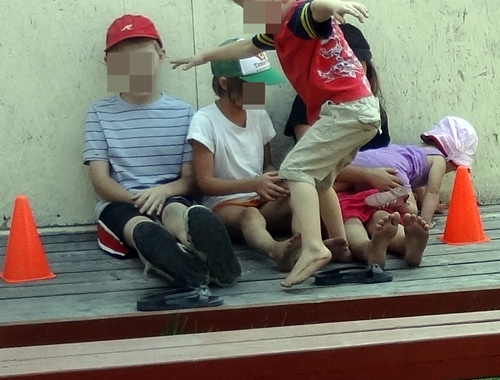
16-04-roughNtumble

Friday, October 28, 2011

Good Vs. Evil

Weapon play and fighting games – allowed or forbidden – that is a controversial question.  It doesn’t have and easy answer.  I don’t encourage the use weapons and I don’t have toy guns or swords available in the playroom.  However, that doesn’t necessarily mean I won’t let the children pretend to use guns and swords.  Confused?

This confusion is due to the difficulty in defining the ‘fighting’ aspect of the children’s games.  So, I’m going to try to provide an explanation of my views on the subject. First, let me discuss weapons.  What is a weapon? According to the legal dictionary at Duhaime.org  a weapon is “An instrument of combat; something to fight with – used or designed to injure or kill”.  So then, consider these scenarios – all actual dramatic play activities that I have observed the children engage in;
  1.  The princess and her friends have been captured by the evil witch.  They are trapped in a dungeon and tied up with imaginary ropes and chains.  The Knight arrives and to rescue them uses his imaginary sword to cut them free.  The princess creates a magic potion and the group chases down the witch who begs for mercy and promises to be good.  The group ignores her pleas claiming ‘You are evil and that will never change’ and they use the potion to destroy her.
  2. The ‘Family’ is at home. The mother is putting her children to bed.  She covers them gently with blankets and reads them a story and then goes to do some housework.  The father is busy using tools to repair the home. A ‘cat’ crawls into the area where the children are sleeping.  The children start to panic, crying for their mother to come and save them.  The mother rushes over and pretends to spray the cat with the soap. The cat is upset and says ‘But I am a good cat and I want to play with you’.  ‘Too bad, you don’t belong here and you have to stay out.’ the mother says.  The father uses a hammer to threaten the cat and chases it away.
  3. The hunters are hiking through the forest.  They use binoculars to spy their imaginary prey.  Slowly they move forward to sneak up on the bear/dragon/dinosaur.  They work together whispering and using gestures to coordinate their movements and corner the beast — then they kill it with their imaginary weapon.  Sometimes the beast gets one of them first and the game play changes as one hunter gets his injured friend to safety.
  4. Two spacemen are engaged in combat – they narrate their actions so the other knows how to interpret the actions.  They are on opposite sides of the room – several other children are present but involved in other unrelated activities.  One spaceman holds his arms out with his palms open toward the other and says “I am forcing you with my power”.  The other responds “I put up my shields and the beam bounces back at you”.   The first one replies “I’m hit”, he falls slowly to the ground – careful to avoid the nearby structure being created in the block area. He then pulls a crystal from his pocket and uses it to restore his ship’s power and the battle continues.
So, which ones are fighting games?  Which ones may require me to become involved?  I’ll tell you what I see;
  1. The princess was in danger and the knight used the sword as a tool, not a weapon.  The princess’ potion is not necessarily considered a weapon but in this case it is used as one.  I would not ban this type of play however, I would use this opportunity to discuss whether the ‘person’ was bad or their ‘action’ was.  In my opinion this princess was just as evil as the witch.  Retaliation is not a good solution to solving disputes.
  2. This is the worst type of fighting game and I will be putting a stop to it immediately.  The children involved here will vehemently deny that they are using any weapons – but they are.  So should I ban the workshop tools and cleaning supplies?  They will deny that they are being mean and excluding the cat – they will have excuses such as ‘allergies’.  Even if they agree to let him play they will continue to be bullies only more subtle and they will watch me just as closely as I am watching them. In fact, they will probably stop playing this game all together because I ruined it.
  3. I love this game.  The cooperation and camaraderie must be commended and encouraged.  Yes, there are weapons and violence involved but it is not the main focus and there are no ‘people as targets’ – which is something that I discourage.  If I did intervene here it would simply be to clarify their reason for killing.  Food? Survival?
  4. OK, this one is in a ‘grey’ area.  They are using people as targets but the players in this game are in total agreement.  They are being respectful of everyone and everything around them.  There is no actual physical contact – most of the play is through conversation.  The younger children in the room are not trying to join in or mimic the older ones – in fact, most of them are unaware that this is actually a fighting game.  Those that do may come to me and ‘tattle’ which will give us the opportunity to have a discussion about what we are observing as the game continues.  This is a teachable moment.
Basically, it all comes down to respect. If the children are being respectful of the space and other people — involved in the game or not, I will not redirect the activity even if it is a fighting game and they are using weapons. Some may agree with me, others may not.  Like I said at the beginning, it’s controversial.