The first post in this series was 'Motivation', the second was 'Centre or Home'.
For this third installment I want to focus strictly on the financial
side of home based childcare - the income. Home based childcare incomes
can vary greatly dependent on your neighbourhood, the ages of your own
children and the children in your care and the type of program you
offer. First let me define the types of home based childcare:
Family Child Care
- located in the providers home - may have a maximum of eight children,
of whom no more than five can be under the age of six, and no more than
three may be less than two years of age. The child care provider's own
children are included in these maximum numbers. All FCC homes must be
licensed and inspected but they have the option of being funded or
unfunded - more on that later.
Private Home Day Care
- is also located in the caregivers home but is not licensed or
inspected. They may offer care for a maximum of four children under the
age of 12, with no more than two children under two years of age
including the caregivers own children. If there are more than four
children in the home at any time the home must be licensed. Unlicensed
homes are never able to receive any type of funding from the Province.
Group Child Care Home
- A group child care home is run by 'two' licensed providers in one of
their homes. A licensed group child care home can accommodate as many as
12 children under the age of 12, of whom no more than three may be less
than two years of age. These homes also have the option to be funded or
unfunded.
Now let me talk a little about income.
Unlicensed/private
home day care providers are free to set their own childcare rates -
they can choose to charge hourly, daily, weekly or monthly. They can
offer discounts to parents with more children. They do not have to
charge all parents the same rates and 100% of their income comes
directly from the parents using their services. They can be trained or
untrained. They have absolutely no regulations regarding their childcare
space, equipment, hours, or programming.
Licensed providers who operate funded
programs receive an annual operating grant to supplement their income. A
funded provider may not charge any parent - subsidized or not - more
than the maximum, government set, daily childcare rates. Set rates for
trained providers are slightly higher than those for providers without
their ECE II/III classification.
These maximum daily rates have
only increased by about $2/day in the past 20 years. The rate that
parents pay for before/after school care is only eighty cents per day
higher than it was when I first opened my childcare home in 1997. These
daily childcare fees are kept low to ensure that childcare is
affordable for low/middle income parents. Funded providers receive wage
increases primarily through increases to operating grants. Current grant
amounts work out to about $2/day for school-age children up to $6/day
for infants.
Licensed providers - either family or group - may
also choose to be unfunded and then - like private providers - they are
also able to set their own childcare rates. Unfunded licensed providers
may accept subsidized families but the maximum subsidy payment is
usually far less than what the provider's regular rates are. The
provider may require subsidized families to cover the additional costs
but it is unlikely that the families could afford to.
It is rare
for a licensed provider in a higher income neighbourhood to choose to be
funded. Many of them can charge rates that are double or even triple
the amount of the subsidized fees and operating grants combined. Even
unlicensed/private home providers can often charge rates that are
considerably higher than the combination of parent fees and operating
grant that a licensed, funded childcare provider earns. In some upscale
areas the rates can be $80/day for care for preschool children or
$25/day for before/after school care and due to the demand for childcare
services these providers are still able to fill their spaces.
This
is not the case in lower income areas where many families are partially
or fully subsidized. Single parents, students, those you work various
shifts, don't have reliable transportation etc will all have fewer
childcare choices available. Even in middle class neighbourhoods some
families 'temporarily' place their children in childcare homes with
higher rates - just until they find something more affordable.
Funded
childcare centres are considered 'Not for Profit' but all home
childcare providers are considered self employed and therefore 'for
profit'. Many home providers feel that funded homes should also have the
'not for profit' status because we have no control over our childcare
rates. Most of us have chosen to operate a funded home because we feel
affordable childcare is an essential service.
I've heard it said
that family childcare providers have options to increase their income
but I don't believe that should include limiting access to quality
childcare to only those who can afford it. This post is long enough
already so in my next post I'll discuss the expenses related to
home-based childcare and some of the things home providers can control.

Adventures in Family Childcare
Thursday, December 31, 2015

Thursday, December 17, 2015
The Christmas Bin
I have a couple of big bins that I call sensory bins. Mostly we just
use them for mixing stuff for messy play. Recently I added a bunch of
Christmas items to the biggest bin.

There are so many decorations that have wonderful sensory qualities but wouldn’t be acceptable to have as loose parts in the playroom with infants & toddlers (and cats). Putting them in a sensory bin gives the opportunity for exploring these materials in a safe, contained, easy to supervise manner.
I included some of our tubes which were used as funnels for dropping other items through. The bead chains were a challenge because if you let go before you got them in past the half way point the weight of the chain pulled the whole thing out. It was frustrating but with a little trial and error and a lot of persistence there was success.
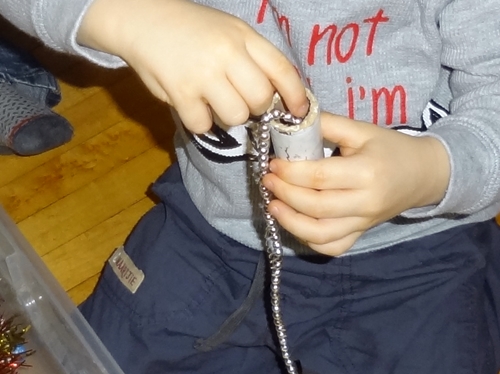
Many of the children enjoyed wrapping and tying the long strands.

Decorating the tubes was very popular – sometimes you couldn’t even see the tube after it was decorated.

I was going to add scented items to the bin but it still smells like the sweet grass we had stored in it last year – Mmmm. I did add some bells, they don’t make much noise if you hold them but sound great as you dig through the bin.
So many colours, shapes, and textures to explore. These star shaped springs were fascinating.
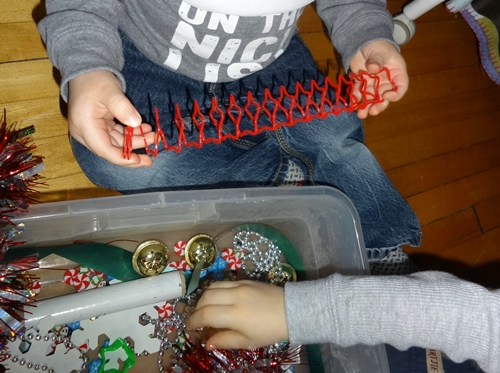
The older children enjoyed collecting, counting, and sorting all the tiny, little rubber shapes (erasers – hundreds of them). It was like a tactile seek & find.

We are all really enjoying this bin.
There are so many decorations that have wonderful sensory qualities but wouldn’t be acceptable to have as loose parts in the playroom with infants & toddlers (and cats). Putting them in a sensory bin gives the opportunity for exploring these materials in a safe, contained, easy to supervise manner.
I included some of our tubes which were used as funnels for dropping other items through. The bead chains were a challenge because if you let go before you got them in past the half way point the weight of the chain pulled the whole thing out. It was frustrating but with a little trial and error and a lot of persistence there was success.
Many of the children enjoyed wrapping and tying the long strands.
Decorating the tubes was very popular – sometimes you couldn’t even see the tube after it was decorated.
I was going to add scented items to the bin but it still smells like the sweet grass we had stored in it last year – Mmmm. I did add some bells, they don’t make much noise if you hold them but sound great as you dig through the bin.
So many colours, shapes, and textures to explore. These star shaped springs were fascinating.
The older children enjoyed collecting, counting, and sorting all the tiny, little rubber shapes (erasers – hundreds of them). It was like a tactile seek & find.
We are all really enjoying this bin.
Wednesday, December 9, 2015
A Matter of Money - Centre or Home
I think one of the greatest things about childcare is that no two
programs/facilities are exactly the same – and that is perfect because
no two children are the same either. Some children thrive in a centre
environment while others need the smaller, more familiar setting that a
family childcare home can offer. The same is true for Early Childhood
Educators. It is the variety of childcare environments that gives ECE’s
the opportunity to choose the one that is the best fit for them to work
in.
In my last post I described family childcare as my ‘calling’ – there is no other job I would rather have regardless of the income and this includes centre based childcare. Just because I think family childcare is the best place for me does not mean I think it is the best form of childcare for every ECE.
My daughter was 12 years old when I first opened my childcare home. She was actively involved in all our activities and couldn’t wait to turn 18 and be able to sub for me. After graduating high school she went on to earn her ECE II diploma and went to work in a centre. She made many financial sacrifices to save enough money from her limited income to buy her own home. Most people assumed she was planning to switch to family childcare. However, when asked about it she was adamant – “NO! She would never, EVER work in family childcare.”
She is now an ECE III working full time in a centre specializing in infant care. I am an ECE II operating a licensed family childcare home We’ve shared many stories and had many conversations about the similarities and differences between our respective careers. Our annual incomes before taxes are almost identical – when mine is calculated at its maximum. There are numerous factors that cause family childcare income to fluctuate – some I will mention later in this post. Family childcare expenses will be covered in a separate post.
We also cannot compare our after tax income because there are so many variables such as number of dependents and total family income that affect the amount we pay for taxes. So, for the moment I’m just going to say that our incomes are both about the same at $32,000 annually before taxes.
So, let’s compare hours next. My childcare home is open Mon-Fri from 6:30 am until 5:30 pm so I spend 55 hours per week with the children without any breaks. Working in a centre I wouldn’t work that many hours so, at the same annual income if you were to count only the hours we spend with the children my hourly wage as a family childcare would be much lower than my daughter working in a centre.
However, working in a centre also requires traveling time and expenses to get to and from work. If you count the time from when my daughter leaves her house to go to work until she arrives back home after then her work day is equal to mine too. I consider the ‘no commute time/expense’ a perk of working in family childcare that is an acceptable trade-off for spending more time with the children.
I also spend about 14 additional hours per week cleaning, doing paperwork, planning activities, and meeting with parents etc when the children are not here. Technically these are all unpaid hours and some of these duties would not be required by an ECE in a centre. Some of them are required and the centre ECE has to get them done sometime during their regular workday. There are a lot of things I could probably do when the children are here but I choose to do after hours because it is easier. To a certain extent how much time I spend ‘working’ is my choice and breaking down family childcare income to an hourly wage is impossible.
I feel the additional hours of work a family childcare puts in is an acceptable trade-off for the amount of control we over our program and environment. I’ve toured many childcare centres where just walking through the rooms makes me shudder and I can’t imagine having to work there. There are centres that I think are fabulous and they have philosophies and programming that I believe in – but they also have other staff members. Many family childcare providers quite willingly label ourselves as ‘Does not work well with others’. It is not that we don’t get along with other people but rather that we have difficulty sharing responsibility. We would prefer to just do it all, our way, by ourselves – that’s why we chose family childcare.
However, there are some definite downsides for an ECE working in family childcare – fluctuating income has to top the list. Remember, my maximum annual income was about the same as that of an ECE working in a centre – but not all providers have eight filled spaces all the time so there are many factors that make my income drop below maximum. If you have difficulty setting and sticking to a budget or are relying solely on one income family childcare may not be a good career option.
Many family childcare providers cannot or will not fill their school-age spaces – there is little financial incentive to do this. The additional expenses, supplies and work required for school-age care are so high that many providers find it is not practical even if they live in an area where there is a demand for school-age care. Considering only the five preschool spaces a family childcare provider has – if all the children in care are over two years old then the provider’s income is more than $600 per month lower than maximum. That puts a family childcare provider’s income significantly lower than that of an ECE working in a centre.
Becoming a licensed family childcare provider is often touted as being a great way to work AND stay at home with your own children but I might really disagree with that view. If your family childcare income is your family’s main or only income it definitely does not make sense to choose FCC over working in a centre. Your own children use up childcare spaces lowering your income from both parent fees and operating grant – essentially costing you more than if you worked outside your home and paid to put your children in childcare. An ECE working in a centre would still receive their full salary and if that was their only income they would probably qualify for a subsidy significantly lowering their costs for childcare.
So yes, there are some big differences between working in family childcare vs. working in a childcare centre but it is all about choices. There are pros and cons to both – you just have to decide which trade-offs you are willing to make. My next post is going to deal more specifically with the financial side of family childcare so, stay tuned….
In my last post I described family childcare as my ‘calling’ – there is no other job I would rather have regardless of the income and this includes centre based childcare. Just because I think family childcare is the best place for me does not mean I think it is the best form of childcare for every ECE.
My daughter was 12 years old when I first opened my childcare home. She was actively involved in all our activities and couldn’t wait to turn 18 and be able to sub for me. After graduating high school she went on to earn her ECE II diploma and went to work in a centre. She made many financial sacrifices to save enough money from her limited income to buy her own home. Most people assumed she was planning to switch to family childcare. However, when asked about it she was adamant – “NO! She would never, EVER work in family childcare.”
She is now an ECE III working full time in a centre specializing in infant care. I am an ECE II operating a licensed family childcare home We’ve shared many stories and had many conversations about the similarities and differences between our respective careers. Our annual incomes before taxes are almost identical – when mine is calculated at its maximum. There are numerous factors that cause family childcare income to fluctuate – some I will mention later in this post. Family childcare expenses will be covered in a separate post.
We also cannot compare our after tax income because there are so many variables such as number of dependents and total family income that affect the amount we pay for taxes. So, for the moment I’m just going to say that our incomes are both about the same at $32,000 annually before taxes.
So, let’s compare hours next. My childcare home is open Mon-Fri from 6:30 am until 5:30 pm so I spend 55 hours per week with the children without any breaks. Working in a centre I wouldn’t work that many hours so, at the same annual income if you were to count only the hours we spend with the children my hourly wage as a family childcare would be much lower than my daughter working in a centre.
However, working in a centre also requires traveling time and expenses to get to and from work. If you count the time from when my daughter leaves her house to go to work until she arrives back home after then her work day is equal to mine too. I consider the ‘no commute time/expense’ a perk of working in family childcare that is an acceptable trade-off for spending more time with the children.
I also spend about 14 additional hours per week cleaning, doing paperwork, planning activities, and meeting with parents etc when the children are not here. Technically these are all unpaid hours and some of these duties would not be required by an ECE in a centre. Some of them are required and the centre ECE has to get them done sometime during their regular workday. There are a lot of things I could probably do when the children are here but I choose to do after hours because it is easier. To a certain extent how much time I spend ‘working’ is my choice and breaking down family childcare income to an hourly wage is impossible.
I feel the additional hours of work a family childcare puts in is an acceptable trade-off for the amount of control we over our program and environment. I’ve toured many childcare centres where just walking through the rooms makes me shudder and I can’t imagine having to work there. There are centres that I think are fabulous and they have philosophies and programming that I believe in – but they also have other staff members. Many family childcare providers quite willingly label ourselves as ‘Does not work well with others’. It is not that we don’t get along with other people but rather that we have difficulty sharing responsibility. We would prefer to just do it all, our way, by ourselves – that’s why we chose family childcare.
However, there are some definite downsides for an ECE working in family childcare – fluctuating income has to top the list. Remember, my maximum annual income was about the same as that of an ECE working in a centre – but not all providers have eight filled spaces all the time so there are many factors that make my income drop below maximum. If you have difficulty setting and sticking to a budget or are relying solely on one income family childcare may not be a good career option.
Many family childcare providers cannot or will not fill their school-age spaces – there is little financial incentive to do this. The additional expenses, supplies and work required for school-age care are so high that many providers find it is not practical even if they live in an area where there is a demand for school-age care. Considering only the five preschool spaces a family childcare provider has – if all the children in care are over two years old then the provider’s income is more than $600 per month lower than maximum. That puts a family childcare provider’s income significantly lower than that of an ECE working in a centre.
Becoming a licensed family childcare provider is often touted as being a great way to work AND stay at home with your own children but I might really disagree with that view. If your family childcare income is your family’s main or only income it definitely does not make sense to choose FCC over working in a centre. Your own children use up childcare spaces lowering your income from both parent fees and operating grant – essentially costing you more than if you worked outside your home and paid to put your children in childcare. An ECE working in a centre would still receive their full salary and if that was their only income they would probably qualify for a subsidy significantly lowering their costs for childcare.
So yes, there are some big differences between working in family childcare vs. working in a childcare centre but it is all about choices. There are pros and cons to both – you just have to decide which trade-offs you are willing to make. My next post is going to deal more specifically with the financial side of family childcare so, stay tuned….
Saturday, December 5, 2015
A Matter of Money - Motivation
I have often been reluctant to join in the fight to demand higher
wages for ECE’s – not because I don’t value what we do but rather,
because I love my job. I think that my reluctance to complain about
wages stems from contentment – for me it doesn’t feel much like work.
The money is not what motivates me to be a licensed family childcare
provider.
Before I opened my childcare home I volunteered in nursery and kindergarten classrooms and ran a recreation program for the children in the housing development where we lived – basically I was ‘working’ for free. Being able to earn an income by doing something I truly enjoyed was an added bonus. In all honesty, if I won a lottery I would still be a family childcare provider – but I would be able to offer the program of my dreams.
Yes, I know ECE’s earn far less than workers in other fields with a similar amount of education but compared to the years my family spent on social assistance this feels pretty comfortable. Yet, without the additional income that my husband earns as a school bus driver I know we would have difficulty paying the bills on my income alone. There are many things we would like to do but don’t do because we lack the funds to do them.
According to the descriptions over at PsychCentral, for me family childcare is not a job, or even just a career – it is a calling.I’ve been called ‘altruistic’ – I had to go look up the meaning of that because it wasn’t a word I’ve ever used – and would definitely never use to describe myself. Actually, I would probably have to say that sometimes I feel selfish for enjoying my job. Yes, there are some aspects of being a family childcare provider that even I don’t relish. There are some days when I’ve had enough and I just want the day to end, but would more money change that? I don’t think so.
So, let’s say I couldn’t be a family childcare provider and had to choose a different job – I would expect more money because I would not enjoy my job as much. In fact, there are some jobs that no amount of money would make me want to do the work. Some jobs that would require such an enormous amount of effort to just show up that even a huge salary would not make it worthwhile. Yet, other people do those jobs so something must motivate them – and maybe it is the money – maybe not.
So, since we’ve already established that I might not the best spokesperson for the ‘Early Childhood Educators need more money’ argument, let’s talk about why I started writing this. When I hear ECE’s constantly lamenting about how hard their job is, how unfair it is that other people get paid more to do less work, making lists of everything they don’t get paid enough to do, my first thought isn’t “You deserve more money”. My first thought is “Maybe you need to find another job.”
Bracing for backlash.
Yes, I do think that ECE’s are underpaid – remember, my ECE wage comparison was social assistance benefits – it took me three years working as a family childcare provider before my income surpassed the need for an income supplement. I do think that the job we do is extremely valuable and that higher wages would help childcare programs attract and keep qualified staff. But – we are trained to speak positively to the children so why speak so negatively about your career?
Tell me what would make it better. How would more money positively affect the job you do? What would a higher wage for you mean to your program, the children in your care and their families. What would you do with more money? Please, don’t attack those who are on your side and doing their best to make a little go a long way.
Before I opened my childcare home I volunteered in nursery and kindergarten classrooms and ran a recreation program for the children in the housing development where we lived – basically I was ‘working’ for free. Being able to earn an income by doing something I truly enjoyed was an added bonus. In all honesty, if I won a lottery I would still be a family childcare provider – but I would be able to offer the program of my dreams.
Yes, I know ECE’s earn far less than workers in other fields with a similar amount of education but compared to the years my family spent on social assistance this feels pretty comfortable. Yet, without the additional income that my husband earns as a school bus driver I know we would have difficulty paying the bills on my income alone. There are many things we would like to do but don’t do because we lack the funds to do them.
According to the descriptions over at PsychCentral, for me family childcare is not a job, or even just a career – it is a calling.I’ve been called ‘altruistic’ – I had to go look up the meaning of that because it wasn’t a word I’ve ever used – and would definitely never use to describe myself. Actually, I would probably have to say that sometimes I feel selfish for enjoying my job. Yes, there are some aspects of being a family childcare provider that even I don’t relish. There are some days when I’ve had enough and I just want the day to end, but would more money change that? I don’t think so.
So, let’s say I couldn’t be a family childcare provider and had to choose a different job – I would expect more money because I would not enjoy my job as much. In fact, there are some jobs that no amount of money would make me want to do the work. Some jobs that would require such an enormous amount of effort to just show up that even a huge salary would not make it worthwhile. Yet, other people do those jobs so something must motivate them – and maybe it is the money – maybe not.
So, since we’ve already established that I might not the best spokesperson for the ‘Early Childhood Educators need more money’ argument, let’s talk about why I started writing this. When I hear ECE’s constantly lamenting about how hard their job is, how unfair it is that other people get paid more to do less work, making lists of everything they don’t get paid enough to do, my first thought isn’t “You deserve more money”. My first thought is “Maybe you need to find another job.”
Bracing for backlash.
Yes, I do think that ECE’s are underpaid – remember, my ECE wage comparison was social assistance benefits – it took me three years working as a family childcare provider before my income surpassed the need for an income supplement. I do think that the job we do is extremely valuable and that higher wages would help childcare programs attract and keep qualified staff. But – we are trained to speak positively to the children so why speak so negatively about your career?
Tell me what would make it better. How would more money positively affect the job you do? What would a higher wage for you mean to your program, the children in your care and their families. What would you do with more money? Please, don’t attack those who are on your side and doing their best to make a little go a long way.
Saturday, November 28, 2015
The Great Divide
This post is intended to provide a little background for another post
that I have been working on – a post which will probably become a whole
series of posts because I’m having trouble organizing all I want to say
into one post. A series of posts I’m going to call ‘A Matter of
Money’. But first…
Many, many years ago when I first began the process to become a licensed family childcare provider there was a significant divide between home based childcare and centre based childcare. There was a separate Family Day Care Association which amalgamated with with the Manitoba Childcare Association shortly after I opened my childcare home.
I was never part of the Family Day Care Association but early in my career I met many providers who had been. There were many family childcare providers who resented the loss of their close-knit little association. They felt they were now little fish in a big pond where the big fish didn’t understand them and had no interest in listening to what they had to say.
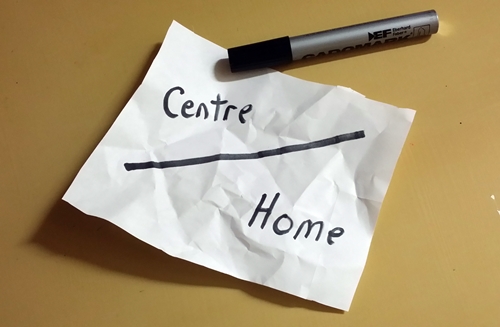
There were some who felt the line between home based childcare and centre based childcare should never be erased. They would have preferred to have had that line drawn with a thick, black permanent marker. I have met line drawers from both sides of the line.
As a newly licensed provider I was lucky to have a large, active family childcare networking group in my area. These veteran providers offered vast amounts of knowledge and support that made diving into the big pond a whole lot easier.
In the beginning we struggled to gain acceptance. Most of the workshops and events we attended were so specific to centre based childcare that there was often little that was pertinent to our environments. Occasionally there were workshops offered explicitly for family childcare providers but, although the information was useful, being offered separate from centre based groups often simply strengthened the divide.
Many family childcare providers would only attend events if they knew others that were going and we could all sit together. At one time or other we had all experienced some sort of discrimination from centre based ECE’s – sometimes being dismissed as mere annoyances – much like the little sister of the teenager who is forced to let them hangout.
At this point I have to say that since those early days things have improved immensely. I have many really good friends who work in centres and value the work we do in family childcare. The important thing is understanding the differences. We each have our own unique set of challenges and benefits. Centre based childcare and family childcare are not the same thing – and neither one is ultimately better than the other.
We do, or at least should, have the same goal – providing the best possible opportunities for all children to reach their full potential. Our fight should be for the children and not against each other.
Many, many years ago when I first began the process to become a licensed family childcare provider there was a significant divide between home based childcare and centre based childcare. There was a separate Family Day Care Association which amalgamated with with the Manitoba Childcare Association shortly after I opened my childcare home.
I was never part of the Family Day Care Association but early in my career I met many providers who had been. There were many family childcare providers who resented the loss of their close-knit little association. They felt they were now little fish in a big pond where the big fish didn’t understand them and had no interest in listening to what they had to say.
There were some who felt the line between home based childcare and centre based childcare should never be erased. They would have preferred to have had that line drawn with a thick, black permanent marker. I have met line drawers from both sides of the line.
As a newly licensed provider I was lucky to have a large, active family childcare networking group in my area. These veteran providers offered vast amounts of knowledge and support that made diving into the big pond a whole lot easier.
In the beginning we struggled to gain acceptance. Most of the workshops and events we attended were so specific to centre based childcare that there was often little that was pertinent to our environments. Occasionally there were workshops offered explicitly for family childcare providers but, although the information was useful, being offered separate from centre based groups often simply strengthened the divide.
Many family childcare providers would only attend events if they knew others that were going and we could all sit together. At one time or other we had all experienced some sort of discrimination from centre based ECE’s – sometimes being dismissed as mere annoyances – much like the little sister of the teenager who is forced to let them hangout.
At this point I have to say that since those early days things have improved immensely. I have many really good friends who work in centres and value the work we do in family childcare. The important thing is understanding the differences. We each have our own unique set of challenges and benefits. Centre based childcare and family childcare are not the same thing – and neither one is ultimately better than the other.
We do, or at least should, have the same goal – providing the best possible opportunities for all children to reach their full potential. Our fight should be for the children and not against each other.
Wednesday, November 25, 2015
New Soup
I have always liked to have at least one home made soup included on
our four week revolving menu. Over the years I have tried many
different soup recipes but sadly none of them have ever received
enthusiastic, positive reviews from the children.
I blame bread. I like to have a heavy, home made savory bread with soup to dip in and soak up the broth…yum. However, if I serve homemade bread then ALL the children eat only the bread and won’t even try the soup.
So, I tend to make all my homemade soups very thick – more like a thin stew than a soup. With pasta or rice included in the soup we don’t need to have bread added as a side dish to get the grains. Still, soup is definitely not a popular item with the children unless it comes from a can and is laden with salt.
Last month I introduced a new soup and this week we had it for the second time. All but one of the children eat this new soup – in fact, most asked for a second helping too. The one who doesn’t eat it has never even tried it, adamantly insisting they don’t like it without tasting even one bite of it. Stubbornly sitting at the table eating only raw vegetables and salad because I didn’t make any bread. ;-)
Here is the recipe for Lasagna Soup;
Stir fry sausages and onions together in large pot. Add pasta sauce, tomatoes, water and vegetable stock. Simmer. Add noodles and cook until softened (about 30 minutes). Remove from heat and add cottage cheese. Serve topped with Parmesan or Mozzarella cheese if desired.
Here’s a picture but it was taken later in the day after the leftover ‘soup’ had already been refrigerated and so the noodles have soaked up almost all the broth but it still tastes good.

I blame bread. I like to have a heavy, home made savory bread with soup to dip in and soak up the broth…yum. However, if I serve homemade bread then ALL the children eat only the bread and won’t even try the soup.
So, I tend to make all my homemade soups very thick – more like a thin stew than a soup. With pasta or rice included in the soup we don’t need to have bread added as a side dish to get the grains. Still, soup is definitely not a popular item with the children unless it comes from a can and is laden with salt.
Last month I introduced a new soup and this week we had it for the second time. All but one of the children eat this new soup – in fact, most asked for a second helping too. The one who doesn’t eat it has never even tried it, adamantly insisting they don’t like it without tasting even one bite of it. Stubbornly sitting at the table eating only raw vegetables and salad because I didn’t make any bread. ;-)
Here is the recipe for Lasagna Soup;
- 4 Italian sausages,cut in half lengthwise and sliced
- 1 medium onion, diced
- 1 680ml can of spaghetti sauce
- 1 can diced tomatoes
- 1 L water
- 1 L vegetable stock
- 8 lasagna noodles, broken in small pieces
- 500 ml cottage cheese
Stir fry sausages and onions together in large pot. Add pasta sauce, tomatoes, water and vegetable stock. Simmer. Add noodles and cook until softened (about 30 minutes). Remove from heat and add cottage cheese. Serve topped with Parmesan or Mozzarella cheese if desired.
Here’s a picture but it was taken later in the day after the leftover ‘soup’ had already been refrigerated and so the noodles have soaked up almost all the broth but it still tastes good.
Thursday, November 19, 2015
Play Room
It was back in July that I wrote about removing the loft from our play space. At that time it looked like this;
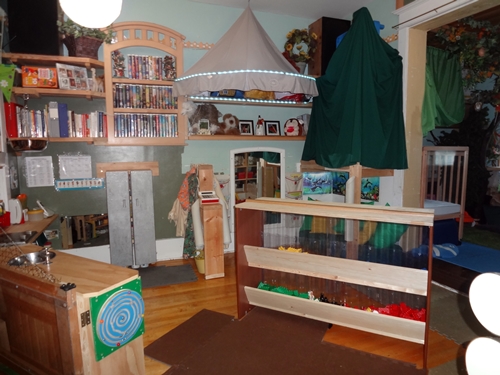
I liked the way the block bin looked when it was placed diagonally across the room but it did not function well. There was limited room in the block area and the angles were causing issues with my plans for replacing the old rubber floor tiles.
So, a few weeks ago I moved the block bin back towards the cozy couch. This move makes the reading nook into a smaller, quieter area that is less prone to active play and heavy traffic flow. It also provided a much larger space for block building adjacent to the workshop/music area.
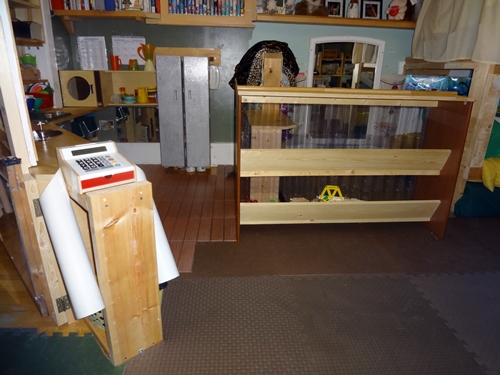
Love the new flooring now too.
I added an another shelf between the back of the block bin and the dress-up clothes rack. This adds stability, provides extra counter space for the housekeeping area and creates a ‘tunnel’ so the children crawl through to the cozy bench instead of running and jumping ;-)

The larger, combined block/workshop/music space has also allowed me to incorporate the new-to-us/second hand ‘science table’ that was donated to our program – thanks Jamie!
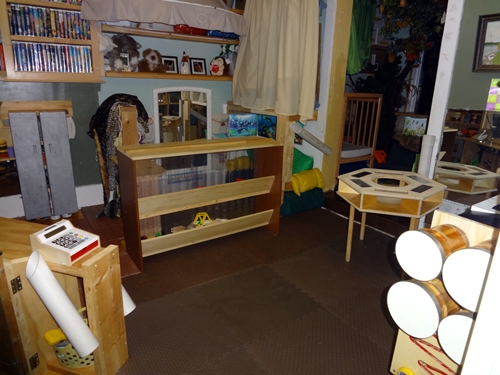
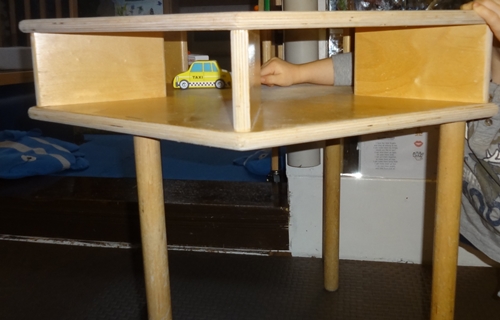
I certainly had no intention of restricting the use of the table to only science activities. With all the tools in the workshop area beside the table I thought it might make a good workbench. So far the children’s favourite use for the table is another tunnel – they much prefer to crawl under the table to get to the nature area instead of walking (running) around the table. They also like to use the spaces in the table as tunnels for the toys;
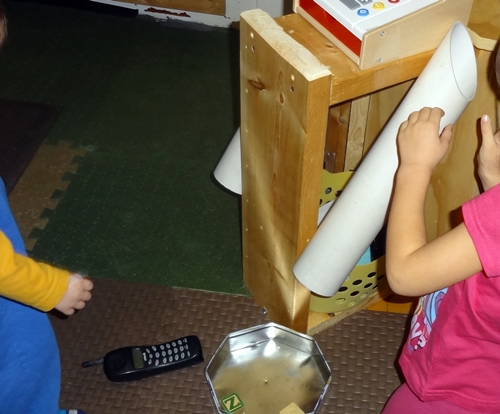
Maybe it is the new room arrangement but dropping – and catching – objects through the pipes has been gaining popularity again too.
I liked the way the block bin looked when it was placed diagonally across the room but it did not function well. There was limited room in the block area and the angles were causing issues with my plans for replacing the old rubber floor tiles.
So, a few weeks ago I moved the block bin back towards the cozy couch. This move makes the reading nook into a smaller, quieter area that is less prone to active play and heavy traffic flow. It also provided a much larger space for block building adjacent to the workshop/music area.
Love the new flooring now too.
I added an another shelf between the back of the block bin and the dress-up clothes rack. This adds stability, provides extra counter space for the housekeeping area and creates a ‘tunnel’ so the children crawl through to the cozy bench instead of running and jumping ;-)
The larger, combined block/workshop/music space has also allowed me to incorporate the new-to-us/second hand ‘science table’ that was donated to our program – thanks Jamie!
I certainly had no intention of restricting the use of the table to only science activities. With all the tools in the workshop area beside the table I thought it might make a good workbench. So far the children’s favourite use for the table is another tunnel – they much prefer to crawl under the table to get to the nature area instead of walking (running) around the table. They also like to use the spaces in the table as tunnels for the toys;
Maybe it is the new room arrangement but dropping – and catching – objects through the pipes has been gaining popularity again too.
We’re loving all the new activity with the old stuff.
Subscribe to:
Posts (Atom)