Monday, April 25, 2016

Rough & Tumble

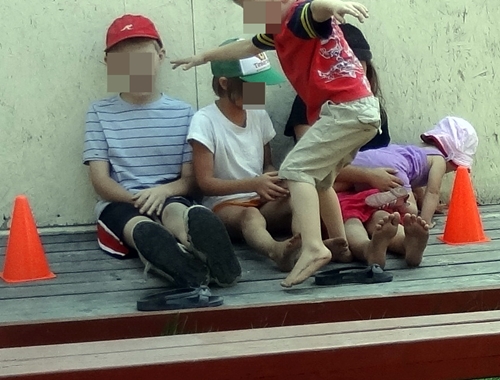
Many parents and childcare providers are uncomfortable allowing children to engage in rough and tumble play or ‘fighting games’ for fear that someone may get hurt.  However, the problem isn’t the type of play but the ‘environment’ – both physical and emotional – in which that play takes place.

I firmly believe that rough and tumble play is very beneficial but in my program I do enforce some basic guidelines.  The first ‘rule’ involves location.  ALL play involving chasing, wrestling, jumping etc is discouraged when we are indoors.  Our main indoor play space is just 150 sq ft and when you add toys, shelving and up to eight children there is simply not enough room – the risks are greater than the reward.

That changes when we get outside.  Although my yard is not a large open space I did design it for gross motor play. There are still some rules like ‘If someone is in front of you, you have to slow down/stop’.  There are many obstacles and the walkways are narrow so when two or more children are trying to maneuver through the same space pushing someone out of your way  is not allowed.

One of the greatest benefits of chasing games and rough and tumble play is that they require/teach awareness and self control.  If you are unable to avoid colliding with another person it is not ‘an accident’.  The problem is NOT that ‘they got in your way’ or ‘they were too slow’- it IS because you were not watching where you were going or you were going too fast for the conditions.

The consequence for knocking someone down isn’t yelling ‘Sorry’ over your shoulder as you continue running away.  The consequence is that you need to stop, help them up and make sure they are OK before you continue playing.  If that is not something you are willing to do then you are not ‘playing’ you are being mean.  If you got hurt too then getting angry and blaming the others isn’t the solution – you need to be more observant, adjust your speed, or find another game to play.

Another ‘rule’ I have is that we only use imaginary weapons.  Now, this is not because I’m totally against weapon play with toy weapons but I have concerns about using toys as weapons in a mixed age group setting.  Yes, I have seen a group of older children involved in a wonderfully cooperative and respectful fighting game using toy weapons.  I have also spent hours/weeks/months teaching toddlers that hitting hurts.  The children and I have many conversations about how super heroes ‘help’ others.

Certainly most school age children can visualize an imaginary scenario, understand the difference between soft and hard objects, regulate the amount of force they use and aim appropriately but the  toddlers are not developmentally equipped to do all this.  The little ones watch, they see hitting and laughter but they don’t understand all the concepts involved and someone will get hurt. So, the imaginary weapons allow the older children to play their game without encouraging the little ones to hit with toys.

The third and most important ‘rule’ is that ALL the children involved in any type of rough and tumble play or fighting game must be willing participants.  This includes ‘shooting’ non-players even with imaginary weapons – in fact, I usually say ‘no people as targets’.  Each player must agree to their role in the game.  If at any point someone says ‘STOP!’ – even if they are laughing – the activity must stop.  If someone cries or gets upset then the game play stops until the problem is resolved.  Stop always means stop or the game is not respectful.

If someone wants to play and agrees to the game rules the others may NOT exclude them. If someone doesn’t want to play there has to be some type of mutual time/space agreement so  multiple activities don’t interfere with each other.  If someone says they want to play but cannot/will not follow the group’s game rules then that person may have to find another activity.

Creating game rules is an important part of the activity and all the children who want to play must be able to participate in this process before play begins.  When only one child is in charge of  creating the game, assigning roles, making the rules, and determining the ‘winner’ then it is not a cooperative game.  This ‘do as I say’ type of activity often enables bullying behaviour and allows the ‘leader’ to change game play in order to control outcome.

One wonderful example of a cooperative rough and tumble game was ‘Fight Club’.  The group of children who created and engaged in this activity were all between five and eleven years old.  They set boundaries for play area.  They chose opponents or teams based on physical abilities and size. They set rules for entering and exiting the game including the option to tag in/out when you got tired. They only played this game outside when there were no little children present. This particular group engaged in this activity on/off for more than a year and never needed me to intervene.  It was perfect.  And it never would have happened if there were no fighting games allowed.
16-04-roughNtumble

Wednesday, April 6, 2016

Spring 2016

There is a thin layer of snow on the front sidewalk but I am stubbornly refusing to go sweep it off.  The temperature display on the weather station reads ‘0’ degrees at 6am so I am confident the sidewalk snow will melt soon – the snow on the steps has already melted.  Yesterday morning when we went out to play there was no snow anywhere in my back yard and there was a collective “Awww, there’s no snow” from the children so I’m certain this recent snowfall is Mother Nature’s response to that lament.

I like winter too and this past (present?) winter has been quite pleasant.  There have been a few indoor issues with running across the playroom and jumping in and out of the nature area.  I’ve tried several indirect measures to curb the reckless behaviour – most had limited effect but this has been quite successful;

16-04-Spring01

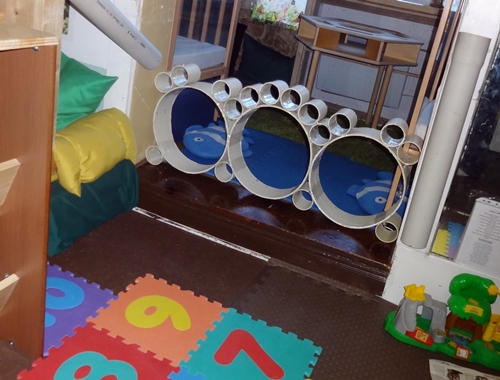
These cardboard circles used to be attached to the loft for toy storage but we no longer have the loft – of course I kept these ‘just in case’ I found another use for them… :-)  The smaller children enjoy using the ‘tunnels’.  The school age children and I can step over.  Either way it slows down traffic – like the pot holes on the street.

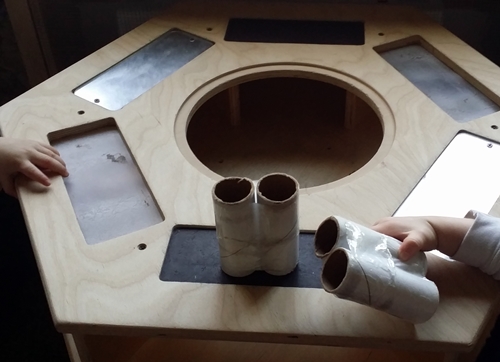
Speaking of cardboard tubes, I can’t believe we still have these ‘binoculars’ made from plastic wrap tubes and tape;

16-04-Spring03

I quickly put them together for some toddlers who wanted them for a dramatic play activity they were engaged in two years ago!  I never expected them to stay in the playroom for more than a day or two but they are just as popular as ever and they haven’t been damaged yet.  I’ve considered making, or having the children make more, fancier ones but no one is really interested so these ones stay.  The current group likes to lay on the floor in the nature area and use them to look for butterflies and birds in the trees.

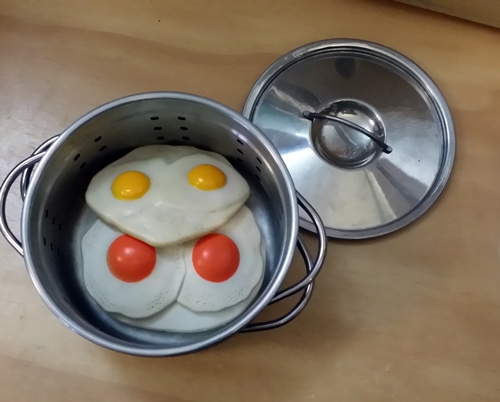
Another constant in the playroom is these eggs in this pot;

16-04-Spring02

Upon entering the playroom one of the toddlers will place these eggs in this pot and set it on the counter.  If at any point someone else moves the pot, puts other food in the pot, or puts the eggs is a different pot there will be a scuffle.  I can’t explain it but it has been like this every day for months now.  No one ever actually plays with the eggs in the pot and the toddlers will happily put them away at clean up time but they MUST be on the counter like this during play time.

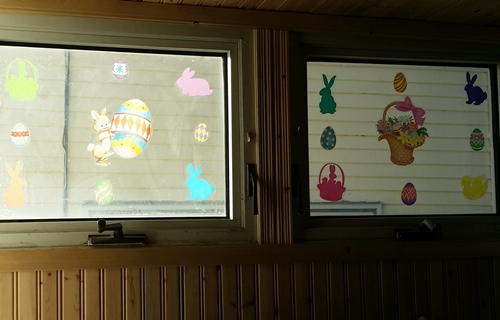
However, there have been several complaints that I have not yet taken down the Easter decorations;


16-04-Spring04

Honestly, I’m happy leaving them up as ‘Spring’ decorations.  I have many window clings for Fall, Halloween, Christmas, Winter, Valentines, St Patrick’s Day, and Easter but for the period between Easter and Fall all I have are butterflies.  Butterflies are nice but I’d like to have some variation over the 5 month Spring/Summer period.  Flowers or birds would be nice.

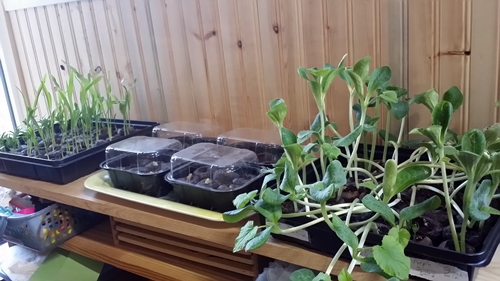
Yes, there is snow on the ground – again – but summer is coming.  Check out our seedlings;

16-04-Spring06

We’ve started our peppers, corn and several types of squash.  The corn surprised us – we don’t usually plant corn but we found an old package of corn seeds in our seed collection - we (I) didn't really expect them to grow.  I don’t usually buy seeds – most of our garden plants are grown from seeds we collect from our garden or produce from the store or CSA box.  Our peas and beans will be planted directly in the garden outside but it is too early yet – we’ve tried digging in the soil every time the snow melts but the ground is still frozen.  Some of us are very eager for Spring to arrive.

Monday, March 21, 2016

Fitness

I am certain that at no point in my life anyone has ever considered me to be a fitness fanatic.  In fact, as a child I was considered ‘The Princess’ and my sister was ‘The Tomboy’ (I abhorred the princess label and everything it embodied but that is another post).  I loved school but loathed gym class.  I have never been able to understand the allure of sports of any kind – neither as a spectator nor a participant.  Equestrian sports were an exception but only because – OMG, horses!  

I took swimming lessons – hated them – still avoid going in to pools, lakes, rivers etc.  As a child I had a bike – begged my dad not to buy it for me but he insisted – my only memories of ‘riding’ it involve falls and collisions.  I have always loved hiking, if time was not a factor I would always, always, choose walking over any other form of transportation – but I don’t run, ever, for any reason.

I have one particularly vivid memory from junior high Math class when we were learning to collect and graph data.  For data collection the teacher chose to test everyone’s grip strength (here you can learn more about why you’d want that info and how to test it).  I stood at the front of the class for what felt like an eternity while the teacher kept insisting that I ‘try again’ and muttering about lowering the class average.  Seriously, 16 pounds was my maximum.

So, even though I’ve never been ‘athletic’, I have also never been sedentary.  In fact, I have trouble sitting for very long at all.  I’ve only been to a movie theater twice in the past 35 years – not because I dislike movies – but because they don’t have movement breaks and they disapprove of me standing, stretching and pacing during the show (like I do at home when I watch TV).

As I *sigh* get older I’m finding winter to be more and more difficult each year.  Yes, I do some yoga, shovel snow and go for occasional short walks but it is nothing compared to my spring/summer/fall activity level when I spend the majority of the day playing and working outdoors.  This winter my husband suggested maybe we should get a treadmill ‘because I like walking’… Ummm, NO!  I won’t like walking on a treadmill with no birds and trees and other things to enjoy.  He has always wanted a treadmill so he didn’t have to go hiking outside – not me!

Still, I was interested in checking out some other types of workout equipment beyond the basic stuff I had at home.  We went to look at some exercise equipment.  Of course he liked the treadmills – I did not.  He also liked the exercise cycles – I wouldn’t likely fall or crash if it was stationary but I doubted I would be motivated to use it.  I did find the elliptical machines interesting but hubby’s doctor wouldn’t recommend he use an elliptical.

We live in an old house with limited floor space and a very low basement ceiling height – we definitely don’t have room for good quality exercise equipment nor can we afford multiple machines to satisfy both our interests.  I began to think maybe we should consider something more than what we could do at home.  So, I suggested maybe we should consider joining a gym… I know, I laughed too when I said it.  We did some research and decided Snap Fitness was our best option.

We’ve been going to the gym four times a week for two months now.  I’ve completed my first fitness score test (since high school).  I’ve learned some things like;

  • I look forward to going to the gym – even feel a little disappointed when it’s not a gym day.  If there was a gym closer to my home I’d walk there every day – driving there is the only deterrent.
  • Working out regularly makes me sleep so soundly every night – it is amazing.
  •  My  heart health and muscle endurance are better that I would have expected but my flexibility is surprisingly poor.
  • For the first time in my life I am intrinsically motivated and stubbornly optimistic that I will improve my physical strength.

Childcare is a physically demanding job and I believe physical fitness is important not only as so I can do the required work but also so I can be a good role model.

Thursday, March 3, 2016

Castle Blocks

A few years ago I bought some sets of Castle Blocks from Quality Classrooms. Like all the various types of blocks I have they are rotated in and out of our play space depending on the interests of the children in my care.

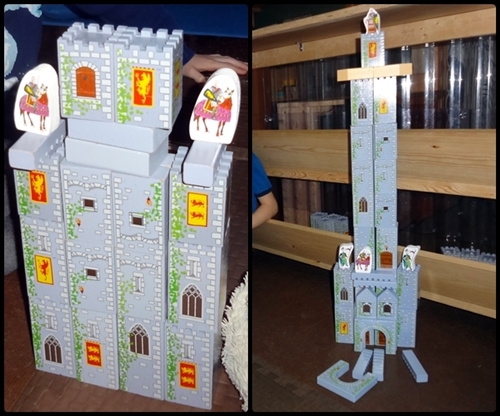
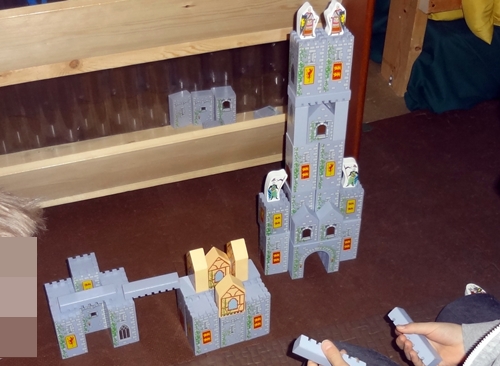
My current group of children has enjoyed building with these blocks for several weeks now.  They particularly like to design and build impressive towers.

16-03-blocks00

I enjoy watching the cooperation when the children agree to work together on a building project;

16-03-blocks01

However, they have encountered a bit of a problem – the baby of the group gets so excited when he sees a tower that he can’t resist knocking it down.  He does immediately attempt to help rebuild the towers but the original builders are still very disappointed by the destruction.

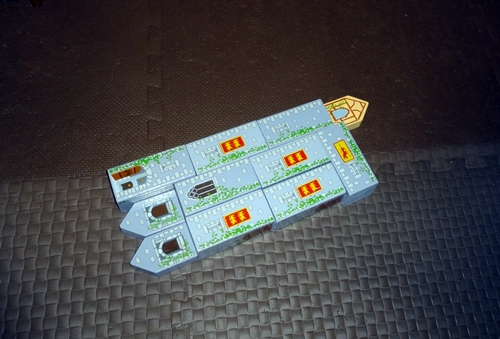
One of the solutions that the children have come up with is to only build towers when the baby is not in the room.  Although effective, this strategy also severely limits the block building time.  Then one day, while the baby was playing in the room, I observed the three-year-old building this;

16-03-blocks03

I asked him to tell me about his creation.  He said “It’s a tower – that the baby can’t knock down.”  Hmmm, very interesting.  These horizontal towers have become quite popular and can be built all day long without any issues.

16-03-blocks04

Nice problem solving :-)

Wednesday, February 24, 2016

What's on Your Shirt?

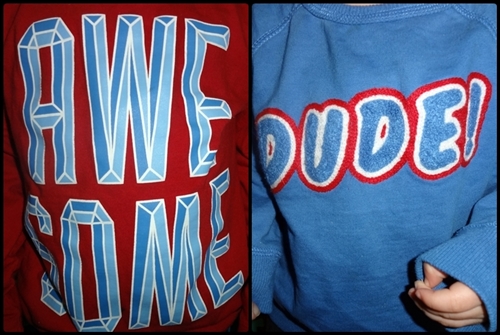
I can’t begin to count the number of time’s I hear the children ask some version of “What’s on your shirt”.  No, they’re not wondering what someone (usually me) has spilled on their shirt.  They want to see the picture, logo, or any words that are printed on the fabric.  If there are words they need to know what they say.  This whole conversation is repeated every time anyone comes in the room.

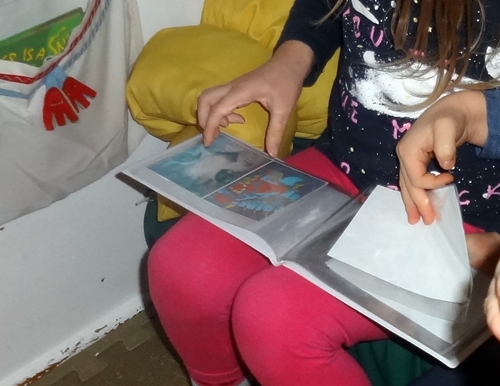
I decided to start documenting this activity by taking photos of all the children’s shirts, printing them and creating a book.  So far we have forty four shirt photos like this;


16-02-shirts01 

16-02-shirts02.jpg 

16-02-shirts03 


The album full of shirt pictures has been extremely popular.  There have been a few minor disputes over it because there is only ONE book but that may change soon because we’ve nearly run out of space so we’ll need a second album. :-)

16-02-shirts04

Even the youngest children can name the owner of each of the shirts in the album.  There have been some really amazing conversations here as the children look through the book together.  The conversations have continued at home too – I hear stories about struggles to get dressed in the morning because ‘I can’t wear that shirt, Cheryl already has a picture of it’.  Some are even demanding shopping trips to get NEW shirts to add to the album.

It is important to keep families involved in our daily activities ;-)

Monday, February 15, 2016

Glue

I both love and detest glue.  I love its potential as a tool for crafts - to adhere two or more items together.  However, there is a long list of annoying things about glue.

Sometimes it is too wet - damaging the paper or taking too long to dry so the children get frustrated and often give up before they successfully complete their project.  Glue is easily spilled and difficult to get it from the container to the spot you want it to be.

Sometimes it is too dry - clogged squeeze bottles, shriveled up glue sticks, glue pots containing rubberized mounds of  old glue.  I find it nearly impossible to have good glue available for the children to use independently whenever they want it.  At least 75% of all the glue I buy gets wasted - thrown out without ever getting used for crafts.

Cleaning up glue is another frustrating task.  Using water just thins it out spreading it further and further until the entire table is coated.  A dry paper towel sticks to the glue on a table more permanently than any of the craft supplies we tried to attach.  Clean-up is more time consuming than set-up and creation combined.

In an effort to find a solution to my issues with purchased glue I've tried several homemade glue/paste recipes.  Most have failed to provide good results - often easy to work with but the crafts simply fall apart after the glue dries.  However, recently I tried this recipe;

• 1 1/2 Cups Water
• 2 Tablespoons Light Corn Syrup
• 1 Teaspoon White Vinegar
• 1/2 Cup Cornstarch
Pour 3/4 cup of the water into a medium sized pot along with the corn syrup and vinegar. Bring this mixture to a full boil, stirring often.
While you are waiting for that mixture to boil, mix the remaining cold water and the cornstarch together. Beat well to remove all of the lumps. Slowly stir the water and cornstarch into your boiling mixture, stirring constantly. Bring this mixture to a boil and let it boil for 1 minute. Remove the pot from the heat and let cool.
Once cooled, put the glue in a covered container and wait at least a day before using.
 
The resulting jelly-like product was easy for even the youngest artists to scoop and spread;

16-02-glue01

Everyone was impressed by how easy this glue was to work with;

16-02-glue02

It is so sticky that layers upon layers of papers were quickly adhered together;

16-02-glue03

Even when only part of the paper touched the glue gravity wasn't strong enough to release it after it dried - and it dried quickly too;

16-02-glue04

Stored  in a covered container, the homemade glue was still sticky and spreadable the following week but I wasn't certain how long it would remain 'good' so I decided to use all the remainder in our sensory bin.  I gathered a bunch of other leftovers - shredded paper, sand, powdered paint, potpourri, etc.  The toddlers were curious and examined the dry 'ingredients'.

16-02-glue05

I envisioned that once the glue was added we would be able to use the mixture much like clay and form it into shapes.  However, the children were hesitant to touch it now.

16-02-glue06

It was so very sticky that mounds of shredded paper was instantly stuck to the hand of anyone who dared to touch the glue.  It was an extreme sensory activity.  One by one the children began to mix the items together in the bin - very hesitantly - mostly just trying to bury the glue.

16-02-glue07

It wasn't until I added a bit of water that the children became less reluctant to participate.  Even then they didn't really seem to like the incredible stickiness.  They were however fascinated by the potpourri - picking out the bigger pieces and peeling apart the layers.

16-02-glue08

Not what I was expecting but very interesting to watch.  Still, the best was yet to come.  This glue, as sticky as it seems, cleans up in seconds.  I was so very impressed.  A quick rinse under running water and it is completely gone!  No sticky hands. No messy containers. No residue on the table.  Nothing.

Easy to make.  Easy to use. Easy to clean up.  Wow!

Tuesday, February 2, 2016

A Compilation

Every once in a while I find I have collected a few photos from activities that don't become a blog post on their own but I'd still like to share them.  These are a few from the past month;

This was the result of nearly an hour of independent play after we got past the 'There's nobody else here to play with me' stage;

16-02-misc01

Here is a picture of a cooperative game these two enjoyed;

16-02-misc02

I thought this was a pretty amazing tower built by a three-year-old;

16-02-misc03.JPG

And this two-year-old sorted these blocks like this several times, every day for more than a week!

16-02-misc04

Finally, this was something I made to use some extra acorn squash.  It was definitely not my favourite squash dish but it had the preschoolers clamoring for more.


16-02-misc05
  • 3 cups acorn squash, cubed
  • 1/2 cup applesauce
  • 1/2 cup raisins
  • 1/4 cup honey
  • 1 Tbsp margarine, melted
  • 2 tsp lemon juice
  • 1/4 tsp cinnamon
Mix all ingredients together and place in a greased baking dish. Bake, covered, in preheated 375 F (190 C) oven for 30 minutes; uncover and bake for another 20 minutes or until squash is tender.