Friday, July 22, 2016

Reuse, Recycle

Warning - I think this might be a long post but I don't want to try to break it up into two or three smaller posts.  Persevere through the rambling history - it will be worth it, I promise...

Often my husband complains people comment that I am always building/making something but really I am always moving/changing something.  Inside and outside my childcare home I create the furnishings, equipment, lofts, storage units etc to fit a specific space or purpose to suit the interests/needs of the group of children enrolled at that time. Sometimes there are items in stores or catalogues that I like but the dimensions or features are wrong for my application so I draw a plan and make one that will work.

Sometimes I feel my projects may seem incomplete/unfinished - maybe I didn't have enough time to complete my vision due to inclement weather or other delays.  Possibly the project has several phases or there was something I forgot to take in to consideration when I made the plan.  I've taken down shelf units and discovered that the wall behind them was a color that is no longer on any other wall in the house and I have had neither the time nor any extra paint to fix it.  That's OK because for me everything is really just temporary - it may not be long before I devise another plan that will require another change and that wall will be covered again.  The original project may even be abandoned entirely in favor of a better idea.

When I remove something from the play space I rarely discard any of the pieces - there may be another use for them at another time.  Sometimes I've even secretly dug a piece or two of scraps from the cut off bin that I felt were too valuable to have been put there.  It drives me crazy to watch those home renovation shows when they take a sledge hammer to the place and destroy perfectly usable parts. Go ahead, label me a 'hoarder' but I can't count the number of times I've said something like "You know what I need here... wait...  I've got something in the basement/shed/bin that just might work".  Occasionally I even 'attach' items that are not really needed at the time but it is easier than finding a place to store the extra pieces.  It is better for the environment if I can reuse something.  Besides, I find shopping for new stuff is so time consuming, often stressful and definitely more expensive.

This spring/summer I have changed at least a portion of every part of our indoor and outdoor play spaces.  In fact, I just looked at the slideshow on my homepage and realized that NONE of the spaces pictured there exist anymore!  Yet, for all my recent projects and changes I estimate the total cost of supplies to be less than $300 - that is a small price tag for a fairly major renovation.  Of course, that doesn't cover what labour costs might be if I didn't consider renovating to be an exciting recreational activity - I'd rather be in the midst of a construction project than traveling or laying on a beach any day!  That comment now leads perfectly to the real topic of this post;

'What I Did on My Vacation - 2016 Edition'.

This year the bulk of the work was done to the outdoor play space - hooray, plenty of outdoor time!  There were several preliminary projects that were done earlier in the spring.  The biggest of those involved moving the garden - this couldn't wait until vacation time because our seedlings needed to be planted earlier than mid-July so the garden phase was started in May.  For a while the old and new garden spaces were only partially finished and had to wait for other project phases to be done.  The most noticeable change took place during the first week of July - the removal of what was left of the shed.

Here is a little shed history.  The original 8 x 10 backyard shed was built a long time ago - I'm not even certain of the exact year but I'm going to estimate that it was about 1999.  My husband designed it and the entire space belonged to him - the children and I used only the 12'x30' ground level deck, the gravel area and a small storage shed beside the upper deck.  In 2009 when I wanted to plant a garden we disassembled the entire shed and then reassembled it on top of the deck adjacent to my little shed.  This enabled me to use the ground space where my husband's shed had been in exchange for a portion of the deck that we rarely used.

That worked for several years until 2013 when we moved half the big shed to the side yard.  The side yard shed contained the tools and allowed my husband to work in his separate side yard space at the same time as the children and I were playing in the back yard. There wasn't room for the whole shed in the side yard so we left half of it on the back deck.  Last summer we put windows in remaining section of the backyard shed thinking maybe it would make a good playhouse type space.  However, it was only used maybe three or four times in the past year and I felt the open deck space would be more beneficial so down it came.  Of course I've safely stored the windows and all the other usable parts too.

Throughout all these shed projects the only time we purchased new wood was when we didn't have old pieces that were long enough.  Consequently there was a lot of nostalgia as the shed was disassembled.  I found grey boards from the original shed, green and purple boards from the old wooden play structure, white boards from the old fence, black pieces from the old wooden wagon and even a couple dark brown stained pieces that may have even been from the shed at our old house!
So, I bet you are wondering what the 'new' back yard looks like.  You're probably getting tired of just words so how about a bunch of pictures with just a few words.  Here is the view of the gravel area from the 'new' entrance;

16-07-RR03

And a closer view of the tipi corner;
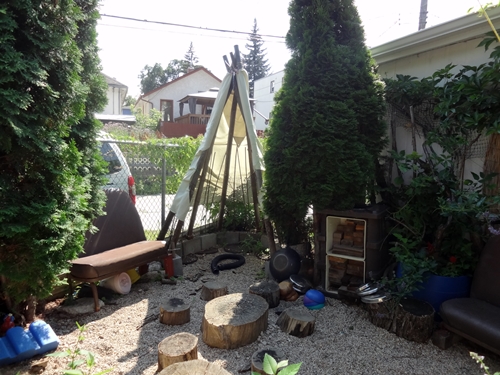
16-07-RR03a

This is where the entrance to the gravel area used to be - I always had to trim the willow back so we could get by.  Now I can let it grow and it makes such a cozy seating area (you can hardly see the benches in the corner).  The cinder block 'chalk wall' was extended too;

16-07-RR04

Here's another view of that corner;

16-07-RR04a.JPG

This is the new little 'bridge' entrance to the gravel area;

16-07-RR04b

The entrance to the gravel area was moved to make way for the new garden space so all these projects were done in May.  This is what our new garden looked like in June - peas, beans, corn, peppers, tomatoes, wheat and flax;

16-07-RR05

And in July;


16-07-RR05a

From the other side;

16-07-RR05b

Here's the new seating/play area where the old garden had been.  The children call this the 'trampoline' because the thick layer of mulch is spongy to walk/run on.  Part of the old garden is still here - Milkweed and herbs.

16-07-RR06

Here is what you see if you sit on the benches and look toward the gravel area;

16-07-RR06a

This is Frank - a friend I made when we first began the shed demo.  I kept moving him to safer places so he didn't accidentally get squished.

16-07-RR01.JPG

So beautiful and friendly.  Kept distracting me.  Almost forgot to take the 'before demo' picture.  Here's an 'already started but still mostly there' picture;

16-07-RR02

The new open, freshly painted deck space after shed demo - all this space was under the shed in 2009 and half in 2013;

16-07-RR07a

Combination wooden bench/balance beam/toddler table/moveable space divider and also a fun little fold-up/down table (extra parts).  This is the same camera angle as the 'before demo' picture.

16-07-RR07b

View of new space from the gravel area;

16-07-RR06b

Wood, gravel, garden, mulch - texture everywhere :-)

Sunday, July 3, 2016

Mud & More

June 29th is International Mud Day – something we celebrate every year.  This year the school-age children were thrilled that there was no school so they were able to join in the day’s activities.  I had the water table set up full of dirt – it was up to the children to add the water and make the mud;

16-6-mud01

I also put out another bin with plain water for hand washing but some of the children enjoyed making repeated trips from mud to hand washing and back so really there were TWO mud bins.  I cleaned the hand washing bin and added fresh water several times but it always looked like this;

16-6-mud02

Because of this;

16-6-mud03.JPG

We were outside all morning and the children took breaks from mud play to build bridges;

16-6-mud04

play tag, and capture things like this;

16-6-mud05.JPG

There was a five minute downpour which was very exciting after I reassured the children that we would NOT have to go back inside.  We do often play in the rain but because we didn’t have raincoats and boots some of the children were concerned that we were not properly dressed for the weather.  However, it was Mud Day and everyone had clean clothes waiting inside so  all that rain was just a bonus:-) It created some muddy puddles and the tarp became a slip and slide;

16-6-mud06

and the mud table got soupier;

16-6-mud07

Then, one of the children notice that the first tomato has begun to grow.  Three of the children decided to ‘watch’ it for nearly 20 minutes ‘waiting for it to turn red’.

16-6-mud08

I think maybe it will be ready when they return in two weeks – after my vacation.  I wonder if they will remember to check, or will they be too interested in exploring all the other new things – my ‘vacation to-do list’ is two pages long.  I love vacation time but the return of the children is so exciting too!

Wednesday, June 22, 2016

Spiders

I think most young children are fascinated by insects, caterpillars, worms etc.  I recently had an Early Childhood Education student here to do her practicum. She was required to plan activities based on the children’s interests and she noted that insects were definitely popular with my little group – as they have been with all my groups.

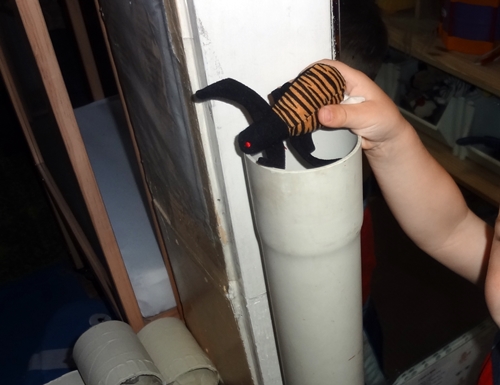
Spring is always the peak insect love season – I assume because they are rarely seen over winter and  so they are ‘new and exciting’ when they emerge in abundance in the spring.  Of course I always encourage it further by bringing out the insect toys and puppets too.  One of the toddlers was repeatedly dropping this little stuffed spider through the tube – as they like to do with all small toys.

16-06-spider01

I didn’t think much about it until I heard him very quietly singing the Itsy Bitsy Spider song too:-)

Admittedly there are some creepy crawlies that I am not particularly fond of because of the damage they do to our garden  yet I am careful not to instill in the children any fear or hatred towards even the ‘bad’ bugs.  It is simply another learning opportunity –  we may not want them in our garden but we can find appropriate ways to coexist.  We also include bugs in our many discussions about ‘bullies’ – great big humans picking on little bitty bugs usually because they don’t understand their purpose.

Many children are fearful of spiders – I believe this is a learned fear – one that I spend a lot of time discussing with the children.  With every fear, like or dislike I always ask the children ‘why’.  I’ll admit that I have often been startled by spiders – they are speedy little critters, but startled by and afraid of are two entirely different things.  Spiders are good – they are very welcome in my garden and even in my house.

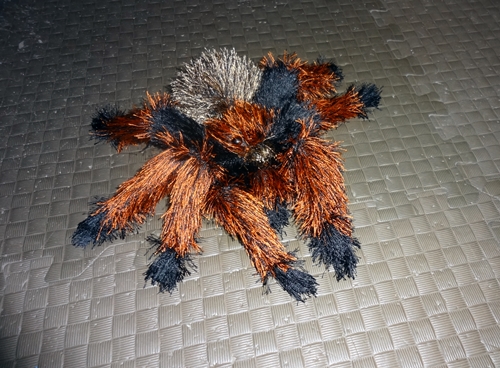
I noticed that the youngest of the toddlers seemed to be afraid of my very favourite spider puppet – never touching it and always giving it a wide berth if someone else left it on the floor.

16-06-spider02

What was even more interesting was how quickly the other two toddlers – who had previously liked this toy – now picked up on this ‘fear’.  Upon arrival each of them would timidly survey the playroom to ensure they knew the spider’s location so they didn’t come across it unexpectedly.
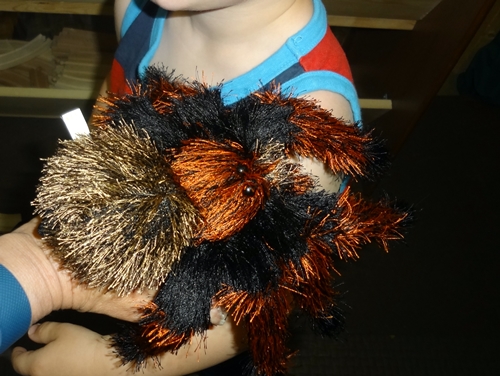
So, for several days I carried and played with the spider puppet.  I talked about how cute I thought he was – how much I liked his little beady eyes and his fluffy hair.  Then even the timid children took turns talking to and petting the spider puppet.  Soon the spider’s fan club got bigger and several of the children ‘begged’ to have the spider walk up their arm and tickle their neck.

16-06-spider03

Loving or hating things that are ‘different’ begins with something as small as a spider.  It is important to understand why we don’t like something or someone – is it the color, texture, or something else?  What are some appropriate ways to address those fears or dislikes? Should you build walls and avoid contact or spend some time learning to understand and accept the differences and the benefits.  You don’t have to love them but what can you do before the fear becomes hate.

Hope this year we are lucky enough to find some more cat faced spiders in the yard – they are my favourite ‘real’ spiders.   I don’t enjoy the sensation of having any insect crawl on me but that is not their fault and I can still enjoy the benefits of having them around.

16-06-spider04

Friday, June 10, 2016

Professional Development

The 2016 Manitoba Child Care conference was held May 26th - 28th and as usual I attended all three days.  Three full days of workshops always leaves me with information overload so I give myself a little break before I go review my notes to remind myself of all the points I found noteworthy.   This year's theme was 'Be Inspired, Be Incredible' and the workshops I attended were truly inspiring especially Teacher Tom!

I've attended various workshops and conferences annually throughout my childcare career.  I've written about some of them here, here, here and here.  Occasionally I have met ECE's who appear to be there against their will - completely apathetic and unwilling to participate.  It always makes me wonder why they chose childcare as a career if they have no desire to learn - how can they expect to inspire the children they care for?

I can't imagine not being interested in expanding your interests - to have no curiosity - to be stagnant.  I've attended some workshops that turned out to be much different than I had anticipated/hoped yet I have still found at least some tidbit of useful information.  If it turns out that the workshop presenter and I have completely different views/goals I would still consider it a learning opportunity - even if it is only to reinforce my own beliefs.

I am disappointed that there are rarely more than a few family childcare providers in attendance at conferences.  I've heard the excuses 'It is too expensive' (It's a write-off), 'I can't afford to close for two days' (Attend an evening or Saturday workshop),  'There is nothing that interests me' (really?!?!), 'I already know all that stuff' (so go lead a workshop - be the expert of your group - mentor others!),'I don't know anyone else who is going' (Great! Make some new friends).  In fact, I think that last one is really important - possibly the most important reason you should be going. Family childcare providers work in isolation and it is really easy to get stuck in an old, outdated routine and never grow.

Certainly we can develop wonderful relationships with the families we have enrolled but that can't provide the type of benefit we get from interacting with peers. Besides - we get food at conferences - food we don't need to cook ourselves!  I love food that someone else cooks - except fishy things, I don't like seafood.  One of the reasons I joined a gym is so I never have to turn down food when someone offers it to me.  Ooops, sorry, I got a little off topic for a moment...

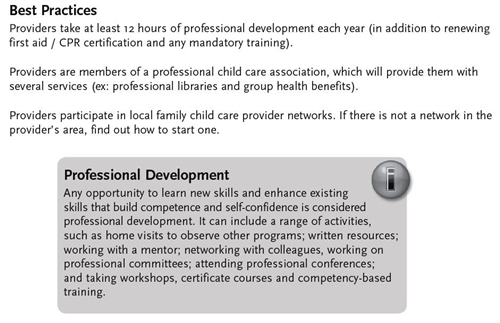
The Province of Manitoba Best Practices Licensing Manual for Family and Group Childcare Homes recommends:

16-06-PD01


Networking with colleagues is extremely important whether through conferences, committees, courses or some other type of training.  Although useful at times I don't think looking for new ideas on Pinterest or interacting with peers on social media sites counts as professional development. Personally I believe professional development should be a regulation, a requirement for licensing not just a best practice.

So, here are a few points from my notes from this year's MCCA conference;
  • Attitude matters, 100 positive people + 1 negative person = 101 negative people.
  • Quality is only as strong as your most marginal performer.
  • Cooperation is hardwired, competition is taught.
  • Formal instruction prepares people to work in factories.
  • Education is not the filling of an empty vessel - it is the ignition of the flame.
  • If it is not interesting to you it is not interesting to them either.
  • Play is what children do when adults stop telling them what they should do.
  • Young children are the most creative problem solvers in the world.
  • The role of the teacher is to prepare the environment for the children to play.

To be honest most of these points are not new knowledge for me but the conversations I was involved in surrounding these points were extremely enlightening and that is why I go to conferences. Counting down the days until my next conference - The Manitoba Nature Summit is just three months away - so excited!  

Monday, April 25, 2016

Rough & Tumble

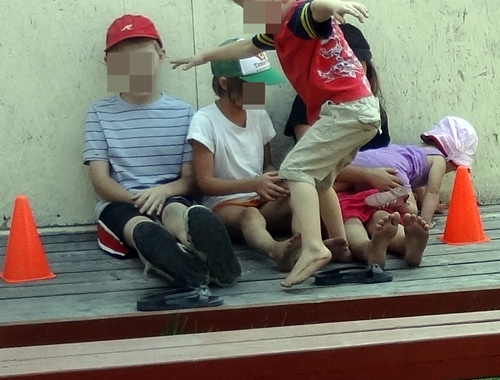
Many parents and childcare providers are uncomfortable allowing children to engage in rough and tumble play or ‘fighting games’ for fear that someone may get hurt.  However, the problem isn’t the type of play but the ‘environment’ – both physical and emotional – in which that play takes place.

I firmly believe that rough and tumble play is very beneficial but in my program I do enforce some basic guidelines.  The first ‘rule’ involves location.  ALL play involving chasing, wrestling, jumping etc is discouraged when we are indoors.  Our main indoor play space is just 150 sq ft and when you add toys, shelving and up to eight children there is simply not enough room – the risks are greater than the reward.

That changes when we get outside.  Although my yard is not a large open space I did design it for gross motor play. There are still some rules like ‘If someone is in front of you, you have to slow down/stop’.  There are many obstacles and the walkways are narrow so when two or more children are trying to maneuver through the same space pushing someone out of your way  is not allowed.

One of the greatest benefits of chasing games and rough and tumble play is that they require/teach awareness and self control.  If you are unable to avoid colliding with another person it is not ‘an accident’.  The problem is NOT that ‘they got in your way’ or ‘they were too slow’- it IS because you were not watching where you were going or you were going too fast for the conditions.

The consequence for knocking someone down isn’t yelling ‘Sorry’ over your shoulder as you continue running away.  The consequence is that you need to stop, help them up and make sure they are OK before you continue playing.  If that is not something you are willing to do then you are not ‘playing’ you are being mean.  If you got hurt too then getting angry and blaming the others isn’t the solution – you need to be more observant, adjust your speed, or find another game to play.

Another ‘rule’ I have is that we only use imaginary weapons.  Now, this is not because I’m totally against weapon play with toy weapons but I have concerns about using toys as weapons in a mixed age group setting.  Yes, I have seen a group of older children involved in a wonderfully cooperative and respectful fighting game using toy weapons.  I have also spent hours/weeks/months teaching toddlers that hitting hurts.  The children and I have many conversations about how super heroes ‘help’ others.

Certainly most school age children can visualize an imaginary scenario, understand the difference between soft and hard objects, regulate the amount of force they use and aim appropriately but the  toddlers are not developmentally equipped to do all this.  The little ones watch, they see hitting and laughter but they don’t understand all the concepts involved and someone will get hurt. So, the imaginary weapons allow the older children to play their game without encouraging the little ones to hit with toys.

The third and most important ‘rule’ is that ALL the children involved in any type of rough and tumble play or fighting game must be willing participants.  This includes ‘shooting’ non-players even with imaginary weapons – in fact, I usually say ‘no people as targets’.  Each player must agree to their role in the game.  If at any point someone says ‘STOP!’ – even if they are laughing – the activity must stop.  If someone cries or gets upset then the game play stops until the problem is resolved.  Stop always means stop or the game is not respectful.

If someone wants to play and agrees to the game rules the others may NOT exclude them. If someone doesn’t want to play there has to be some type of mutual time/space agreement so  multiple activities don’t interfere with each other.  If someone says they want to play but cannot/will not follow the group’s game rules then that person may have to find another activity.

Creating game rules is an important part of the activity and all the children who want to play must be able to participate in this process before play begins.  When only one child is in charge of  creating the game, assigning roles, making the rules, and determining the ‘winner’ then it is not a cooperative game.  This ‘do as I say’ type of activity often enables bullying behaviour and allows the ‘leader’ to change game play in order to control outcome.

One wonderful example of a cooperative rough and tumble game was ‘Fight Club’.  The group of children who created and engaged in this activity were all between five and eleven years old.  They set boundaries for play area.  They chose opponents or teams based on physical abilities and size. They set rules for entering and exiting the game including the option to tag in/out when you got tired. They only played this game outside when there were no little children present. This particular group engaged in this activity on/off for more than a year and never needed me to intervene.  It was perfect.  And it never would have happened if there were no fighting games allowed.

16-04-roughNtumble

Wednesday, April 6, 2016

Spring 2016

There is a thin layer of snow on the front sidewalk but I am stubbornly refusing to go sweep it off.  The temperature display on the weather station reads ‘0’ degrees at 6am so I am confident the sidewalk snow will melt soon – the snow on the steps has already melted.  Yesterday morning when we went out to play there was no snow anywhere in my back yard and there was a collective “Awww, there’s no snow” from the children so I’m certain this recent snowfall is Mother Nature’s response to that lament.

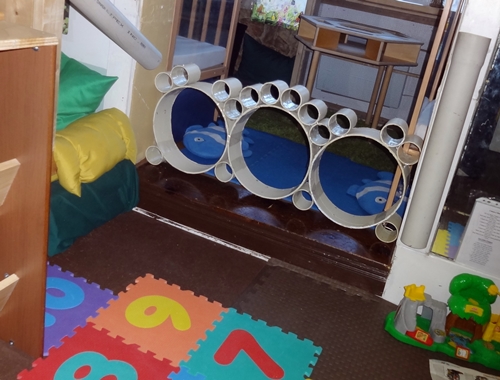
I like winter too and this past (present?) winter has been quite pleasant.  There have been a few indoor issues with running across the playroom and jumping in and out of the nature area.  I’ve tried several indirect measures to curb the reckless behaviour – most had limited effect but this has been quite successful;

16-04-Spring01

These cardboard circles used to be attached to the loft for toy storage but we no longer have the loft – of course I kept these ‘just in case’ I found another use for them… :-)  The smaller children enjoy using the ‘tunnels’.  The school age children and I can step over.  Either way it slows down traffic – like the pot holes on the street.

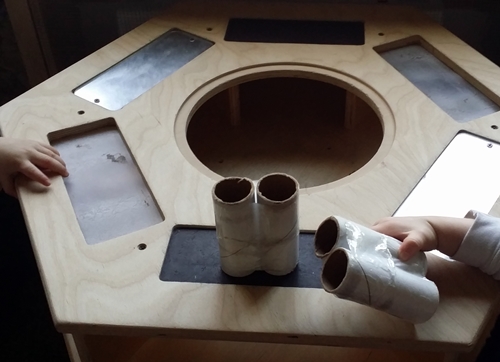
Speaking of cardboard tubes, I can’t believe we still have these ‘binoculars’ made from plastic wrap tubes and tape;

16-04-Spring03

I quickly put them together for some toddlers who wanted them for a dramatic play activity they were engaged in two years ago!  I never expected them to stay in the playroom for more than a day or two but they are just as popular as ever and they haven’t been damaged yet.  I’ve considered making, or having the children make more, fancier ones but no one is really interested so these ones stay.  The current group likes to lay on the floor in the nature area and use them to look for butterflies and birds in the trees.

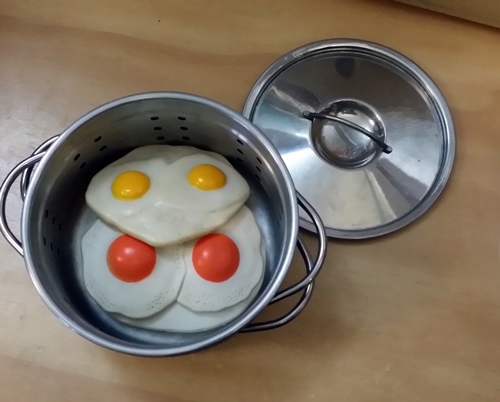
Another constant in the playroom is these eggs in this pot;

16-04-Spring02

Upon entering the playroom one of the toddlers will place these eggs in this pot and set it on the counter.  If at any point someone else moves the pot, puts other food in the pot, or puts the eggs is a different pot there will be a scuffle.  I can’t explain it but it has been like this every day for months now.  No one ever actually plays with the eggs in the pot and the toddlers will happily put them away at clean up time but they MUST be on the counter like this during play time.

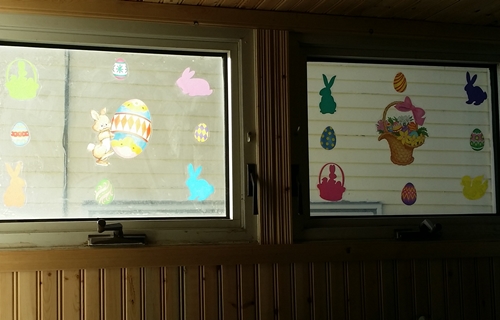
However, there have been several complaints that I have not yet taken down the Easter decorations;


16-04-Spring04

Honestly, I’m happy leaving them up as ‘Spring’ decorations.  I have many window clings for Fall, Halloween, Christmas, Winter, Valentines, St Patrick’s Day, and Easter but for the period between Easter and Fall all I have are butterflies.  Butterflies are nice but I’d like to have some variation over the 5 month Spring/Summer period.  Flowers or birds would be nice.

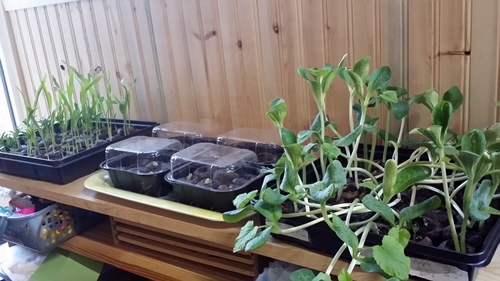
Yes, there is snow on the ground – again – but summer is coming.  Check out our seedlings;

16-04-Spring06

We’ve started our peppers, corn and several types of squash.  The corn surprised us – we don’t usually plant corn but we found an old package of corn seeds in our seed collection - we (I) didn't really expect them to grow.  I don’t usually buy seeds – most of our garden plants are grown from seeds we collect from our garden or produce from the store or CSA box.  Our peas and beans will be planted directly in the garden outside but it is too early yet – we’ve tried digging in the soil every time the snow melts but the ground is still frozen.  Some of us are very eager for Spring to arrive.

Monday, March 21, 2016

Fitness

I am certain that at no point in my life anyone has ever considered me to be a fitness fanatic.  In fact, as a child I was considered ‘The Princess’ and my sister was ‘The Tomboy’ (I abhorred the princess label and everything it embodied but that is another post).  I loved school but loathed gym class.  I have never been able to understand the allure of sports of any kind – neither as a spectator nor a participant.  Equestrian sports were an exception but only because – OMG, horses!  

I took swimming lessons – hated them – still avoid going in to pools, lakes, rivers etc.  As a child I had a bike – begged my dad not to buy it for me but he insisted – my only memories of ‘riding’ it involve falls and collisions.  I have always loved hiking, if time was not a factor I would always, always, choose walking over any other form of transportation – but I don’t run, ever, for any reason.

I have one particularly vivid memory from junior high Math class when we were learning to collect and graph data.  For data collection the teacher chose to test everyone’s grip strength (here you can learn more about why you’d want that info and how to test it).  I stood at the front of the class for what felt like an eternity while the teacher kept insisting that I ‘try again’ and muttering about lowering the class average.  Seriously, 16 pounds was my maximum.

So, even though I’ve never been ‘athletic’, I have also never been sedentary.  In fact, I have trouble sitting for very long at all.  I’ve only been to a movie theater twice in the past 35 years – not because I dislike movies – but because they don’t have movement breaks and they disapprove of me standing, stretching and pacing during the show (like I do at home when I watch TV).

As I *sigh* get older I’m finding winter to be more and more difficult each year.  Yes, I do some yoga, shovel snow and go for occasional short walks but it is nothing compared to my spring/summer/fall activity level when I spend the majority of the day playing and working outdoors.  This winter my husband suggested maybe we should get a treadmill ‘because I like walking’… Ummm, NO!  I won’t like walking on a treadmill with no birds and trees and other things to enjoy.  He has always wanted a treadmill so he didn’t have to go hiking outside – not me!

Still, I was interested in checking out some other types of workout equipment beyond the basic stuff I had at home.  We went to look at some exercise equipment.  Of course he liked the treadmills – I did not.  He also liked the exercise cycles – I wouldn’t likely fall or crash if it was stationary but I doubted I would be motivated to use it.  I did find the elliptical machines interesting but hubby’s doctor wouldn’t recommend he use an elliptical.

We live in an old house with limited floor space and a very low basement ceiling height – we definitely don’t have room for good quality exercise equipment nor can we afford multiple machines to satisfy both our interests.  I began to think maybe we should consider something more than what we could do at home.  So, I suggested maybe we should consider joining a gym… I know, I laughed too when I said it.  We did some research and decided Snap Fitness was our best option.

We’ve been going to the gym four times a week for two months now.  I’ve completed my first fitness score test (since high school).  I’ve learned some things like;

  • I look forward to going to the gym – even feel a little disappointed when it’s not a gym day.  If there was a gym closer to my home I’d walk there every day – driving there is the only deterrent.
  • Working out regularly makes me sleep so soundly every night – it is amazing.
  •  My  heart health and muscle endurance are better that I would have expected but my flexibility is surprisingly poor.
  • For the first time in my life I am intrinsically motivated and stubbornly optimistic that I will improve my physical strength.

Childcare is a physically demanding job and I believe physical fitness is important not only as so I can do the required work but also so I can be a good role model.