Thursday, March 3, 2016

Castle Blocks

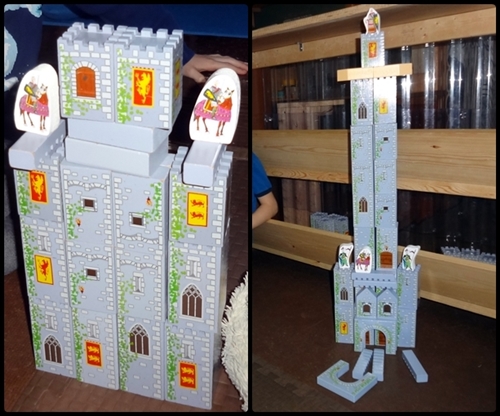
A few years ago I bought some sets of Castle Blocks from Quality Classrooms. Like all the various types of blocks I have they are rotated in and out of our play space depending on the interests of the children in my care.

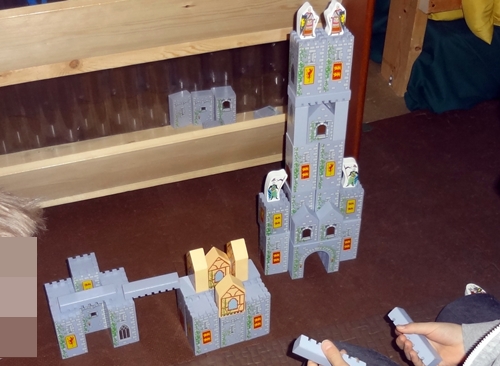
My current group of children has enjoyed building with these blocks for several weeks now.  They particularly like to design and build impressive towers.

16-03-blocks00

I enjoy watching the cooperation when the children agree to work together on a building project;

16-03-blocks01

However, they have encountered a bit of a problem – the baby of the group gets so excited when he sees a tower that he can’t resist knocking it down.  He does immediately attempt to help rebuild the towers but the original builders are still very disappointed by the destruction.

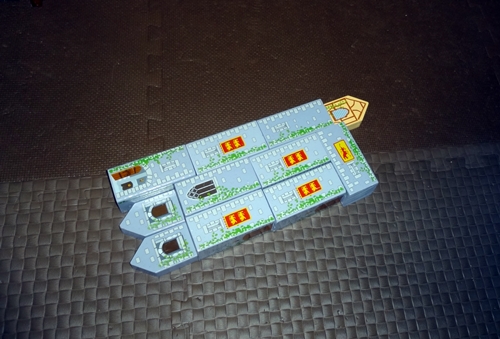
One of the solutions that the children have come up with is to only build towers when the baby is not in the room.  Although effective, this strategy also severely limits the block building time.  Then one day, while the baby was playing in the room, I observed the three-year-old building this;

16-03-blocks03

I asked him to tell me about his creation.  He said “It’s a tower – that the baby can’t knock down.”  Hmmm, very interesting.  These horizontal towers have become quite popular and can be built all day long without any issues.

16-03-blocks04

Nice problem solving :-)

Wednesday, February 24, 2016

What's on Your Shirt?

I can’t begin to count the number of time’s I hear the children ask some version of “What’s on your shirt”.  No, they’re not wondering what someone (usually me) has spilled on their shirt.  They want to see the picture, logo, or any words that are printed on the fabric.  If there are words they need to know what they say.  This whole conversation is repeated every time anyone comes in the room.

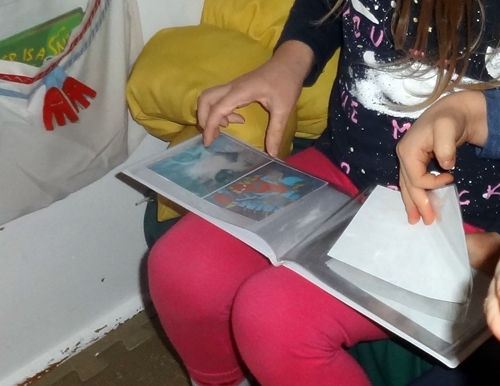
I decided to start documenting this activity by taking photos of all the children’s shirts, printing them and creating a book.  So far we have forty four shirt photos like this;


16-02-shirts01 

16-02-shirts02.jpg 

16-02-shirts03 


The album full of shirt pictures has been extremely popular.  There have been a few minor disputes over it because there is only ONE book but that may change soon because we’ve nearly run out of space so we’ll need a second album. :-)

16-02-shirts04

Even the youngest children can name the owner of each of the shirts in the album.  There have been some really amazing conversations here as the children look through the book together.  The conversations have continued at home too – I hear stories about struggles to get dressed in the morning because ‘I can’t wear that shirt, Cheryl already has a picture of it’.  Some are even demanding shopping trips to get NEW shirts to add to the album.

It is important to keep families involved in our daily activities ;-)

Monday, February 15, 2016

Glue

I both love and detest glue.  I love its potential as a tool for crafts - to adhere two or more items together.  However, there is a long list of annoying things about glue.

Sometimes it is too wet - damaging the paper or taking too long to dry so the children get frustrated and often give up before they successfully complete their project.  Glue is easily spilled and difficult to get it from the container to the spot you want it to be.

Sometimes it is too dry - clogged squeeze bottles, shriveled up glue sticks, glue pots containing rubberized mounds of  old glue.  I find it nearly impossible to have good glue available for the children to use independently whenever they want it.  At least 75% of all the glue I buy gets wasted - thrown out without ever getting used for crafts.

Cleaning up glue is another frustrating task.  Using water just thins it out spreading it further and further until the entire table is coated.  A dry paper towel sticks to the glue on a table more permanently than any of the craft supplies we tried to attach.  Clean-up is more time consuming than set-up and creation combined.

In an effort to find a solution to my issues with purchased glue I've tried several homemade glue/paste recipes.  Most have failed to provide good results - often easy to work with but the crafts simply fall apart after the glue dries.  However, recently I tried this recipe;

• 1 1/2 Cups Water
• 2 Tablespoons Light Corn Syrup
• 1 Teaspoon White Vinegar
• 1/2 Cup Cornstarch
Pour 3/4 cup of the water into a medium sized pot along with the corn syrup and vinegar. Bring this mixture to a full boil, stirring often.
While you are waiting for that mixture to boil, mix the remaining cold water and the cornstarch together. Beat well to remove all of the lumps. Slowly stir the water and cornstarch into your boiling mixture, stirring constantly. Bring this mixture to a boil and let it boil for 1 minute. Remove the pot from the heat and let cool.
Once cooled, put the glue in a covered container and wait at least a day before using.
 
The resulting jelly-like product was easy for even the youngest artists to scoop and spread;

16-02-glue01

Everyone was impressed by how easy this glue was to work with;

16-02-glue02

It is so sticky that layers upon layers of papers were quickly adhered together;

16-02-glue03

Even when only part of the paper touched the glue gravity wasn't strong enough to release it after it dried - and it dried quickly too;

16-02-glue04

Stored  in a covered container, the homemade glue was still sticky and spreadable the following week but I wasn't certain how long it would remain 'good' so I decided to use all the remainder in our sensory bin.  I gathered a bunch of other leftovers - shredded paper, sand, powdered paint, potpourri, etc.  The toddlers were curious and examined the dry 'ingredients'.

16-02-glue05

I envisioned that once the glue was added we would be able to use the mixture much like clay and form it into shapes.  However, the children were hesitant to touch it now.

16-02-glue06

It was so very sticky that mounds of shredded paper was instantly stuck to the hand of anyone who dared to touch the glue.  It was an extreme sensory activity.  One by one the children began to mix the items together in the bin - very hesitantly - mostly just trying to bury the glue.

16-02-glue07

It wasn't until I added a bit of water that the children became less reluctant to participate.  Even then they didn't really seem to like the incredible stickiness.  They were however fascinated by the potpourri - picking out the bigger pieces and peeling apart the layers.

16-02-glue08

Not what I was expecting but very interesting to watch.  Still, the best was yet to come.  This glue, as sticky as it seems, cleans up in seconds.  I was so very impressed.  A quick rinse under running water and it is completely gone!  No sticky hands. No messy containers. No residue on the table.  Nothing.

Easy to make.  Easy to use. Easy to clean up.  Wow!

Tuesday, February 2, 2016

A Compilation

Every once in a while I find I have collected a few photos from activities that don't become a blog post on their own but I'd still like to share them.  These are a few from the past month;

This was the result of nearly an hour of independent play after we got past the 'There's nobody else here to play with me' stage;

16-02-misc01

Here is a picture of a cooperative game these two enjoyed;

16-02-misc02

I thought this was a pretty amazing tower built by a three-year-old;

16-02-misc03.JPG

And this two-year-old sorted these blocks like this several times, every day for more than a week!

16-02-misc04

Finally, this was something I made to use some extra acorn squash.  It was definitely not my favourite squash dish but it had the preschoolers clamoring for more.


16-02-misc05
  • 3 cups acorn squash, cubed
  • 1/2 cup applesauce
  • 1/2 cup raisins
  • 1/4 cup honey
  • 1 Tbsp margarine, melted
  • 2 tsp lemon juice
  • 1/4 tsp cinnamon
Mix all ingredients together and place in a greased baking dish. Bake, covered, in preheated 375 F (190 C) oven for 30 minutes; uncover and bake for another 20 minutes or until squash is tender.

Thursday, January 28, 2016

Winter Yard

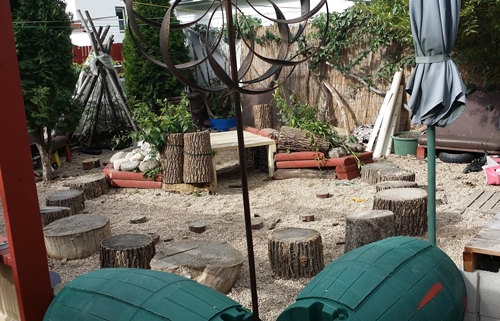
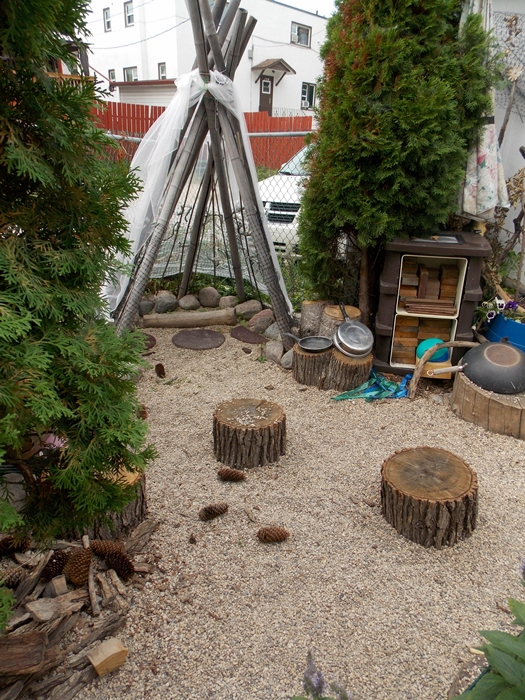
Last summer I rearranged the stumps in the yard to create a path to and over the rocks on the little hill/tunnel.

16-01-hill01

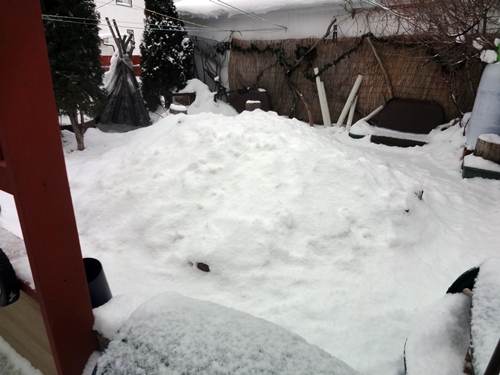
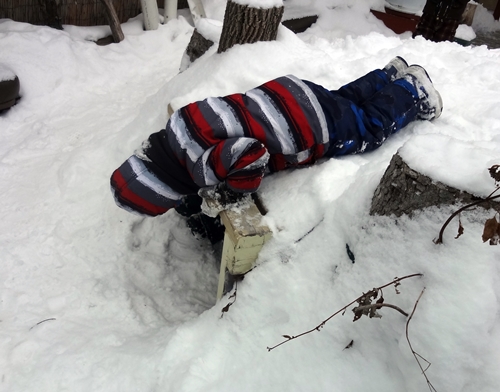
At that time I wasn’t thinking about winter but now that the snow is here we have been creating a BIG hill in the yard by piling all the snow inside the stump circle.

16-01-hill02

This picture was taken before the recent snowfall.  Yesterday we spent nearly two hours adding more snow to the pile so now the hill is much bigger :-) Watching the children play on this hill makes me dream of permanently filling that stump circle so we have a big hill in the summer too – but I would miss the inner stump circle and the tunnel too.

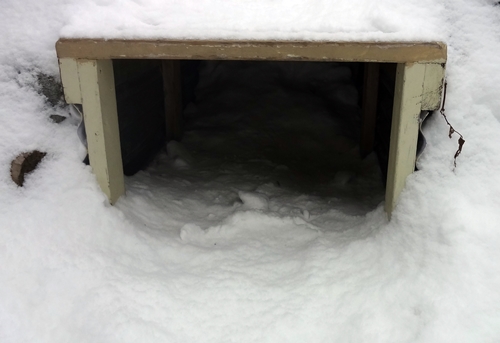
With all the snow piled up one side of the tunnel is now blocked so the ‘tunnel’ is actually a ‘cave’.

16-01-hill03

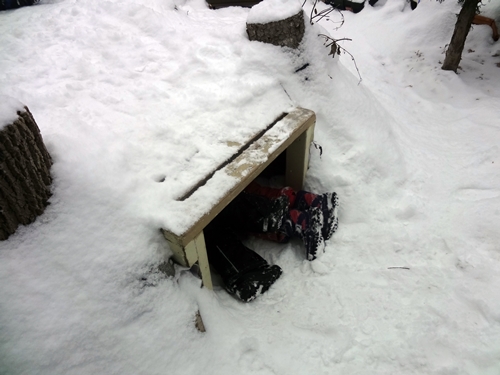
This cave is now a favourite – not so secret – hiding spot.

16-01-hill04

Found you!

16-01-hill05

Another favourite space is inside the tipi.  In summer it is nice to be able to see through the tipi and into the lane beyond the fence.

16-01-hill06

In the winter I pile snow behind the tipi and it becomes a wonderful place to sit when you want shelter from the wind.

16-01-hill07

We love our winter yard.

Thursday, January 14, 2016

Puzzle Masters

In my collection of childcare supplies I have dozens of puzzles.  Some of them belonged to my own children when they were young, others have been purchased or donated to my childcare program. There are some very simple puzzles with only a few pieces, some with up to 1000 pieces, and everything in between.

Puzzles have always been available as a quiet time activity but they have never been a favourite choice for any of the school-age children.  Occasionally the older children would choose a few of the simplest puzzles and have competitions to see who could complete them the fastest – this tended to be too loud for quiet time.  The larger, more complicated puzzles were never popular and simply gathered dust.

In the past I’ve wondered if the children found these larger puzzles to be too time consuming to be completed in one sitting.  When I have had several older children in attendance for longer periods of time during school breaks I have set up a puzzle area where they could work on a puzzle project independently or with others.  There was no need to put it away when they tired of working on it and so it could be completed over several days.  Still, no interest.

My current group of preschoolers might change that.  For these little ones puzzles are one of their favourite activities.  They have done all the smaller puzzles many, many times.  They can easily complete several puzzles in one sitting and often have many puzzles out at once because they finish them so quickly.  They never seem to get tired of doing puzzles.

None of the preschool puzzles offer much a a challenge to these three and four year old children any more so we now work on the 100 piece puzzles.  What I find most interesting is that they also ask if they can do these puzzles ‘together’.  Cooperating on any activity is a challenge for these little ones so of course I’m going to facilitate any request like this.

16-01-puzzle01

There are so many learning opportunities throughout this one activity!

16-01-puzzle02

Even when they are busy doing other activities they often talk about doing puzzles together – planning or reminiscing.

16-01-puzzle03

Start to finish these two can complete a puzzle this size in about 30 minutes.

16-01-puzzle04

They are puzzle masters.

Sunday, January 10, 2016

A Matter of Money - Expenses

In my last post I wrote about the daily rates charged by various home based childcare providers but that barely begins to cover how widely net incomes can vary. I know some home based providers try to break down their income to an hourly wage and lament they earn less than minimum wage. I've also heard it said that unlike centre based ECE's whose wages and hours are set by their employer, home based providers have more control over their income, expenses and hours. For this scenario let's ignore the differences in number of spaces, the ages of the children in care, daily rates etc. Let's just consider how expenses and work hours can affect a home based childcare provider's income. What can be controlled and what can't be.

The Childcare Space - the building in which it is located. A portion of the cost of the childcare home's utilities, taxes and mortgage interest is considered a business expense but the amount is dependent on how much of the home is used for childcare and for how many hours per day. Do they have a large dedicated childcare space or shared childcare/personal space? What type of neighbourhood is the home located in (property tax rate)? Has the home been purchased recently or is it nearly paid off (mortgage interest costs)? Is the home large or small, old or new, energy efficient or old technology (utility costs)? All those factors will affect the total cost of operating the childcare home.

Does the childcare home have limited hours, offer flexible hours to accommodate parents working various shifts or maybe they are even 'open' 24 hours/day, 7 days/week. Offering extended hours does not generally increase income - in fact, the net income could actually be lower. Drop off times for evening childcare are usually earlier than pick-up times for daytime care so enrolling one evening child and one daytime child will still require two spaces due to the period of time they overlap. The provider does not have all the children present at the same time which results in a longer workday and higher expenses too.

In short - more space & longer hours = more deductions and lower net income.

The Learning Environment - my personal favourite topic - the toys, equipment and furnishings in the childcare space. Is it set up as a traditional home - living room, kitchen, bedrooms etc - are there simply a few toys stored in a corner, spare room or a closet? Is the home larger than the family that lives there needs - an extra room or unused basement has become childcare space. Has the provider given up much of their personal space to create multiple classrooms?

Did the provider make no real changes to their own space and simply accommodates the children like part of their extended family? Did they convert a large space into an elaborate facility - purchasing expensive, high end equipment and furnishings designed specifically for commercial childcare facilities? Did they opt for more economical furnishings and take the chance they will need to replace things often? Do they design and make their own toys and furnishings using recycled materials - very little expense but a lot of 'unpaid' work hours.

How long has the childcare program been operating at this location? How long do they intend to stay in business? Does/did the provider have their own children who have outgrown items which are now used for the childcare program? Is this a primary or secondary income for this household? All of these factors will impact the amount the provider has already invested or is willing/able to invest in the space now or in the future.

The Programming - what types of activities do they offer? Structured or spontaneous? Formal instruction or free play? Do they have all the latest technology available for the children to use with purchased curriculum software? Do they have regularly scheduled field trips, hire instructors or attend group classes for music, recreation, or art? Do they use printed worksheets, packaged product crafts, or watch movies/TV? Some of the most expensive activities will require the least amount of provider time/effort.

Training/networking - does the provider regularly attend workshops, conferences and meetings with other educators? These types of learning opportunities allow the provider to increase her own skills and be less likely to need to outsource programming. However, they can also be expensive. For the home provider there is not only the cost of course registration but also wages for substitutes, lost income for closures, or additional unpaid time after regular work hours.

Supplies - what does the provider require the parents to send with their child? Certainly parents are responsible for sending personal items like clothing, diapers and possibly bedding for their child but some providers may also have an additional supply list. These periodic supply lists can include items such as tissues, sun screen, glue, paper etc much like annual school supply lists. Some even ask parents to supply grocery staples like boxes of cereal, crackers, pasta etc or to pay additional fees for some provider supplied items or services.

Meals - does the provider supply all or some meals or is the parent responsible for sending food with their child every day? Many providers supply snacks but some also provide breakfast/lunch/supper depending on their operating hours. If they provide meals do they buy/prepare food in bulk to save money? Do they purchase individual serving sizes and many processed items to save time? Do they seek out the best quality, organic products that can be found locally? Do they offer alternatives for children/families with dietary restrictions?

What other tasks may a provider be willing to pay someone else to do? Bookkeeping/accounting? Cleaning? Again, this is a matter of making a choice between higher expenses/lower net income or longer work hours/higher net income. A provider may not feel it is necessary to pay high premiums for disability insurance and benefit packages if they have a spouse with coverage. If childcare is the main or only income for the provider's family then this insurance may be essential - or the premiums may be beyond the possibility of their limited budget.

So yes, home based childcare providers do have some control over how much or how little they spend on operating expenses for their childcare facility and how much they leave for salary. I think what is more important to note is WHY the providers are making the choices. Maybe the provider enjoys cooking for the children in her care or maybe she knows the food she gives them is the only healthy food they will get that day. Maybe childcare is the only income for this provider's family and the budget is too tight to afford any 'extras' for the program. Maybe the provider enjoys working with children but the second income isn't a necessity for her family - she spends more on her program specifically to lower her taxable income.

A long time ago I was told that childcare centres spend about 80% of their income on wages for their staff - I assume that number is still fairly accurate today. Maybe home based providers should try something similar.  Stop trying to take what little money is left after expenses, dividing it by the hours they work and complaining that it is not a livable wage. Instead, try counting 80% of your total gross income as your salary and pay the appropriate taxes on that income. Then take the remaining 20% and use it for your program expenses. Then you can start complaining about how little you money you have to operate a quality childcare program.