Wednesday, December 21, 2016

Art & Crafts

Many, many years ago I used to buy craft kits for my own children – often as Christmas gifts.  Sometimes they enjoyed creating the pictured product, sometimes they used the supplies to make something entirely different, and sometimes they did nothing.  I have also purchased the occasional craft kit for myself but I tend to use the instructions more like guidelines, changing things along the way much like the way I ‘tweak’ recipes when I am cooking.  It could be that I wanted to personalize it but probably also a little ‘don’t tell me what to do’ rebellion.

I’m not sure exactly when I went anti-craft but at some point I began to despise product crafts. Maybe it was the year I volunteered in my son’s Kindergarten class when I spent hours cutting out pieces for the children to assemble according to the prescribed pattern.  Maybe it was after I opened my childcare home and watched a steady procession of elementary school children bringing back exactly the same craft products year after year after year.

Over the past fifteen or so years I’ve rarely provided any sort of art/craft instruction and never insisted everyone had to participate.  I’ve taken a ‘loose parts’ approach to setting up the art area and the children are able to choose to use the art supplies freely throughout the  day to create whatever interests them.

I’ve watched some children create really amazing art work.  They have wonderful imaginations and problem solving skills.  If there is something missing from the art area that they think would benefit their projects they ask for it or bring it from home.  Some of these expert artists also enjoy assisting others and will lead spontaneous art classes.

I’ve also observed children who struggle with an open-ended art area.  Some don’t know how to start if there isn’t a leader showing the way.  Some are easily frustrated and give up mid project.  Some never set foot in the art area either because they are not interested or because they doubt their own ability.  There are even some for whom the ‘product’ is so important that they will send the ‘artists’ to make things for them but never attempt to create their own.

Sometimes there isn’t a lead artist in the group – there may be one or two that are very creative but they are ‘followers’.  Even though they can create imaginative artwork when working independently, if another child is present they just imitate each other.  Often there isn’t even any art, just play with the art materials – pencil swords, rolled paper trumpets, etc.  Groups like this rarely have any ‘products’ and the few they do have are exactly the same three pencil lines on a crumpled piece of paper day after day.

Some art tools, like scissors, are more like ‘weapons of mass destruction’.  Sure I think scissors skills are important but I’m not entirely certain scissors are a ‘creative’ tool that I want all preschoolers to have free independent access to.

I’ve tried to limit my ‘instruction’ to introducing new supplies – demonstrating methods and techniques – not products.  Invariably there will be at least one child who will simply copy everything I do and others who will follow along.  *sigh*  We have now created what looks like a product craft.

I think there has to be a middle ground – at least for preschoolers.  Not just ‘follow my instructions and make this’ product crafts.  Not just ‘here are some materials, play with them’ entirely child led process.   So, here are a few things we’ve done recently;

Tissue paper, paper plates & glue: ripping, crumpling, flattening, spreading, pouring, pressing and more – a lot of different ‘process’ yet the ‘products’ all looked pretty similar in the end.

16-12-art01 

16-12-art02

Clay, water, tools, sand, glue – several steps on/off throughout a week long experience – many differences along the way yet very similar in the end.

16-12-art03 

16-12-art04 

16-12-art05 

16-12-art06

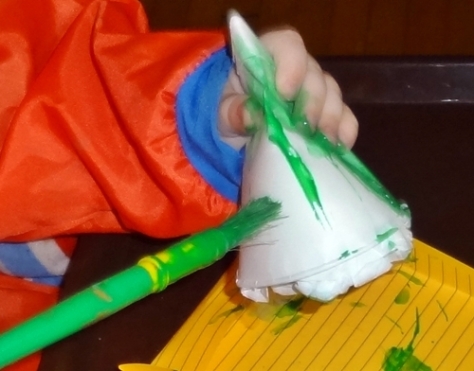
Paper cones, paint, glitter, clay and sticks;
16-12-art6a 

16-12-art07 

16-12-art08

Yes, there were a lot of new experiences, a lot of process, some instruction, a lot of imitation – trying what someone else did and liking it, and even some ‘product’.  I think the important thing was there was no ‘correction’ – no, ‘that’s not what you are supposed to be making, fix it’.  If they wanted to make something different they could – and some did – briefly – then they scrapped it and copied what the others were doing because that is what they do.  That is what they like to do – most of them – at least in this group – but if they didn’t want to that would have been OK too.

Monday, December 5, 2016

Good Morning

It has been 10 months since I first joined the gym - here you can read more about why I joined.  Honestly, I may love going to the gym even more now that I originally did :-) Yes, I've lost some weight and lowered my BMI but that was never my main goal.  I've taken my second fitness test and I'm happy with the results.  My muscle strength improved from 'poor' to 'average', muscle endurance went from 'average' to 'excellent', and my flexibility is now 'superior' instead of 'poor' - I'm stoked about that!

I'll admit that in preparation for my second fitness test session I had spent some extra time working on the exercises that the trainer had had me do at the first session.  Then for the second session the trainer chose different exercises - sneaky trick.  When he asked if I do squats I replied 'No' because they are not part of my gym routine.  Yet, during the test I found them surprisingly easy to do.  In the days since the test I've realized that I do squats all day long - every time I pick up a toy off the floor while carrying a baby.  :-)

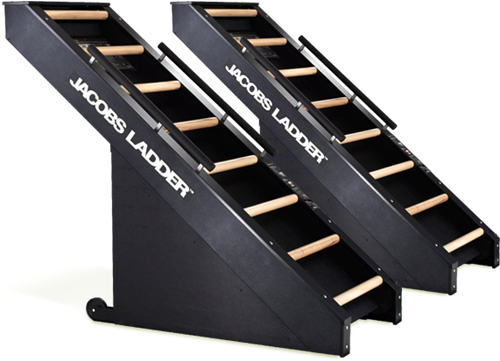
Over time I have made some changes to my gym routine.  I have different preferred gym locations than I used to hence my 'home' gym is different now.  Some of the machines or programs that used to be my favourites I now rarely use - in part because they are no longer challenging.  Some of the machines that I used to find intimidating - like this one;

jl-overview

are now exhilarating.  This makes me happy that I didn't choose to buy exercise equipment to use at home - I probably would have quickly lost interest.

However, probably the biggest change I've made is when I go to the gym.  Originally I chose Monday, Wednesday, & Friday evenings as well as Sunday mornings - this gave me four weekly workouts that were spaced roughly 36 - 48 hours apart.  It was during my summer vacation that I first made the change - going to the gym in the morning on weekdays too.  Wow, I've always been a morning person - morning workouts are soooo much better for me.

I thought the biggest problem was going to be that on weekdays I already get up at 5:00 am so to add a trip to the gym in before my day with the children would mean losing sleep and getting up at 4:00 am instead.  Interestingly I've discovered that I actually get MORE sleep at night now since the long wind-down period after an evening workout meant I was never able to get to bed at a decent time and my schedule was messed up.  A morning workout is a great way to greet the day!

16-12-gm02

Also interesting is that although there are fewer people at the gym at 4 am  than at 9 pm there are still a surprising number of us there.  Not surprising is how chipper they are - these are my peeps - cheerful and eager to meet the new day even without coffee.

Good Morning!  I'm ready to play, are you?

Wednesday, November 9, 2016

From Beginning to End

The project began last fall when we saved some of the seeds from the pie pumpkin that came in our Wild Earth Farms CSA bin.  I think it is important to not only know where your food comes from but also where your seeds come from.  Most of the plants we grow in our garden start as seeds we collect from plants we have grown or food we have eaten.

In the early spring we started some of our seeds indoors - the seedlings really liked the box window location.  The preschool table is located in front of this window so the children got to see the progress of seedlings every day.

16-11-be00

Once it got warm enough outside we moved all the seedling to our outdoor gardening space.  The various squash plants got planted a block away in my daughter's back yard - she doesn't use her outdoor space and we don't have enough room for those sprawling plants. 

Throughout the summer we often stopped by her yard when we were out for a walk.  We are supposed to do some weeding and yard work when we go but mostly all the plants are 'wild' and just grow however and wherever they want.  Between the squash plants and the weeds there are so many prickly things but the children are still excited to explore every time we visit.

By the end of September her yard looked more like a jungle than a garden.  The children enjoyed searching for things to harvest.

16-11-be01

We found quite a few on this trip over - had trouble carrying them all back.  All the drivers were smiling as they watched our little parade cross the street.

16-11-be02

When we got back we examined the various produce and discussed what we would do with them.  

16-11-be03

The flowers were added to our spaghetti at lunch that day.  The zucchini was used in a stir fry the following week.The rest were displayed as decorations until the end of October when all the pumpkins had turned orange.  Then we cut open the pumpkins and scooped out the innards.

16-11-be04

Then I roasted the pumpkin halves to prepare them for the next phase. 

16-11-be05

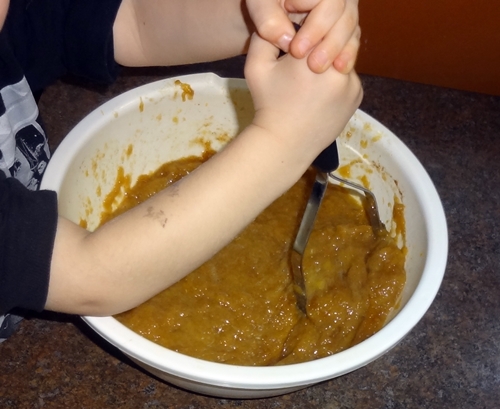
The following day the children took turns mashing the cooked pumpkin.

16-11-be06

We added the other ingredients - everyone got to smell and even taste some of them before we mixed them in.

16-11-be07

Almost done;

16-11-be08

We poured them in to pie shells and baked them in the oven. Afternoon snack on Friday - perfect end to a busy week;

16-11-be09

There were comments like "This is better than birthday cake".  Some of the children recognized the taste or smell of the various spices - savoring every bit to pick out the individual flavours.

A year long project from beginning to end - but, its not really the end, is it;

16-11-be10

Wednesday, November 2, 2016

The 'Un' Factor

 'Un' is a prefix meaning “not,” freely used as an English formative, giving negative or opposite force in adjectives and their derivative adverbs and nouns.  In the field of family childcare we often use the words 'unlicensed', 'unregulated', 'untrained' yet for many government officials and people outside the field of childcare those 'un' words are not viewed as negative - simply a choice that parents should be allowed to make regarding the care of their children.

There are regulations governing the manufacturing of items like cribs, strollers, carseats, and toys etc so parents know they are safe.  There are regulations regarding the production, packaging, and labeling of food products to ensure they meet predetermined standards so people know what they are buying. Why do government officials and the general public think that parents should be able to choose unlicensed, untrained childcare but need regulations to assist them to safely feed, house, and transport their own children?

What other career field allows some businesses to operate unlicensed and/or untrained when others providing the same service are licensed?  What is the incentive for any business to be licensed if they can legally operate without any oversight?  Without any licensing/training requirements?  What if, like in childcare, they could actually make more money if they were not licensed/trained than if they were licensed/trained?

Let's use truck drivers as an example.  The majority of adults have a class 5 driver's license and have experience driving their own or a friend's vehicle.  What if there were no restrictions on what size of vehicle you could drive and anyone could just decide "Hey, I'm going to buy a big truck and start a business delivering things for other people."

 Why, is an experienced driver with their own vehicle not allowed to start up a trucking business without additional training or license? Why don't people argue "It's his truck, he can do what he wants with it.  If other people are OK with letting him transport their stuff why not let him/them.  He's never had an accident and doesn't need a little piece of paper to prove he's a good driver."

What if that same driver or another class 5 driver then decided "A bus isn't much different than a big truck.  If I had a bus I could earn money driving people around."  What if you'd seen that driver on the street with his bus full of happy passengers and decided to take a ride on his bus.  Then imagine that one day there was an issue - something was wrong with the bus or the driver.  What if it is too late to get off the bus before the accident happened?

Some argue that licensing all childcare facilities and requiring training for all childcare workers doesn't ensure quality - but it helps.  Just like trained bus/truck drivers in licensed companies will still have accidents there are standards and checks in place to limit them.  Why don't we hear arguments that training/licensing truck drivers doesn't prevent accidents so let's save some money and not bother requiring them to be licensed?

Do we need more incentives for family childcare providers to become licensed or do we need to eliminated the option for them to operate unlicensed childcare homes?  Currently only licensed providers can accept government subsidized families but private paying families usually pay higher rates than the maximum subsidized rate so that isn't an incentive to be licensed.

What about training?  Currently family childcare providers with Early Childhood Educator II/III training can receive slightly higher subsidized rates than untrained providers but those rates are still lower than the private rates most unlicensed/untrained providers charge so why bother?  Just think of all the tax dollars we could save if we had trained and untrained police officers  - both had the same duties but the city could pay the untrained ones less - but either trained or untrained officers could go work privately for more money without a gun permit or any other type of license.

In an effort to increase the number of licensed childcare spaces, the provincial government is considering lessening the requirements and 'red tape' needed to open licensed childcare homes.  Why, when there was a shortage of family doctors was it never suggested that we lower the requirements to become a doctor?  I don't think lowering FCC licensing requirements will increase the number of licensed childcare spaces and I'm absolutely positive it won't improve quality.

What part of licensing do they think is unnecessary?   Criminal record/child abuse registry checks? First aid training or a 40 hour course? Behaviour management, nutrition, safety and supervision policies? Adequate equipment? Developmentally appropriate activities? Documentation and record keeping?

I don't think any part of the licensing process is difficult or unnecessary.  If fact, I'd like to see more.  I'd like to see MANDATORY licensing for ALL childcare homes.  Greater incentives for trained providers (possibly higher ratios).  MANDATORY annual professional development and more.  I'm thinking about the best interests of the children, not just convenience and the cost for quality and safety.


licensing-manual

Wednesday, October 26, 2016

Stick Insect (icide)

We have had stick insects as ‘pets’ for the past six years.  When we got our first one the children were all so excited and there was a long process to pick a name for her.  It didn’t take long for us to discover that stick insects are so prolific that naming them all is impossible.

I think having stick insects is a wonderful science activity.  As with any activity some of the children are very interested – watching the insects for long periods of time, eagerly anticipating the hatching and molting stages and more.  Other children have little interest and rarely even notice their existence in our room.

16-10-insects01

The ‘baby’ stage is my personal favourite.  They are cute when they first hatch although they can occasionally escape when they are that small;

16-10-insects02

I only keep a few of the eggs that are laid and even then when they hatch it sometimes seems like we may have too many.  Sadly (luckily?) only a small percentage of the babies make it to adulthood and lay eggs for our next generation of insects.

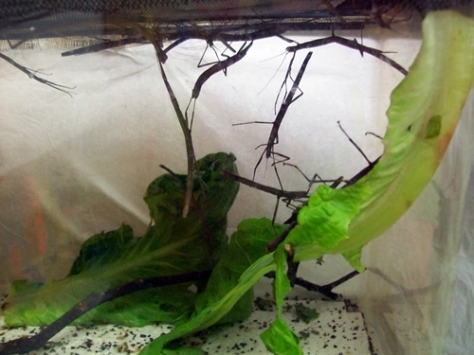
Sometimes the little ones are hard to find when they camouflage on the sticks or on the lettuce leaf;

16-10-insects03

As they continue to grow they are easier to see but they also make more mess;

16-10-insects04

On a few occasions we have run into a problem when we have a particularly large number of insects at various stages.  The adults make the cage very dirty but the numerous hatch-lings make it difficult to properly clean and keep everyone contained.  If it is winter I will take the container outside briefly to clean it – cold insects are slow insects.

Last month we were at the overcrowded, filthy cage level but it wasn’t yet cold enough outside to slow them down.  Then something unexpected happened.  I ran out of romaine lettuce and there was NONE in the fresh produce section of the store where I was shopping.  Instead of making a special trip to another store just for insect food I decided to buy a package of romaine hearts.

Back at home I tossed two leafs into the cage for the insects.  The next day ALL of them were dead.  A hundred + infant to adult stick insects were strewn across the bottom of the cage.  I assume insecticide caused the mass extinction and I know I won’t be buying packaged romaine hearts for any reason anymore.

For the first time in six years we have no stick insects.  I managed to save a few dozen eggs when I cleaned the cage but only time will tell if the insecticide affected them too. :-(

Monday, October 17, 2016

The Train Debate

It has been just over three months since I last had the train tracks available in the block area.  There are several building sets that have not been our for over six months but the boys (there are no girls in my current group) had been begging for me to bring the trains out again.  I was hesitant because we have a new infant here now - babies are not usually very 'helpful' when it comes to building with train tracks but the boys were so insistent.

Last year I wrote about how wonderfully this group plays with the trains and tracks so I relented and brought the trains out again.  Even though all but one of these children were here last year, they are currently at different stages than they were before and the dynamics are much different.  Having the trains out now has been... interesting.

There is one boy who loves to sort and classify everything.  Now that the trains and tracks are available he arranges them all according to size and shape.  He creates groupings and lines the pieces up in straight lines.  He gets frustrated and very vocal when others come near or disrupt his methodology  in any way.

Another one just wants the train cars - ALL of them.  Upon entering the playroom he tries to pick up and hold all of train cars at once but that is impossible.  Instead, he makes a pile of train cars and sits on them.  If any other child has one or more train cars he will sit and whimper, complaining that they have 'his' trains.  If I suggest that maybe he should build a track for the trains he has, he will attach two track pieces together, pile his train cars on the track and then sit on them.

The third boy loves to create several small circular tracks.  He is an expert builder and can quickly select all the appropriate track pieces and assemble his tracks.  He excitedly shows everyone his accomplishment and then walks away.  When I remind him to put away his toys if he is finished with them he wails.  For each track section there is dramatic effort required to pick up and take it to the bin.  Each piece is so heavy that he couldn't possibly carry more than one and often he is unable to even stand so he must slither and drag himself to the bin while sobbing "I CAN'T DO IT...I caaannn'tttt"

The fourth boy is so concerned about and distracted by what everyone else is doing that he has difficulty settling into an activity.  He seems eager to play with trains, states his intentions and invites others to join him however it takes a very long time before he begins to play.  Often he hovers around the block area and complains about what the others are doing.  Once he does finally sit down and become engaged in the activity he can play cooperatively, it just takes so long to get there and there are so many disputes along the way that the others lose interest or we run out of time.

Boy five has little interest in building with the tracks but enjoys driving trains on the tracks that others have built.  He reenacts elaborate scenarios complete with narrative descriptions and sound effects but seems oblivious to the others playing around him.  He is fully engaged in independent play but will get very upset if others interrupt or 'bother' him.

Boy six likes to build complex track systems using as many of the track sections as possible.  He enjoys having the others watch him build but is easily frustrated if they attempt to assist - he has a plan.  He discusses his design plans with the others and explains how they will be able to use it once complete.  Occasionally he too plays with trains - briefly - but usually once finished building he loses interest and leaves the block are.  However, he cannot clean up because the others are still playing - they do love this massive track.  When finished playing the others will be overwhelmed by the prospect of putting away all those tracks - they would never have built anything that big. 

*Sigh*  By the end of the first week of train play I was ready to pack them up and put something different in the block area.  It is not that anyone is using the toys 'wrong' but that they are all using them differently.  It wouldn't be a problem if they would sometimes play with other toys but for the whole first week they all wanted to play with trains - only trains - together but not in agreement.  Essentially it was a week long argument.

I know that dealing with disputes is an important skill to learn but personally I'd prefer to avoid all confrontation.  It would be easier for me to put away the trains and say it is a consequence due to the incessant fighting.  It might be easier for me to create a chart and assign each child a specified time slot where they can each have an equal amount of uninterrupted independent play with trains. However it is probably better if I let them work it out themselves.  I can tell them what I see.  I can facilitate conversations and mediate physical disputes.  I just don't like to.

At the moment I really don't like trains either.  Yet, during train week two there were a few moments of hope.  I few fleeting periods when I thought maybe - just maybe they had figured it out.  We are now beginning train week three and the debate continues....


Tuesday, September 27, 2016

Hiking in the City

It has been just over a week since I returned home after Nature Summit 2016.  I'll admit that for the first few days I did seriously consider putting my tent up in the backyard because I really missed spending all day, every day outside.  Summit was fabulous as usual - I got to participate in many outdoor workshops.  I went for a ride on a zip line, climbed almost to the top of this;

16-09-hike0

And of course I did a lot of hiking through the woods.

I know I really enjoy a nature hike and so do the  children in my care.  I also know that, even in the city, there are many places where we can hike and feel like we are out in the wilderness.  However, a city hike can be pretty special too - especially to a group of boys who can tell me the name and purpose of almost every type of construction vehicle. :-)

My little group and I have spent the last few months exploring the the nearby neighbourhoods.  Our city hikes vary in length from just a few blocks to up to 8 km.  They can take anywhere from a half hour to several hours and it is rarely the children that suggest we've been walking too long and it is time to go back.  Pretty amazing when you consider that these are 2 and 3 year olds.

So, what do we see when we go on an 8km city hike?  Back hoes, buses, dump trucks and trains.  Cement trucks, front loaders, street cleaners and cranes.  Yes, there is a lot of noisy traffic but there are also many quiet spots too.  In fact, one of our favourite paths takes us through the cemetery.

16-09-hike00

We look for birds - the children know where all the nest boxes are located (there is a nest box in the above picture but it is hard to see).  We listen to the wind in the trees and watch the river in the distance.  Inevitably the river sparks the topic of bridges - which one will we cross today?  Within walking distance of the cemetery there are FIVE bridges we can go over, and THREE that we can go under.

There are several more bridges we can explore if we pack a lunch and make it a day long hike but that tends to be too much even for this active little group.  Once this past summer we did make it to two distant bridges but the children were obviously tired and there was not much excitement.  Besides, when we stick to the familiar, nearby areas there is a whole more to our hikes than just walking.

In some cases we can cross one bridge and examine the structure of another bridge at the same time.

16-09-hike01

There are bridges for people, bikes, cars and trains. Only some of our bridges cross over water.  Others cross over roads or train tracks and give us a whole lot more to talk about.  The children often complained that there were never any trains on these tracks when we crossed over them - but twice this summer there was a train here!  So of course we had to stop for a while to watch.

16-09-hike02

One time the train was moving so very slowly that we were able to continue our walk, loop around and walk under the same train we had just been standing over.

16-09-hike03

Standing under a train bridge while a train slowly squeaked and creaked, clanged and banged overhead was a new experience.  Trains on bridges sound much different that cars on bridges. The children also enjoyed yelling 'ECHO!' as they do every time we venture under bridges.

We don't spend all our time on noisy city streets.  For contrast we also explore parks and riverbanks along the way.  We get to hear and smell the difference between the roadway and the forest.  On this particular hike the 'big' boys were with us and the 'littles' enjoyed showing them all our favourite spots.

16-09-hike04

Just as we use the bridges to compare the traffic and trains from above and below we can also do the same with the river.  Standing on the bridge we watch the water flow, count geese and ducks, and watch sticks and other debris float by but there is the noise of the traffic crossing the bridge too.
It is amazing how just a few steps away from a busy road can feel like a totally different world.  What can you hear now?  Our river bank trails offer another perspective of the water.  We can get closer to the water - but not too close, this is not a swimming river.

16-09-hike05

There is a tree they want to climb.  Normally I'd say yes to a tree climbing adventure but a quick risk assessment resulted in a 'No' to climbing on this tree;

16-09-hike06

Yes, I love a good nature hike but a city hike offers something special too.  We could read books or watch videos and memorize facts about cars and trucks, trees and birds, rivers and roads or we can go for a city hike, experience it, and begin to understand the impact we have on the natural environment.